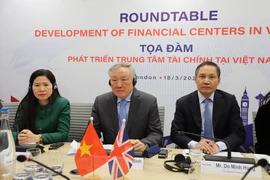
London (VNA) – Vietnam has the potential to emerge as an attractive financial destination if it effectively applies international experience and leverages cooperation with global partners, according to Christine Le, CEO and Founder of Eastern Horizon Wealth Management, a UK-based asset management and personal financial planning services company.
She told the Vietnam News Agency that Vietnam’s plan to establish regional and international financial centres in Da Nang City and Ho Chi Minh City will not only enhance the country’s position in the regional and global financial systems but also create motives for sustainable economic growth.
However, she noted significant challenges for Vietnam to lure capital inflows, including competition with leading financial centres in the region like Singapore, China’s Hong Kong. Therefore, Vietnam needs to focus on improving its business climate, completing legal framework, developing modern infrastructure, and enhancing human resources quality, the key factors to attract international financial organisations and investors.
According to Le, Vietnam requires a comprehensive development strategy, including reforming the business environment towards greater transparency, stability, and competitiveness, and accelerating investment in finance – technology infrastructure, particularly financial – technological infrastructure, blockchain, and Big Data. Besides, it is necessary to build an internationally standardised legal system that ensures transparency to strengthen investor confidence as well as develop high-quality human resources through specialised training and talent attraction in the sector.
She recommended cooperating with international universities and organisations, penning competitive initiatives for international experts and overseas Vietnamese talents, and developing international internship and exchange programmes through cooperation with leading financial centres like London and Singapore.
Le described Vietnam’s goal to set up the financial centres as a strategic move demonstrating its commitment to deep integration into the global financial system.
Boasting an open economy, strategic geographic location in the Asia – Pacific region, young and dynamic workforce, together with political and economic stability, Vietnam could rise as an international financial hub, she said, adding the success of financial centres in Vietnam depends not only on the Government’s strategy but also on close coordination between the public and private sectors
Drawing from her years of study and work experience in the UK financial sector, Le notes that London, as one of the world's leading global financial centres, was built on a solid legal foundation, transparent business environment, and advanced financial infrastructure. This is a model that countries aspire to learn from and cooperate with when developing international financial centres.
London is not only a destination for major financial institutions but also leads in areas such as financial technology (fintech), financial planning, asset management, insurance, and international capital markets. In particular, the implementation of the world's first fintech sandbox testing mechanism alongside policies encouraging innovation has helped London maintain its competitive edge and attract investment capital.
Le expressed her optimism that Vietnam has looked to the UK for experience, suggesting the country could learn and apply London’s lessons in perfecting legal frameworks, building fintech and innovation ecosystem, and improving human resources quality.
The recent visit of the Lord Mayor of the City of London to Vietnam and that of Deputy Prime Minister Nguyen Hoa Binh to the UK have opened numerous cooperation opportunities for the two sides in the fields. Many financial organisations and major corporations like Standard Chartered, HSBC, Prudential, Michelmores, KMPG, and A&O Shearman are increasingly interested in the Vietnamese market, creating chances to attract capital flows and develop premium financial services.
If Vietnam effectively capitalises on international cooperation and implements strategic reforms, the country can certainly become an attractive financial destination in the near future, Le stated./.
VNA