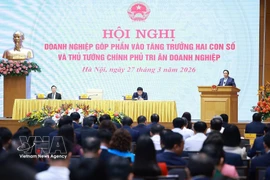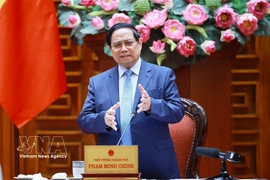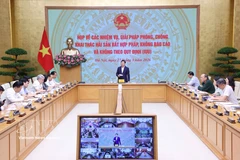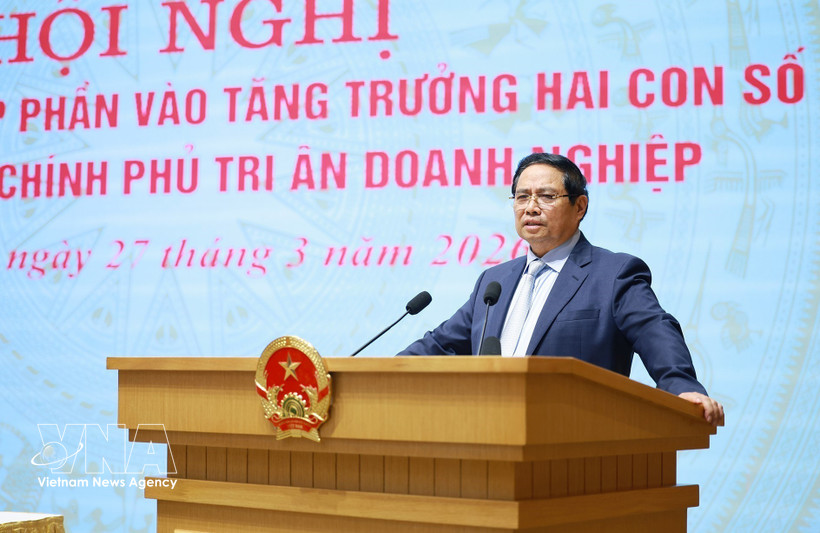
Hanoi (VNA) - The business community will play a leading role in driving double-digit economic growth in 2026 and the following years, Prime Minister Pham Minh Chinh told a conference in Hanoi on March 27.
PM Chinh reiterated Vietnam’s two centenary strategic goals, saying that double-digit growth from 2026 and beyond will require stronger, more mature enterprises capable of driving sustained expansion.
The PM outlined four guiding principles for policy enforcement: ensuring substantive, quality and sustainable growth; maintaining macroeconomic stability and controlling inflation while safeguarding key economic balances; pooling all resources for development; and ensuring citizens benefit from growth. He spotlighted a development model in which the State acts as an enabler, businesses take the lead and public-private cooperation underpins national growth and social prosperity.
Vietnam faces heavy development responsibilities in the coming years, with economic growth of at least 10% targeted from 2026, he said, adding that policies will be enforced in a coordinated and consistent manner under strong central leadership and close coordination among ministries, local authorities and the broader political system.
On the back of the Party Central Committee’s resolutions, Party General Secretary To Lam’s directions and feedback at the event, he pointed out future key priorities, including removing institutional and procedural bottlenecks, cutting compliance costs and at least 30% of unnecessary administrative procedures and business conditions.
The Land Law will be revised for submission to the National Assembly while regulatory sandboxes will be introduced for emerging sectors, such as the digital economy, fintech, AI, data, strategic technologies, circular economy and low-altitude economy, with clear scope, timelines and oversight, he said.
Public investment will be used more actively to spur growth and crowd in private capital for strategic infrastructure, energy, logistics, supporting industries, digital infrastructure, semiconductors, AI and manufacturing, with project progress and completed volumes used as key performance benchmarks.
On consumption, the government leader called for targeted stimulus measures, including selective tax and fee cuts, expansion of e-commerce and digital payments, and stronger links among consumption, tourism, logistics and domestic distribution networks.
According to the PM, export policy should shift from broad support to market- and sector-specific assistance, focusing on technical barriers, green standards, traceability, logistics and trade defence. Authorities should provide detailed guidance to help companies better utilise free trade agreements (FTAs) rather than leaving them navigate independently.
Priority should be given to facilitating new growth drivers such as semiconductors, AI, electronics, energy, supporting industries, manufacturing and data economy through targeted schemes aimed at expanding production capacity, workforce skills, infrastructure and local value creation.
State-owned enterprises should be restructured to play a leading role in sectors where private investment is limited, with more flexible market-based mechanisms and performance evaluations tied to capital efficiency, competitiveness, technological innovation and supply chain contributions, he said.
The Government leader called for the emergence of large private corporations capable of leading supply chains, while encouraging small and medium-sized enterprises to grow alongside major firms.
Foreign direct investment (FDI) must be more selective, with stronger requirements for technology transfer and support for domestic industry upgrading. Fiscal and monetary policies must be aligned to channel capital into productive sectors and tech upgrades while limiting speculative asset flows and improving labour productivity through automation, digital management, standardised processes and workforce reskilling.
The PM stressed strict discipline based on clear roles, tasks, timelines, responsibilities and measurable results, warning that weak performance could undermine the double-digit growth target.
Business associations were assigned to foster cooperation between domestic and foreign firms, promote trade and support members in policy advocacy and dispute settlement, while coordinating closely with government agencies to disseminate new policies and corporate support schemes
Companies were encouraged to engage in building national digital platforms and open data systems with broad spillover effects, especially shared platforms enabling citizens to start and scale small, flexible firms built on digital technology and AI. They were also asked to launch key national sci-tech schemes and priority projects in strategic sectors, invest in research and development, commercialise innovation, proactively strengthen production capacity, particularly in strategic industries, to advance greater self-reliance and resilience in sci-tech, and leverage FTAs to expand global market access, improve their edges and integrate deeper into global value chains.
They must improve corporate governance, meet technical, environmental and labour standards, stay updated on market and policy developments, develop appropriate export strategies and strengthen partnerships with domestic and international partners.
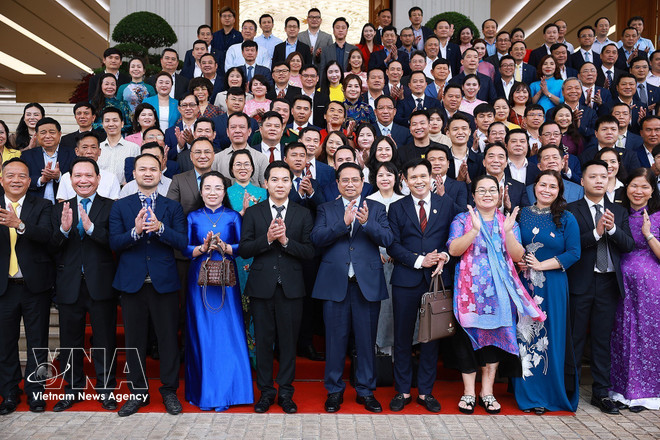
On the occasion, the Government and PM expressed heartfelt appreciation to the business community for continuing to think big, invest boldly and innovate even during the COVID-19 pandemic, natural disasters and global geopolitical volatility, helping the country overcome challenges and reinforcing confidence that Vietnam is capable of achieving a strong economic breakthrough.
The Government and PM pledged to stand side by side with businesses, placing enterprises at the centre of policy support, while fostering an open, transparent, stable and predictable investment climate. Authorities will continue to listen to and promptly address corporate challenges and obstacles in line with the law and the broader interests of the country and its people, he said.
Reports delivered at the conference showed that Vietnam had about 1 million active enterprises by late 2025, up more than 25% from 2020, contributing roughly 60% of GDP and employing more than 16 million workers. They also account for the bulk of the country’s trade turnover, while Vietnam ranks among the world’s top 15 destinations for foreign direct investment.
Total social investment pooled from the business sector during 2021–2025 was equivalent to about 33% of GDP, while the stock market reached roughly 86.7% of GDP and the bond market about 30% of GDP by the end of 2025. Private capital accounted for nearly 75% of investment in 564 projects launched or completed in 2025.
Despite progress, delegates said the economy and business sector continued to face challenges, particularly in legal and institutional frameworks, unresolved project and corporate legal issues, and investment procedures. They called for deeper institutional reform, improved business environment, equal access to resources and expanded regulatory sandbox mechanisms for fintech, AI, new and strategic technologies./.