Hue accelerates tech upgrades, strengthens vessel monitoring to combat IUU fishing

During the first quarter, the Department of Agriculture and Environment worked closely with city police and the Border Guard Command to inspect and supervise so-called “three-no” fishing vessels — those lacking registration, licences, or inspection certification — along with boats deemed ineligible for operation in Thuan An, Quang Dien, Vinh Loc, and Chan May–Lang Co.

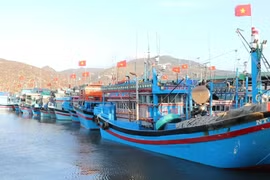
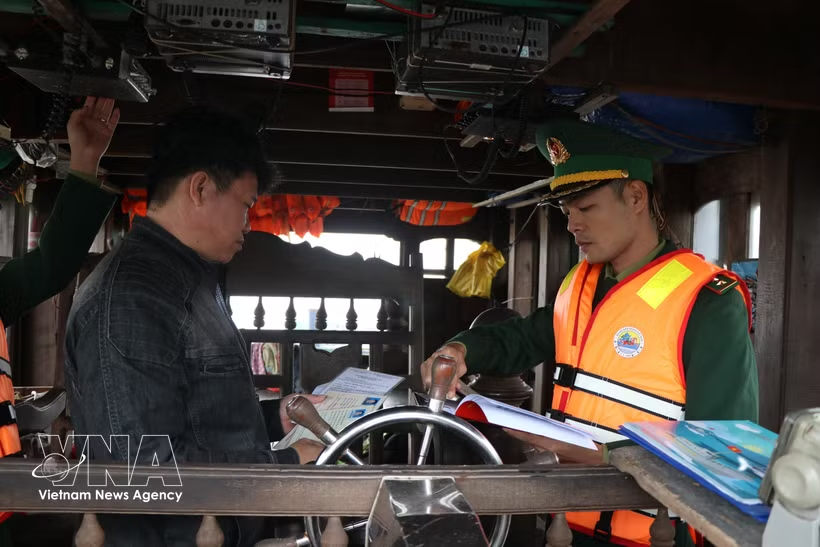
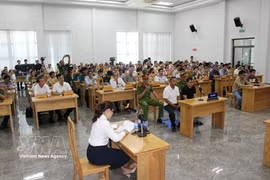
Border guards inspect and verify fishing vessels’ documents and procedural records before departure. (Photo: VNA)

Hue (VNA) – Hue city has ramped up technological upgrades and tightened oversight of fishing activities in early 2026 as part of efforts to address illegal, unreported and unregulated (IUU) fishing and prevent violations in foreign waters.

During the first quarter, the Department of Agriculture and Environment worked closely with city police and the Border Guard Command to inspect and supervise so-called “three-no” fishing vessels — those lacking registration, licences, or inspection certification — along with boats deemed ineligible for operation in Thuan An, Quang Dien, Vinh Loc, and Chan May–Lang Co. These vessels are now subject to strict weekly monitoring and are prohibited from leaving port.

Authorities have also continued reviewing fishing vessel data to align with the national Vnfishbase database, while reassessing violation records to remove compliant vessels from monitoring lists when adequate evidence is provided. Inspection teams have simultaneously strengthened checks on seafood origin certification at export-oriented processing enterprises.

Local officials said outreach efforts have been expanded through multiple communication channels to raise fishermen’s awareness of anti-IUU fishing regulations. Border guard forces have maintained strict port controls, refusing departure clearance for vessels that fail to meet operational requirements or violate regulations, while conducting routine inspections covering documentation, crew verification, communications equipment, and vessel monitoring systems.

Hue is also accelerating upgrades to information technology infrastructure at fishing ports, enabling fishermen to update catch data through the electronic catch documentation and traceability (eCDT) system and adopt electronic fishing logbooks. By December 31, 2025, all vessels measuring 15 metres or longer had completed port entry and departure procedures via the eCDT platform.

The city now requires seafood buyers, processing enterprises, fishing ports, and fisheries management agencies to monitor landed catch volumes and traceability records digitally through the same system. To date, 56 vessels have adopted electronic logbooks, with installation and training continuing to ensure wider implementation.

According to the municipal Fisheries Sub-Department, Hue has completed the inventory and verification of vessel owners across all 11 coastal wards and communes, with 1,100 registered fishing vessels fully updated in Vnfishbase.

The locality still records five “three-no” vessels, 30 boats ineligible for operation, and 151 vessels whose registrations have been revoked since 2024. All have been entered into the national fisheries database and remain under strict visual and location-based monitoring by local authorities to ensure they do not operate at sea./.
VNA

See more

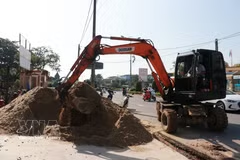
The sidewalks on Hung Vuong street in Quang Tri province are under renovation. (Photo: VNA)

Quang Tri approves 103 priority projects for investment during 2026–2030

The 103 projects are categorised into seven fields, comprising energy; logistics; tourism, services, and trade; green and high-tech agriculture; industry, industrial zones, and production infrastructure; urban development and commercial housing; and healthcare, wellness, and resort services.

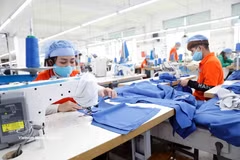
Workers make clothes for export to the Japanese market at Hung Viet Garment Company in Hung Yen province (Photo: VNA)

Vietnam’s textile-garment firms striving to achieve export targets, sustain employment

To achieve the annual target, textile and garment businesses are jointly implementing several core tasks, including diversifying export markets and partners, developing the supporting industries for raw materials and accessories to establish integrated supply chains, investing in technological innovation linked to AI, stepping up high-quality workforce training, promoting green transformation based on circular economy models, and building brands in both domestic and international markets.

Minister of Public Security General Luong Tam Quang (R) receives Choo Hyeong Wook, President and CEO of the Republic of Korea’s SK Innovation in Hanoi on November 16. (Photo: VNA)

Vietnam promotes international cooperation in energy, high technology

Minister of Public Security General Luong Tam Quang called on the RoK's SK Innovation to share experience and work with Vietnamese partners in developing clean and renewable energy, hydrogen, liquefied natural gas, energy storage technologies and carbon emission reduction solutions.

Delegates pose for a photo at the Chile-Vietnam Business Forum in Hanoi on November 16 (Photo: VNA)

Vietnam, Chile seek to expand trade ties

Chilean President José Antonio Kast pointed to potential for cooperation in agriculture and food, and called for stronger technical cooperation, better market access and closer links in innovation, technology, services and sustainable development.

Production of footwear for export at Lefaso Tra Vinh Industrial Investment and Production Joint Stock Company, Tra Cu commune, Vinh Long province (Illustrative image. Source: VNA)

VEFTA implementation requires exporters to restructure supply chains: Experts

Under VEFTA, tariff reductions to zero will be meaningless for Vietnam’s key export sectors, including textiles and garments, footwear, and agricultural and aquatic products, if goods are found to contain banned chemicals, violate rules of origin or lack transparency regarding their carbon footprints.

Deputy Prime Minister Nguyen Van Thang meets with Martin Sommer, head of the IMF’s Article IV consultation mission team to Vietnam, in Hanoi on November 13, 2026. (Photo: VNA)

IMF sees positive growth prospects for Vietnam, urges cautious monetary policy

Martin Sommer, head of the IMF’s Article IV consultation mission team to Vietnam, noted that inflation risks in Vietnam remain under control, but several factors could add to price pressures. He therefore called for cautious monetary policy management and readiness to respond promptly if inflationary pressures increased.

Representatives of the three first-prize-winning startups receive their awards at the event. (Photo: SGGP)

Seven green-tech startups secure 770,000 USD at Net Zero Challenge 2026

In its fourth year, the competition attracted more than 1,100 applications from 80 countries and territories, making it the most competitive edition since its launch in 2023. Nine finalists presented solutions in three categories, namely renewable energy and carbon removal; food systems and sustainable agriculture; and circular economy and waste management.