Hanoi sets vision to become global city beyond 2065

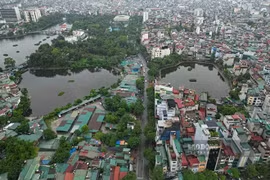
Under its master plan with a 100-year vision, Hanoi is expected to evolve into a global city beyond 2065 – recognised among leading international capitals for quality of life and overall well-being.

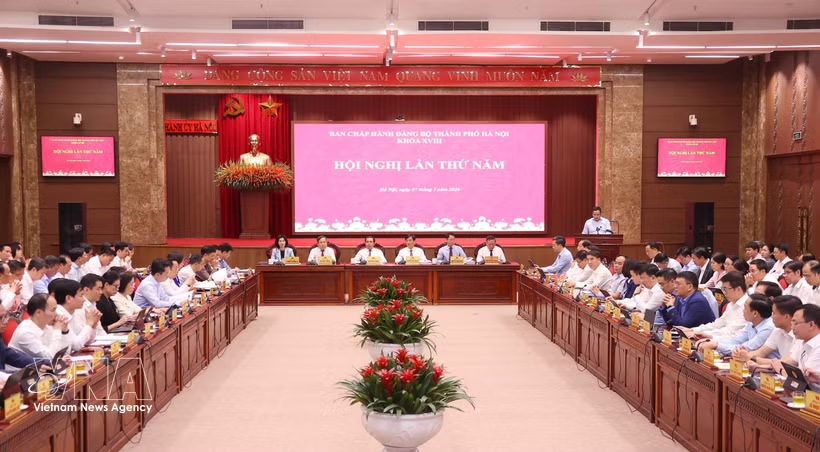
The fifth conference of the 18th-tenure Hanoi Party Committee (Photo: VNA)

Hanoi (VNA) – The 18th-tenure Hanoi Party Committee convened its fifth conference on March 27 to deliberate and adopt a range of strategic decisions shaping the capital’s development in a new era.

A focus of discussions was the master plan for Hanoi with a 100-year vision, under which the capital is expected to evolve into a global city beyond 2065 – recognised among leading international capitals for quality of life and overall well-being.

Presenting the master plan, Standing Vice Chairman of the municipal People’s Committee Duong Duc Tuan said the planning scope covers the entire administrative area of Hanoi, comprising 126 communes and wards, while extending to the Capital Region, consisting of Hanoi and Phu Tho, Thai Nguyen, Bac Ninh, Hung Yen and Ninh Binh provinces, and promoting regional linkages with others in the Red River Delta, the northern mountainous and mid-land region, and national economic corridors.

Hanoi is envisioned as the core of a multi-centred urban cluster, playing a leading role in driving development across the Capital Region.

The city spans approximately 3,360 sq.km, with population projections reaching 14–15 million by 2035, 15–16 million by 2045, and 17–19 million by 2065. The long-term outlook aims to stabilise the population level below 20 million, ensuring sustainable urban density while maintaining the capacity to accommodate transient populations.

By 2035, Hanoi aims to become a “civilised, modern and happy” capital of time-honoured culture, and serve as a leading hub for economy, education, health care, and innovation in the Asia-Pacific. By 2045, it is expected to stand on par with capitals of developed nations in terms of knowledge and technology. Beyond 2065, the city aspires to achieve the global city status.

The master plan also outlines an open spatial structure described as “multi-layered, multi-polar, and multi-centred”, with the Red River serving as the central ecological and cultural axis, closely integrated with regional, national and international economic networks.

Meanwhile, Vice Chairman of the municipal People’s Committee Nguyen Xuan Luu presented the socio-economic development plan for 2026–2030, which targets fast yet sustainable development based on a new growth model. By 2030, Hanoi is expected to strengthen its position as the political – administrative centre of Vietnam and a leading hub for innovation, digital transformation, green transition, and the circular economy with strong competitiveness in the region.

Key targets include an average annual GRDP growth rate of 11%, per capita GRDP of 12,000 USD, and the digital economy contributing 40% of GRDP by 2030. The urbanisation rate is projected to reach 65–70% while public transport is expected to meet at least 30% of travel demand.

In his closing remarks, Secretary of the municipal Party Committee Nguyen Duy Ngoc underscored that Hanoi is entering a new development phase marked by both significant challenges and historic opportunities.

The aspiration to develop the capital must not remain a slogan, but be realised through concrete actions by authorities at every level, all sectors, and all officials, he stated, calling for stronger determination, greater efficiency, and unified implementation across the political system to turn policies into tangible outcomes./.

VNA
See more

At the meeting between General Secretary of the Communist Party of Vietnam Central Committee and President To Lam and Mexican President Claudia Sheinbaum in Shenzhen, China, on November 18 (Photo: VNA)

Top Vietnamese leader meets with Mexican President in China

General Secretary of the Communist Party of Vietnam (CPV) Central Committee and President To Lam suggested Vietnam and Mexico step up cooperation in politics, economy, trade, investment, culture, education, tourism and traditional medicine, while enhancing coordination at inter-regional forums.

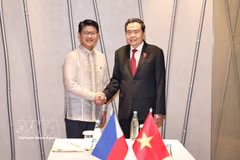
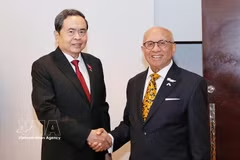
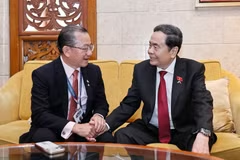
NA President Tran Thanh Man (R) and Speaker of the House of Representatives of the Philippines Faustino “Bojie” G. Dy III (Photo: VNA)

Vietnam, Philippines push parliamentary cooperation via bilateral, multilateral channels

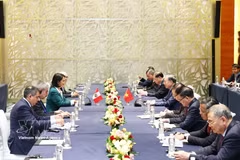
Vietnam and the Philippines agreed to boost bilateral parliamentary cooperation as well as coordination in multilateral inter-parliamentary forums. On global and regional issues of shared concern, they pledged to maintain ASEAN’s common stance on the East Sea issue and make active, responsible contributions to developing an effective and substantive Code of Conduct in the East Sea (COC).

At the meeting between General Secretary of the Communist Party of Vietnam Central Committee and President To Lam and Peruvian President Keiko Fujimori in Shenzhen on November 18 (Photo: VNA)

Vietnam attaches importance to ties with Peru: Top leader

Vietnam and Peru agreed to coordinate and support each other within multilateral frameworks, especially the United Nations, the Comprehensive and Progressive Agreement for Trans-Pacific Partnership (CPTPP) and Asia-Pacific Economic Cooperation (APEC), and boost ASEAN-Latin America cooperation.

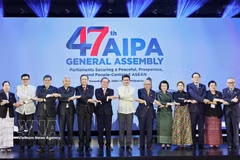
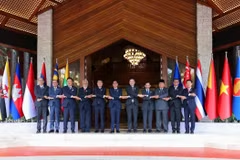
President of the Vietnamese National Assembly (NA) Tran Thanh Man (fifth from left) and other heads of delegations pose for a group photo at the opening ceremony of the 47th General Assembly of the ASEAN Inter-Parliamentary Assembly (AIPA-47) in Manila, the Philippines, on November 18. (Photo: VNA)

Vietnam sends messages to opening of 47th AIPA General Assembly

General Secretary and President Lam stressed that Vietnam will continue working with the parliaments of the AIPA member nations to make more practical contributions to AIPA’s activities, contributing to building a resilient, dynamic, innovative and people-centred ASEAN Community.

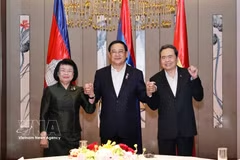
President of the Vietnamese National Assembly Tran Thanh Man (right) and his Lao and Cambodian counterparts, Sonexay Siphandone (centre) and Khuon Sudary, on the morning of November 18 (Photo: VNA)

Vietnamese NA President holds working breakfast with Lao, Cambodian counterparts

The NA leaders of Vietnam, Laos and Cambodia reached consensus on future cooperation priorities, including organising in-person and online meetings among the three NA leaders, conducting high-level visits, and arranging exchanges among parliamentary committees, friendship parliamentary groups, young and women parliamentarians, while studying the establishment of a hotline among the three legislatures.

President of the Vietnamese NA Tran Thanh Man (R) and Speaker of the Parliament of Singapore Seah Kian Peng (Photo: VNA)

Vietnam, Singapore to drive parliamentary cooperation

The Vietnamese NA President’s December 2024 visit to Singapore and the Singaporean Parliament Speaker's upcoming Vietnam visit are key momentum for bilateral parliamentary cooperation and increasingly close ties between the two nations.

Prime Minister Le Minh Hung and heads of delegations attend the retreat session of the 49th ASEAN Summit. Photo: VNA.

Vietnam makes substantial contributions to 49th ASEAN Summit

Vietnam made positive contributions to discussions and put forward numerous practical, strategic proposals and initiatives to help shape ASEAN cooperation in the coming period. Vietnam also demonstrated a leading role in promoting subregional cooperation and narrowing the development gap.

Prime Minister Le Minh Hung meets with Cambodian Prime Minister Hun Manet in Manila, the Philippines on November 17. Photo: VNA

Vietnam further enhances coordination with Cambodia, UN

Prime Minister Le Minh Hung held bilateral meetings with Cambodian Prime Minister Hun Manet and United Nations (UN) Secretary-General António Guterres in Manila, the Philippines on November 17, on the sidelines of the 49th ASEAN Summit and related summits.

General Secretary of the Communist Party of Vietnam Central Committee and President To Lam receives Huang Kunming, Politburo Member and Secretary of the Party Committee of Guangdong province in Shenzhen on the evening of November 17. Photo: VNA

Top leader receives Guangdong Party Committee Secretary

Vietnam's top leader called on Guangdong to increase imports of Vietnamese products in which Vietnam has competitive strengths, step up logistics connectivity, promote direct cooperation among universities, research institutes, innovation centres and science and technology enterprises, and share experience in hosting APEC events.

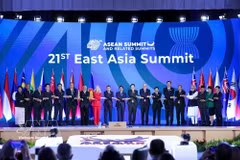
Prime Minister Le Minh Hung (second, right) attends the 29th ASEAN Plus Three Summit (Photo: VNA)

PM concludes working trip to Philippines following 49th ASEAN Summit

During the four-day trip, PM Hung attended a series of multilateral and bilateral activities, including ASEAN meetings, and summits between ASEAN and dialogue partners, engagements with leaders of ASEAN member states and other countries and international organisations. He put forward strategic proposals to strengthen regional cooperation.

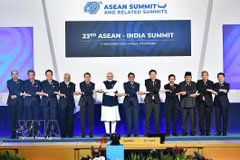
Vietnamese Prime Minister Le Minh Hung (fifth, left), other ASEAN leaders and Indian Prime Minister Narendra Modi pose for a group photo at the 23rd ASEAN-India Summit in Manila, the Philippines, on November 17 (Photo: VNA)

Vietnamese Prime Minister Le Minh Hung attends 23rd ASEAN-India Summit

The PM called for closer cooperation to maintain peace, stability, security, safety and freedom of navigation and overflight in accordance with international law, particularly the 1982 United Nations Convention on the Law of the Sea (UNCLOS). He also proposed considering the establishment of an ASEAN-India maritime dialogue mechanism, and welcomed India’s consistent support for ASEAN’s principled stance on the East Sea.

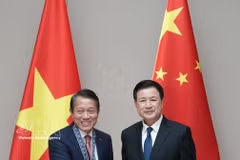
Minister of Public Security General Luong Tam Quang (left) meets with Chinese Minister of Public Security Wang Xiaohong in Shenzhen, Guangdong province, on November 17 (Photo: VNA)

Vietnam, China step up security, law enforcement cooperation

Building on the important common understandings reached by General Secretary of the Communist Party of Vietnam Central Committee and President To Lam and General Secretary of the Communist Party of China (CPC) Central Committee and President of China Xi Jinping, Minister of Public Security General Luong Tam Quang proposed further enhancing the depth and effectiveness of bilateral cooperation.

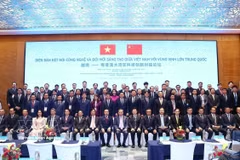
General Secretary of the Communist Party of Vietnam Central Committee and President To Lam and delegates pose for a group photo at the forum. (Photo: VNA)

Top leader attends Vietnam–China Greater Bay Area technology connectivity forum

General Secretary and President Lam stated that Vietnam consistently regards the consolidation and development of relations with China as a strategic choice and top priority in its foreign policy of independence, self-reliance, self-strengthening, multilateralisation and diversification. On this basis, the two countries are continuing to deepen their Comprehensive Strategic Cooperative Partnership and promote the building of a Vietnam-China Community with a shared future that carries strategic significance at a higher level in the new era.