Digital transformation, AI remain driving recruitment trends: Adecco Vietnam

Demand for professionals in technology, AI, and digital skills is no longer limited to the IT sector but is expanding into retail, finance, and manufacturing.

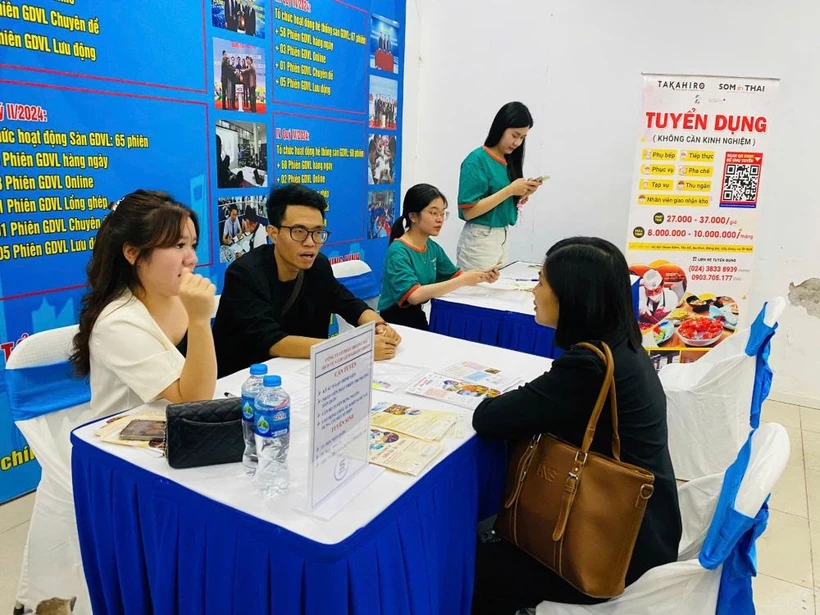
Demand for professionals in technology, AI, and digital skills is no longer limited to the IT sector but is expanding into retail, finance, and manufacturing (Photo: laodong.vn)

HCM City (VNA) - Digital transformation and artificial intelligence (AI) are driving recruitment trends across industries in 2025, according to the Salary Guide 2025 by Adecco Vietnam, a member of The Adecco Group, a leading recruitment, payroll, staffing and outsourcing service provider.

According to the report, Vietnam’s strategic partnership with Nvidia reflects the country’s commitment to advancing technology and attracting investment in the semiconductor sector.

As a result, demand for professionals in technology, AI, and digital skills is no longer limited to the IT sector but is expanding into retail, finance, and manufacturing. In these industries, automation and data-driven decision-making are becoming essential for business growth.

At the same time, companies are placing greater emphasis on data security, environmental, social, and governance (ESG) practices, and diversity, equity, and inclusion (DE&I). This shift is pushing businesses to invest more in these areas while encouraging employees to upskill to meet evolving job demands.

A recent Adecco Vietnam survey, which included professionals with at least two years of experience, highlighted three key workplace trends, namely digital transformation, flexible work models, and generative AI tools.

In particular, digital transformation continues to be a game-changer, improving efficiency, streamlining processes, and enabling smart solutions. Flexible work models remain popular after COVID-19, though adoption varies by sector, and hybrid and remote work are more common in technology and service industries. Generative AI (GenAI) tools, such as ChatGPT, Copilot, and Bard, are increasingly integrated into daily work, especially in content creation, data analysis, and customer service, it added.

Adecco Vietnam's experts held that in a fluctuating economy, 65% of surveyed employees received salary increases of under 10% in 2024, while 15% saw raises exceeding 20%. Looking ahead, expectations are even higher – 37% of workers anticipate salary hikes of over 20% in 2025.

Job mobility is also on the rise. The survey found that 72% of employees are open to new opportunities in 2025, up from 69% in 2024 and just 37% in 2023. This growing trend suggests an increasingly competitive job market, creating both challenges and opportunities for employers.

Most professionals find jobs through recruitment agencies, LinkedIn, and personal referrals.

When considering a job change, employees prioritise salary and benefits, career growth, workplace environment, and work-life balance. However, salary remains the deciding factor in job transitions.

AI adoption in Vietnam remains largely focused on basic automation, including simple programming, customer service, data analysis, and content creation. Among those surveyed, 65% believe AI boosts productivity, 54% see its value in strategic thinking, and 35% stress the need for upskilling to harness AI’s full potential.

Meanwhile, DE&I is gaining traction, particularly in multinational corporations and industries with global connections. While still an emerging concept in Vietnam, local businesses – especially private enterprises – are increasingly adopting DE&I strategies to meet employees’ growing expectations for fairness and diversity in the workplace./.

VNA

See more

Brocade weaving is a cultural lifeblood for the Khmer community in the Bay Nui (seven-mountain) area of An Giang. (Photo: VNA)

Khmer brocade weaving helps drive heritage-based economic development

Nestled at the foot of the majestic That Son mountain range, Van Giao - the brocade weaving village of Khmer people in An Cu commune, An Giang province - is not only a repository of centuries-old cultural heritage but is also emerging as a model for heritage-based economic development.

People and vehicles travel across the Lo river pontoon bridge on the morning of February 16. (Photo: VNA)

PM commends units for constructing pontoon bridge to serve Tet travel demand

Prime Minister Pham Minh Chinh on February 16 sent a letter commending the determination and strong sense of responsibility of agencies and units in urgently building a pontoon bridge across the Lo river in Phu Tho province to promptly serve people’s travel demand during the Lunar New Year (Tet) 2026.

Prime Minister Pham Minh Chinh visits and extends Lunar New Year greetings to a patient undergoing treatment at Bach Mai Hospital. (Photo: VNA)

PM extends best wishes to doctors, patients on Tet occasion

Prime Minister Pham Minh Chinh visited and extended Tet greetings to medical staff and patients at Bach Mai Hospital and Viet Duc University Hospital in Hanoi while inspecting healthcare services during the holiday at these two leading central hospitals on February 16, or the last day of the Year of the Snake.

The Van Mieu-Quoc Tu Giam heritage site in Hanoi remains a major attraction for large numbers of visitors during the early days of spring. (Photo: VNA)

Hanoi offers free parking, public transport during Lunar New Year

During Tet, Hanoi offers free parking at selected schools and locations surrounding central heritage sites. In addition, single-journey fares are waived on the Cat Linh–Ha Dong and Nhon–Hanoi Station metro lines, while subsidised public bus services across the city are operating free of charge during the holiday period.

President Luong Cuong, his spouse, delegates and artists at the special Spring Homeland Art Programme 2026. (Photo: VNA)

Five major shifts chart overseas Vietnamese affairs in 2026 and beyond

In a world marked by intensifying strategic competition, emerging conflicts and intertwined economic, security and social challenges, nearly 6.5 million Vietnamese living in over 130 countries and territories have continued to look to the homeland as a firm spiritual anchor. The homeland remains a source of confidence, connection and aspiration for Vietnamese abroad.

Vietnamese Ambassador to Cuba Le Quang Long (right) symbolically hands over 250 tonnes of rice to Cuban Deputy Minister of Agriculture Telce Abdel González (Photo: VNA)

Vietnam supports Cuba in ensuring food security

Cuban Deputy Minister of Agriculture Telce Abdel González affirmed that Cuba will create all favourable conditions for AgriVMA’s rice production project in Los Palacios district, Pinar del Río province, with a view to expanding the model to other localities across the country.

The Binh Phuoc provincial Intelligent Operations Center (IOC), operational since September 2020, has played an important role in supporting the development of digital government. (Photo: VNA)

Breakthroughs under Resolution 57 drive local development

Following the Politburo’s Resolution No. 57-NQ/TW on advancing science, technology, innovation and national digital transformation, many localities across Vietnam are translating strategic guidelines into concrete action, laying the foundation for a new development model based on knowledge, technology and modern governance.