Dual transition to drive Vietnam toward sustainable future

The combined forces of political determination, technological innovation and proactive business engagement are emerging as key drivers for Vietnam as it pursues prosperity and its 2050 Net Zero commitment.

Delegates at the seminar “Drivers for the Sustainable Era”, organised on November 27 by the Ministry of Finance’s Finance–Investment Newspaper (Photo: VietnamPlus)

Hanoi (VNA) - The combined forces of political determination, technological innovation and proactive business engagement are emerging as key drivers for Vietnam as it pursues prosperity and its 2050 Net Zero commitment.

As the country faces unprecedented climate challenges in 2025, Vietnam is also entering what experts describe as a “dual transition” - digitalisation and green transformation - seen as essential for sustainable and inclusive growth.

This vision was highlighted at the seminar “Drivers for the Sustainable Era”, organised on November 27 by the Ministry of Finance’s Finance–Investment Newspaper. Policymakers, technology specialists and business leaders shared perspectives on building a new economic landscape in which profitability aligns with responsibility, and technology provides the foundation for a resilient future.

The event followed COP30 in Brazil, where strong calls for climate action were juxtaposed with contradictions in global climate finance.

Addressing the event, Editor-in-Chief Pham Van Hoanh underscored the urgency of climate risks, pointing to recent severe storms and floods across northern and central Vietnam.

According to Hoanh, the world is confronting its most severe climate crisis, yet political resolve among some major economies is weakening.

He noted, however, that challenges also create momentum for change. Vietnam is emerging as a proactive member, implementing strategic reforms to shift its growth model. The Party and Government are promoting development grounded in pillar resolutions, fostering a favourable environment for business innovation. Investor confidence in the country’s green agenda has also grown, reflected in a more than 60% increase in domestic green bond issuance since the beginning of the year.

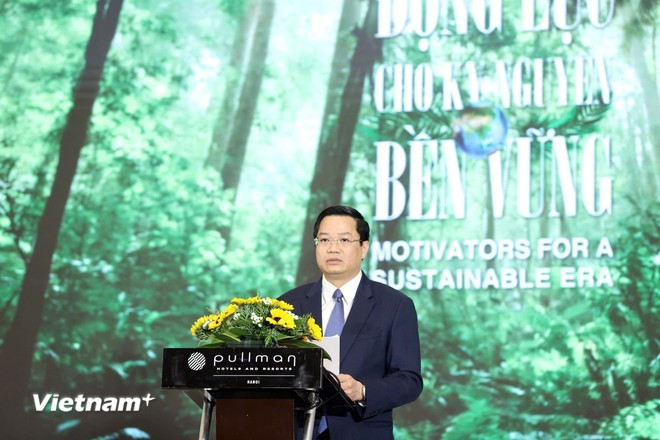
Deputy Minister of Finance Nguyen Duc Tam described 2025 as a historic milestone for the economy and the finance sector, particularly the merger of government agencies aimed at enhancing macro-management effectiveness.
4.jpg
Deputy Minister of Finance Nguyen Duc Tam speaks at the event (Photo: VietnamPlus)

He stressed that digital transformation and green transitions are not separate goals but complementary processes. Digitalisation supports transparent management, while green transition provides the direction for humane and sustainable development.

To realise this vision, the Ministry of Finance is refining the legal and policy framework, including tax incentives, priority credit packages, and funds to support innovation. The ministry is also studying public–private partnership mechanisms for digital infrastructure and renewable energy projects. A key development is the issuance of the national Green Taxonomy, which serves as an important tool for identifying and promoting environmentally sustainable investment. Vietnam aims to establish an effective domestic carbon market by 2030, enabling deeper integration of local enterprises into global supply chains. While policy offers direction, technology provides the leverage for Vietnam to meet its climate targets.

3.jpg
To realise this vision, the Ministry of Finance is refining the legal and policy framework, including tax incentives, priority credit packages, and funds to support innovation. (Photo: VietnamPlus)

Pham Thai Lai, President and CEO of Siemens ASEAN and Vietnam, highlighted the transformative role of artificial intelligence and digital twin technology. He compared the impact of digitalisation today to that of electrification in the last century, noting its profound influence on manufacturing and smart infrastructure.

Lai cited data centres as an example. These facilities consume vast amounts of electricity, yet digital twin models allow operators to simulate operations, design heat maps and identify precise cooling needs. This prevents damage to high-value chips while reducing energy waste.

According to Lai, Siemens is supporting several renewable energy and electric-vehicle manufacturing projects in Vietnam as part of its global commitment to achieve Net Zero by 2030, demonstrating the central role of technology in addressing climate challenges.

From the business perspective, green transition has become a survival factor rather than a conceptual goal. Larry Lee Chio Lim, Deputy CEO of Saigon Beer–Alcohol–Beverage Corporation (SABECO), said sustainability is now a prerequisite for market access, investment and talent attraction. Nearly half of consumers are willing to pay more for sustainable products, placing increasing pressure on FMCG and F&B companies.

Lim said early investment in energy efficiency can reduce operating costs by 5–14%. SABECO has made notable progress, now sourcing over 40% of its production energy from renewables, cutting greenhouse gas emissions by 9.3%, and ensuring that all primary packaging materials are recyclable or reusable. Circular-economy practices have been embedded throughout operations, turning materials into resources rather than waste.

He emphasised that sustainability must be systemic, from board-level ESG governance to community livelihoods.

He said a brewery must also be a responsible steward of water resources, or it cannot sustain its business or support the surrounding community.

With coordinated policy, advanced technology and active business participation, speakers concluded that Vietnam is positioned to advance firmly into a sustainable era driven by dual transition./.

VNA

See more

Local residents and visitors tour and shop at a fair. (Photo: VNA)

Made in Vietnam Fair set to open in Hanoi

The Made in Vietnam Fair will showcase a wide range of products, including industrial and consumer goods, processed foods, agricultural produce and handicrafts, with the participation of distribution systems, e-commerce platforms, digital platforms and digital financial solution providers operating in Vietnam.

2025 a good year for Vietnam’s securities sector: SSC

2025 a good year for Vietnam’s securities sector: SSC

During the year, the SSC made significant progress in improving the legal and policy framework. Institutional work was implemented in a coordinated manner, including the issuance of two decrees, one resolution, seven circulars and three major schemes. At the same time, the regulator strengthened policy dialogue and expanded cooperation with international organisations to support the market upgrade process.

Vietnam shows strong FDI performance in the first 11 months of 2025 (Source: vtv.vn)

Vietnam shifting FDI attraction focus from volume to quality

As production relocation to Southeast Asia accelerates and competition for FDI intensifies, Vietnam faces increasing pressure from regional rivals such as India, Malaysia and Indonesia, which are offering bold tax incentives and developing specialised industrial parks. This reality requires Vietnam to shift its focus from attracting large volumes of capital to drawing high-quality investment, prioritising core technologies, innovation, value chain linkages and higher localisation rates.

Vice Chairman of the Ho Chi Minh City People’s Committee Hoang Nguyen Dinh inspects IUU fishing prevention efforts at Hung Thai Port in Long Hai commune. (Photo: VNA)

Ho Chi Minh City steps up oversight of unqualified fishing vessels

HCM City currently has 4,475 fishing vessels, all of which have been registered and updated on the VNFishbase system. Among them, 4,268 vessels, or 95.37%, have been granted fishing licences, while 207 unqualified vessels are being strictly managed and kept ashore.

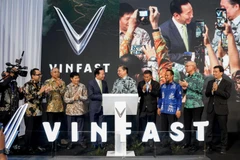
Airlangga Hartarto (fifth from right), Indonesian Coordinating Minister for Economic Affairs, and CEO of VinFast Asia Pham Sanh Chau (sixth from right) at the plant opening ceremony on December 15. (Photo: VinFast)

VinFast inaugurates EV plant in Indonesia

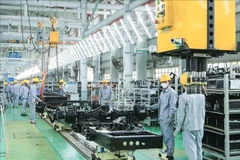
The VinFast Subang plant was completed and put into operation just 17 months after groundbreaking, demonstrating the company's rapid execution capability and strong implementation capacity. This is VinFast's fourth operational facility worldwide, and its first plant in Indonesia and Southeast Asia outside of Vietnam.

From early December, major retail chains in Ho Chi Minh City have recorded a noticeable increase in shoppers seeking Tet products. (Photo: VNA)

HCM City businesses ramp up production to meet Lunar New Year demand

From early December, major retail chains in the city have recorded a noticeable increase in shoppers seeking Tet products. Many consumers are taking advantage of promotional programmes to purchase gift items with long shelf lives, such as confectionery, soft drinks and processed foods, well ahead of the holiday peak.

Workers process fish to be tinned for export at KTC Canned Food Factory under Kien Giang Trading JSC. (Photo: VNA)

Vietnam to host seminar on export growth strategies

Vietnam's exports rose 16.1% to 430.2 billion USD in the first 11 months of 2025, while total trade hit 839.8 billion USD during the same period. This strong performance shows that exports remain a key driver of economic growth, boosting Vietnam's standing on the world stage in recent years.

The vessel carrying the 2 millionth TEU arrives at Hai Phong Port. (Photo:VNA)

Hai Phong Port reaches 2-million-TEU milestone

Handling the 2 millionth TEU in 2025 not only demonstrates Hai Phong Port’s operational capacity and the collective efforts of its workforce, but also highlights its increasingly important role in regional and global supply chains, the confidence of shipping lines, logistics firms and the business community, and the effectiveness of policies to improve the investment climate and strengthen maritime infrastructure and services.

Melons labelled with traceability codes on display at the Song Van agricultural produce store in Ninh Binh city, Ninh Binh province. (Photo: VNA)

Tracing origins hindered by fragmented data systems

As the Government accelerates the digital economy, establishing a unified national traceability system has become a crucial move to end data fragmentation and disconnection among ministries, sectors and localities.