Electronics firms face labour shortage

Hundreds of electronics manufacturers in Vietnam are having difficulty recruiting labourers, said an official from the Ministry of Labour, Invalids and Social Affairs (MOLISA).
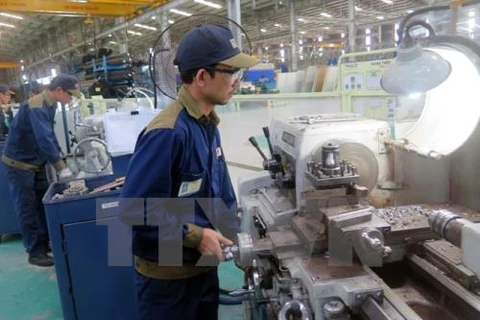
Electronics firms face labour shortage ảnh 1An electronic component factory (Photo: VNA)

Hanoi (VNA) - Hundreds ofelectronics manufacturers in Vietnam are having difficulty recruitinglabourers, said an official from the Ministry of Labour, Invalids and SocialAffairs (MOLISA).

Despite forecasts about automation technologiesreplacing manual labour, manual labourers are still in high demand atelectronics manufacturers in Vietnam, especially those with skills andqualifications.

The number of electronics companies in Vietnamhas risen drastically in the past decade, from 307 in 2006 to 1,165 in 2015 (up16.3 percent per year), said Dr Chu Thi Lan, director of the Centre of ResearchWorks on Working Environment and Conditions under MOLISA’s Institute of LabourScience and Social Affairs.

The number of electronics labourers has alsorisen drastically, from about 142,800 in 2009 to 453,200 in 2016, she said at arecent conference on securing jobs for workers at electronics companies inVietnam.

“However, about 70 percent of these workerspossess no qualifications for their jobs, and 80 percent of the companies arefacing a severe shortage of skilled labourers,” Lan added.

New technologies are one of the factors leadingto the shortage, said Dr Dao Quang Vinh, director ofthe Institute of Labour Science and Social Affairs.

“They require workers to adapt to big changes,increase competition, reduce manufacturing cost and build demand for morehigh-quality labourers,” he said.

Meanwhile, since the majority of Vietnameselabourers came from rural areas and did not receive any formal training fortechnological jobs, they lack flexibility in adapting to technological changes,said Dr Vu Quang Tho, director of MOLISA’s Institute for Workers – TradeUnions.

The harsh working conditions at manufacturingfactories also lead some workers to quit their jobs, Tho added.

Nguyen Tien Tung, MOLISA’s chief inspector, saidthat wrong doings were discovered in 216 electronic companies in 2017nationwide.

“All of these companies required their staff towork overtime, and 60 percent of them violated the regulations on overtimepay,” he said.

Twenty-seven enterprises made serious violationsof the Labour Code and were fined 1.4 billion VND (61,600 USD), Tung added.Most of them did not ensure workers’ rights, he said.

To improve the situation, Dr Chu Thi Lan saidelectronics companies should shake up their practices, strictly comply withlabour regulations, maintain labour standards and offer incentives to recruitlabourers.

“They should absolutely avoid forced labour andchild labour, and avoid firing workers over 35 years old,” she said.

Dr Dao Quang Vinh said that workers shouldreceive training and re-training every time their companies acquire newtechnologies. “They should be aware of the change and prepared to gain newskills to meet new requirements,” he said.

The State should have policies that ensure jobstability and on-the-job training for electronics workers, he added.

“In case they are not able to adapt totechnological changes, these workers should be informed about other employmentopportunities,” he said.-VNA
VNA

See more

Party General Secretary To Lam presents Nhan Dan newspaper with the first-class Labour Order on March 11. (Photo: VNA)

Nhan Dan newspaper must act as ideological vanguard, shield, information sensor: Party chief

In a keynote address at a ceremony in Hanoi marking the 75th anniversary of the newspaper’s first issue on March 11, General Secretary Lam highlighted its more than seven decades of evolution while maintaining its role as the Party’s sharp ideological weapon, an effective information and communication channel for Party committees and authorities at all levels, and a trusted platform for Party members and people.

A poster celebrating the Election Day (Photo: VNA)

Final preparations underway for Election Day

In Hanoi, local authorities have increased the dissemination of election-related information through community loudspeaker systems, information boards, official websites and verified social media pages, helping officials, Party members and residents better understand their rights and responsibilities as voters.

NA Chairman Tran Thanh Man inspects a constituency in Dong Nai province. (Photo: VNA)

Dong Nai works to ensure workers cast vote on Election Day

With the utmost regard for citizens’ electoral rights and responsibilities, and in a spirit of creating optimal conditions for workers, especially those employed in industrial parks and non-state enterprises, the provincial leader has requested that no overtime be scheduled during voting hours.

Zambia's Minister of Agriculture Reuben Mtolo Phiri (first, left), learns about the OM19 rice variety grown at Tien Thuan cooperative in Thanh Quoi commune,, Can Tho city (Photo: VNA)

Can Tho shares agricultural transformation experience with Zambia

Rice production remains Can Tho’s key industry. Alongside maintaining production, Can Tho has encouraged value chain linkages among farmers, cooperatives and businesses, while accelerating the application of science and technology, mechanisation and digital transformation in farming.

Staff members of the Hanoi Public Administrative Service Centre handle administrative procedures for local residents. (Photo: VNA)

Hanoi: 95% of administrative procedures to be handled from home

The plan targets that at least 80% of administrative procedures under the city’s authority will be provided as fully online public services, while more than 95% of applications will be received and processed entirely online. By June 30, 2026, about 80% of administrative procedures are expected to be restructured based on integrated data systems, with the figure rising to 95% by the end of the year.

Delegates at the SEAN Future Forum NextGen Workshop 2026 held in Jakarta, Indonesia on March 9 (Photo: VNA)

Vietnam contributes youth perspectives to AFF NextGen initiative

The ambassador expressed confidence that fresh perspectives, innovative thinking and lessons drawn from the workshop will be proposed to AFF 2026, representing the voice of the younger generation in shaping ASEAN’s future in line with their aspirations.

A young volunteer donates blood during the 2026 Red Sunday programme. (Photo: VNA)

Nearly 5,000 people join blood donation campaign in Ho Chi Minh City

According to health authorities, Vietnam collected nearly 1.75 million units of blood in 2025, with 98% from volunteer donors, equivalent to around 1.75% of the population participating in blood donation. Large-scale campaigns such as Red Sunday have played a key role in achieving these results.