Enterprises urged to help protect rights of children

UNICEF will engage with businesses in Vietnam to build a culture of respect and support for children’s rights among them, an official has said.
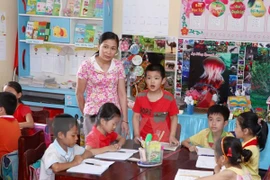
Enterprises urged to help protect rights of children ảnh 1Illustrative photo (Photo: VNA)


HCM City (VNA)
- UNICEF will engage with businesses in Vietnam to build a culture of respect and support for children’s rights among them, an official has said.

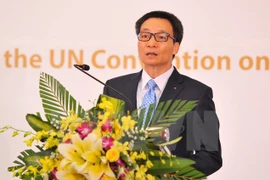
Marianne Oehlers of UNICEF Vietnam’s chief programme partnerships office told a workshop in HCM City on May 13 that UNICEF has identified a set of key industries with a high impact on children and significant value-chain influence.

The event, held under the overall framework of the "Meet to Meet the SDG" Platform, aimed to explore how the business community can take action on children’s rights in the context of the Sustainable Development Goals.

It sought to explore, in partnership with experts and colleagues from UNICEF, what the business community can do to realise the goals with a child rights perspective.

The priority sectors include travel and tourism and footwear and apparel, Oehlers said.

A study on the impact of the apparel and footwear sectors on children’s rights in Vietnam will be done between 2016 and 2017.

A toolkit on children’s rights will also be customised for the apparel and footwear supply chains.

Preliminary findings from child rights impact assessments carried out in Vietnam’s travel and tourism sector last year will be presented.

“By focusing on children and supporting their rights, businesses can benefit from improved access to skilled labour and improved employee satisfaction, improve the communities in which you work, raise the value of your brand and thereby also your bottom line,” Jesper Moller, UNICEF’s deputy representative, said.

“Virtually all companies interact with children in some way. Businesses impact children in the workplace, in the market place and in the community as they are the children of your workers, children that consume your products, and children in the community where you operate.

“The first step in the journey for a responsible business is to make children visible, understand that they are there and that the company has various levels of impact on children’s lives.”

To help private sector partners do that, UNICEF has joined Save the Children and the UN Global Compact to develop the Children’s Rights and Business Principles (CRBP).

CRBP was developed and released in 2012 and launched in Vietnam in 2014.

It is the first comprehensive set of principles to guide companies on a full range of actions they can take in the workplace, marketplace and community to respect and support children’s rights.

Ten principles identify actions all businesses should take to respect and support children’s rights.

They are child rights integration, child labour, young workers and family-friendly workplace, protection and safety of children, products and services, responsible marketing and advertising, environment and land acquisition, security arrangements, emergencies, and support for community and government efforts for children.-VNA

VNA

See more

Automated ticketing system is used on the urban railway Cat Linh-Ha Dong line in Hanoi. (Photo: VNA)

Digital transformation powers Hanoi metro expansion

Beyond convenience, stable fares and the elimination of fuel, parking and maintenance costs have made urban rail increasingly attractive. The growing preference for metro travel is also contributing to a greener, more modern urban lifestyle.

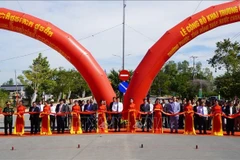
Delegates cut the ribbon to inaugurate the operation of electric bus route No. 43. (Photo: VNA)

Hanoi accelerates shift to green buses, targets 100% by 2030

In the 2027–2030 period, the city will accelerate the transition towards the complete phase-out of fossil fuel-powered buses. The share of electric and green energy-fueled buses is projected to reach 79–89% by 2029 and 100% by 2030.

At the second session of the Ho Chi Minh City People’s Council (Photo: VNA)

Ho Chi Minh City greenlights central square, administrative centre in Thu Thiem

The new central city square and administrative centre will create a modern, centralised political-administrative complex for Ho Chi Minh City, designed to house around 8,000 officials, civil servants, and employees. It will also handle daily traffic of 1,500- 2,000 citizens and business representatives through a unified one-stop-shop administrative service system.

A working session at the job fair (Photo: VNA)

Vietnamese students flock to Seoul Job Fair 2026

The second annual Job Fair 2026 was held for Vietnamese students in the Republic of Korea. Organisers pitched it as a straight-up bridge between eager students and bosses hungry for young talent who can actually handle multicultural workplaces.

Defendants at the court (Photo: VNA)

Ho Chi Minh City court opens trial over Agribank lending scandal

The investigation revealed that multiple credit files were incomplete or riddled with inaccurate information, while some pledged assets lacked proper legal standing yet were accepted and grossly overvalued. As a result, the loans became high-risk and largely unrecoverable, leading to losses surpassing 1 trillion VND.

Hanoi introduces 53 electric buses from April 18 (Photo: VNA)

Hanoi to add 53 electric buses from April 18

According to the plan, all buses operating within Ring Road 1 will use green energy by July 1, 2026. The requirement will expand to Ring Road 2 by January 1, 2028, and to Ring Road 3 by 2030.

Illustrative image (Photo: VNA)

National, local traffic safety committees to be dissolved from June 1

Under the dicision, ministries and ministerial-level agencies will assume responsibility for tasks previously performed by the committee, in line with their mandates under the Law on Government Organisation, the Law on Road Traffic Order and Safety, the Law on Roads and other relevant legal frameworks, ensuring that traffic safety and order are maintained without disrupiton.