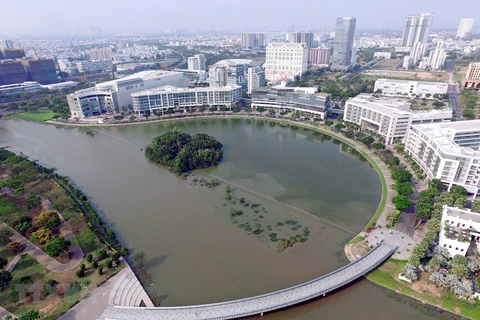
Issuance of ownership certificates for condotels will solve difficulties in the domestic hospitality market (Photo: vietnammoi.vn)
 Hanoi (VNS/VNA) - Experts believe the State's issuance of ownership certificates for non-residential real estate projects will solve existing difficulties in Vietnam’s real estate market.
The Ministry of Natural Resources and Environment last week issued new guidelines about the land use regime and the certification of non-residential construction works, such as condotels.
“These new guidelines bring positive signals to Vietnam’s real estate market at the start of this year, especially for hospitality developers and investors,” Su Ngoc Khuong, Senior Director of Investment, Savills Vietnam, told Vietnam News.
“If the guideline is officially implemented, it will provide great support and leverage for the hospitality sector.”
Hospitality investors have two main sources of income: selling second-home villas and condotels, and entertainment activities and leisure services in their projects. Currently, as the revenue of hospitality services has dropped, investors can take advantage of the fact that the buyer is granted the property ownership certificate, to stimulate the needs of buyers, thereby preserving the initial investment, according to Khuong.
For individual investors, this is also considered a positive move, as the real estate market in big cities like Hanoi and HCM City is facing numerous issues related to legal problems or limited supply. They will also be more assured in proactively increasing profits by owning a new type of property such as a second home, condotel or office-tel.
Nguyen Huu Quang, deputy general director of the Netland Real Estate Joint Stock Company, said granting ownership certificates for condotels was a breakthrough in completing the legal system for condotel products. It would protect the rights of buyers.
The buyers could mortgage their condotel products at banks or credit institutions to get loans. For businesses, this important document would remove difficulties in trading those products, Quang said.
Nguyen Thanh Huong, general director of Dai Phuc Land, told bizlive.vn that the condotel market had developed strongly in recent years along with the high growth in travel services and resorts from north to south. However, the existing legal documents had not yet been completed to ensure interests of investors and buyers in the condotel market.
Condotel ownership was one of the problems that had directly affected buyers’ interest in the long term. Therefore, this regulation had removed "bottlenecks" in the legal system to promote development of this potential condotel market, she said.
Van Dung Chinh, general secretary of the Khanh Hoa Real Estate Association, said the ownership certificates for condotel would have a legal value in trading activities on the secondary market.
It would make the market more transparent and sustainable after a few years of development. In the future, reputable investors with financial ability would have more chances to develop.
However, Chinh said, the issuance of ownership certificates for condotels could not boost development of the condotel market to reach strong growth like 2-3 years ago.
In the short term, this market still faced difficulties, he said.
Meanwhile, lawyer Mai Thi Thao, head of the Economic Department at the TAT Law Firm, is afraid that granting an ownership certificate for each condotel apartment will give a right to the buyer. Therefore, they could change the initial use purpose of the condotel to serve tourists or other purposes that are different from the original purpose.
Expert Dang Hung Vo said, in the long term, Vietnam would need to add specific regulations relating to multi-functional property products to the Land Law, the Housing Law and the Real Estate Business Law.
Huong Tran Kieu Dung, general director of FLC – a group with many condotel projects in Thanh Hoa, Binh Dinh and Quang Ninh – had also proposed the Government develop regulations allowing foreigners to buy condotel products, reported zing.vn.
In the future, the State also would need to grant ownership certificates for officetels, said Nguyen Le My Hung, head of the Project Legal Department of Novaland Group – a group developing major resort projects in Ba Ria - Vung Tau, Binh Thuan and Khanh Hoa.
Hung said many large businesses in Hanoi and HCM City had invested to develop officetel projects, but buyers of those products were not granted the ownership certificates to ensure their benefits.
He said granting ownership certificates for condotels would increase the potential of the same certificates for officetels (office and hotel). This is also a type of apartment with residential and commercial purposes.
In Vietnam, condotels have developed since 2015, and this segment saw big growth in 2017 and 2018, mainly in coastal provinces such as Quang Ninh, Quy Nhon, Da Nang, Nha Trang, Phan Thiet, Vung Tau and Phu Quoc. However, this market has diminished from the end of 2018.
According to the Ministry of Construction, the domestic tourism real estate market, including condotel and tourist villas, saw about 6,280 transactions in 2019, a decrease of 20 percent year on year.
The reduction was due to a lack of specific regulations for this property product line. In addition, high prices and low liquidity deterred investors.
At present, the condotel market has faced more difficulties after Cocobay Da Nang’s announcement of not being able to pay interest to buyers, as well as the coronavirus epidemic./.
The Ministry of Natural Resources and Environment last week issued new guidelines about the land use regime and the certification of non-residential construction works, such as condotels.
“These new guidelines bring positive signals to Vietnam’s real estate market at the start of this year, especially for hospitality developers and investors,” Su Ngoc Khuong, Senior Director of Investment, Savills Vietnam, told Vietnam News.
“If the guideline is officially implemented, it will provide great support and leverage for the hospitality sector.”
Hospitality investors have two main sources of income: selling second-home villas and condotels, and entertainment activities and leisure services in their projects. Currently, as the revenue of hospitality services has dropped, investors can take advantage of the fact that the buyer is granted the property ownership certificate, to stimulate the needs of buyers, thereby preserving the initial investment, according to Khuong.
For individual investors, this is also considered a positive move, as the real estate market in big cities like Hanoi and HCM City is facing numerous issues related to legal problems or limited supply. They will also be more assured in proactively increasing profits by owning a new type of property such as a second home, condotel or office-tel.
Nguyen Huu Quang, deputy general director of the Netland Real Estate Joint Stock Company, said granting ownership certificates for condotels was a breakthrough in completing the legal system for condotel products. It would protect the rights of buyers.
The buyers could mortgage their condotel products at banks or credit institutions to get loans. For businesses, this important document would remove difficulties in trading those products, Quang said.
Nguyen Thanh Huong, general director of Dai Phuc Land, told bizlive.vn that the condotel market had developed strongly in recent years along with the high growth in travel services and resorts from north to south. However, the existing legal documents had not yet been completed to ensure interests of investors and buyers in the condotel market.
Condotel ownership was one of the problems that had directly affected buyers’ interest in the long term. Therefore, this regulation had removed "bottlenecks" in the legal system to promote development of this potential condotel market, she said.
Van Dung Chinh, general secretary of the Khanh Hoa Real Estate Association, said the ownership certificates for condotel would have a legal value in trading activities on the secondary market.
It would make the market more transparent and sustainable after a few years of development. In the future, reputable investors with financial ability would have more chances to develop.
However, Chinh said, the issuance of ownership certificates for condotels could not boost development of the condotel market to reach strong growth like 2-3 years ago.
In the short term, this market still faced difficulties, he said.
Meanwhile, lawyer Mai Thi Thao, head of the Economic Department at the TAT Law Firm, is afraid that granting an ownership certificate for each condotel apartment will give a right to the buyer. Therefore, they could change the initial use purpose of the condotel to serve tourists or other purposes that are different from the original purpose.
Expert Dang Hung Vo said, in the long term, Vietnam would need to add specific regulations relating to multi-functional property products to the Land Law, the Housing Law and the Real Estate Business Law.
Huong Tran Kieu Dung, general director of FLC – a group with many condotel projects in Thanh Hoa, Binh Dinh and Quang Ninh – had also proposed the Government develop regulations allowing foreigners to buy condotel products, reported zing.vn.
In the future, the State also would need to grant ownership certificates for officetels, said Nguyen Le My Hung, head of the Project Legal Department of Novaland Group – a group developing major resort projects in Ba Ria - Vung Tau, Binh Thuan and Khanh Hoa.
Hung said many large businesses in Hanoi and HCM City had invested to develop officetel projects, but buyers of those products were not granted the ownership certificates to ensure their benefits.
He said granting ownership certificates for condotels would increase the potential of the same certificates for officetels (office and hotel). This is also a type of apartment with residential and commercial purposes.
In Vietnam, condotels have developed since 2015, and this segment saw big growth in 2017 and 2018, mainly in coastal provinces such as Quang Ninh, Quy Nhon, Da Nang, Nha Trang, Phan Thiet, Vung Tau and Phu Quoc. However, this market has diminished from the end of 2018.
According to the Ministry of Construction, the domestic tourism real estate market, including condotel and tourist villas, saw about 6,280 transactions in 2019, a decrease of 20 percent year on year.
The reduction was due to a lack of specific regulations for this property product line. In addition, high prices and low liquidity deterred investors.
At present, the condotel market has faced more difficulties after Cocobay Da Nang’s announcement of not being able to pay interest to buyers, as well as the coronavirus epidemic./.
VNA