At the event (Photo: VNA)
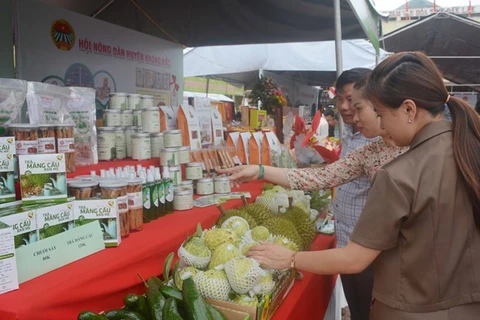
 Participating in the event are 29 provinces and cities nationwide, including Ha Giang, Bac Kan, Lang Son, Tuyen Quang, Quang Ninh, Lao Cai, Yen Bai, Dien Bien, Son La, Bac Ninh, Ha Nam, Hai Phong, and Hung Yen. Of the total stalls, 20 are from Hung Yen and 15 from Nghe An.
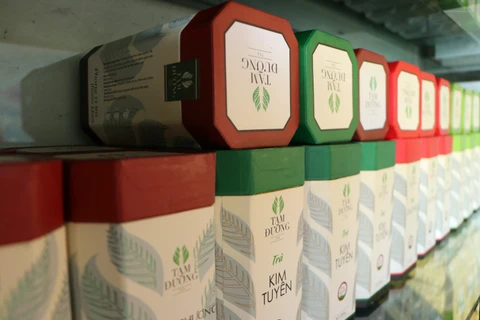
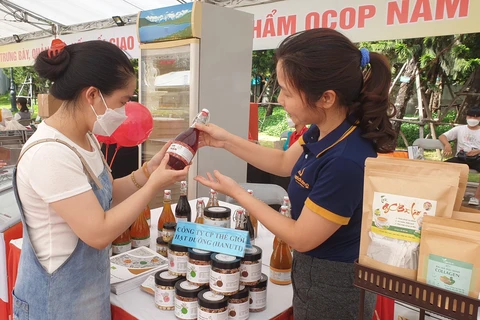
In particular, the host Hanoi is introducing visitors the local coffee, milk and yogurt, herbal tea, and handicrafts, among others.
The neighbouring province of Hung Yen, meanwhile, has brought to the show honey, lotus seeds, longan, dried banana products, Dong Tao chicken, and curcumin powder.
The northern province of Bac Kan is showcasing its tea, honey, and wax gourd, while Gia Lai, Lam Dong, and Dak Nong are running stalls offering coffee, macadamia nuts, strawberry juice, and raspberry juice.
Speaking at the opening ceremony, Director of the Hanoi Centre for Investment, Trade and Tourism Promotion Nguyen Anh Duong stated the key trade promotion programme is expected to be an opportunity for participating units to popularise their products among tourists and consumers in Hanoi.
According to Duong, it aims to support enterprises involved to develop production, connect consumption, stimulate shopping, and develop the domestic market, in contribution to ensuring social security.
Through this activity, the centre will support businesses to introduce and connect OCOP products to OCOP points of sale in the capital city, creating chances for interested units to access the modern retail system, he noted.
Lasting until July 24, the fair also features tasting and hand-one experience activities.
In 2021, the capital city recognised 595 OCOP products, including 367 rated four stars and 228 rated three stars.
So far, Hanoi has recognised 1,649 OCOP products, including four products rated five stars, 1,098 others rated four stars, and 534 rated three stars. It is taking the lead nationwide in terms of the numbers of OCOP products and five-star OCOP products.
Apart from product assessment and rating, the city has also paid attention to organising events, fairs and workshops to increase connectivity under value chains and advertise those products to other localities in Vietnam and international partners. Many showrooms of OCOP products have also been opened in tandem with the development of craft village tourism and rural tourism.
By 2025, Hanoi looks to have an additional 2,000 OCOP products rated at least three stars, all communes that meet advanced criteria of the new-style rural area building programme having OCOP products, and at least 70% of OCOP product makers being cooperatives, cooperative groups and businesses.
From now to the end of 2022, four events are planned to take place in different districts of Hanoi to introduce OCOP products of not only the city but also other provinces in the northern, central, Central Highlands and southern regions./
The OCOP programme was initiated by the Ministry of Agriculture and Rural Development in 2008, based on Japan’s “One Village, One Product” and Thailand’s “One Tambon, One Product” programmes. It is an economic development programme for rural areas and also to help implement the national target programme on new-style rural area building.
OCOP products are made basing on the combination of local resources, traditional culture, and advanced technology, thus promoting product diversification, quality, packaging, and origin traceability.
The programme has provided farmers with the chance to come together to form cooperatives, which in turn have enabled farmers to create goods with better quality, design, and packaging that meet higher standards and match market demand./.
VNA