Focal tasks, solutions specified to aid post-typhoon recovery, economic growth

The Government has issued Resolution No. 143/NQ-CP on the key tasks and solutions for promptly settling the aftermaths of Typhoon Yagi, stabilising people’s life, boosting production and business recovery, actively promoting economic growth, and controlling inflation.

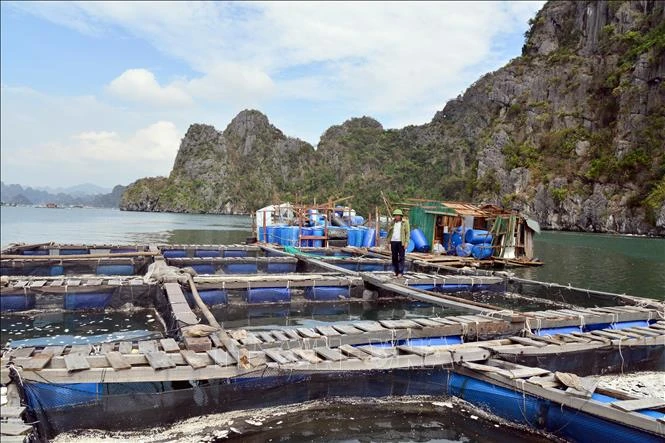
Fish cages of a resident in Cam Thuy ward of Cam Pha city, Quang Ninh province, were damaged by Typhoon Yagi. (Photo: VNA)

Hanoi (VNA) – The Government has issued Resolution No. 143/NQ-CP on the key tasks and solutions for promptly settling the aftermaths of Typhoon Yagi, stabilising people’s life, boosting production and business recovery, actively promoting economic growth, and controlling inflation.

Typhoon Yagi, the third to appear in the East Sea this year, is the most powerful there in 30 years and in the Vietnamese mainland in 70 years. Hitting the northern part of the country on September 7, it caused a heavy toll on all the 26 localities across the area, including Thanh Hoa province in the north-central region. Widespread and prolonged downpour accompanying the storm caused severe flooding and landslides in many localities.

As of September 17, 329 people died or went missing while about 1,930 others were injured. Some 234,700 houses, 1,500 schools, and many infrastructure facilities were pulled down or damaged. Meanwhile, 3,722 aquaculture cages were ruined, nearly 3 million livestock and poultry killed, and almost 310,000 trees uprooted, preliminary statistics show.

Property losses are estimated at more than 50 trillion VND (2 billion USD), which is forecast to slow this year’s GDP growth by around 0.15%.

To quickly settle the typhoon’s aftermaths, stabilise people’s life, boost production and business recovery, actively promote economic growth, and control inflation to secure an economic growth rate of about 6.8 - 7%, the Government demanded ministers, heads of ministry-level agencies, Government agencies and others at the central level, along with the chairpersons of the People’s Committees of the 26 Yagi-hit localities promptly, drastically, and effectively carry out the Politburo’s conclusion, along with the Government and the Prime Minister’s resolutions and directions, focusing on the focal tasks and solutions.

The newly issued resolution highlighted the Government’s viewpoint that support policies and solutions must be feasible and carried out in a swift, timely, effective, and focus-driven manner and directly benefit the affected groups. Every resource must be mobilised, managed, and distributed reasonably, effectively, and transparently while losses, wastefulness, negative phenomena, group interests, and policy profiteering be prevented.

Focal tasks, solutions specified to aid post-typhoon recovery 2.jpg
Electricity workers lift cables out of water and clean equipment to prepare for resuming power supply when water recedes at the Hoa Thach transformer station in Quoc Oai district, Hanoi. (Photo: VNA)

The goal is to protect people’s lives, safety, and health as the top priority; guarantee social security, soon recover daily and social activities to stabilise people’s life, especially in the localities hit hard by the storm, flooding, and landslides; and quickly resume production, supply and labour chains, restore and develop production and business activities, and sustain the growth and recovery trend of the localities and the entire economy in 2024.

Assistance targets people, workers, vulnerable groups, business households, cooperatives, and enterprises in the affected localities.

It will be delivered mainly in September and October. Some support policies for business households and enterprises could be extended to the end of 2025 to match their recovery progress and the seasonal factor of production and business activities, according to the resolution.

The six groups of focal tasks and solutions outlined in the resolution include those on protecting people’s lives, safety, and health; supporting the recovery of daily and social activities to stabilise people’s life; along with supporting production establishments, business households, cooperatives, and enterprises to quickly resume production, supply and labour chains while recovering and bolstering production, business, and economic growth.

Others are on the preparedness against natural disasters, including storms, flooding, and landslides in the coming time; mechanisms, policies, and solutions for reducing and simplifying administrative procedures to implement support policies; and inflation control and economic growth promotion./.
VNA

See more

People shop for Tet at a supermarket. (Photo: VNA)

Vietnamese goods dominate Tet market in Mekong Delta

In key retail hubs such as Can Tho, Long Xuyen and My Tho, high-quality Vietnamese goods account for 85–90% of Tet market share. Surveys at major supermarket chains and traditional markets show that consumers this year are prioritising locally-processed foods, confectionery and beverages.

Prime Minister Pham Minh Chinh strikes the gong to inaugurate the Vietnam International Financial Centre in Ho Chi Minh City. (Photo: VNA)

Int’l Financial Centre – A catalyst for Vietnam’s economic breakthrough: Deputy PM

Standing Deputy Prime Minister Nguyen Hoa Binh, who chairs the IFC’s Governing Council, said that the establishment of the centre in Ho Chi Minh City and Da Nang represented the initial realisation of a major task set out in the Resolution of the 13th National Party Congress. While characterising the launch as an early milestone rather than a final achievement, he underscored that it reflected meticulous, methodical and determined preparations at multiple levels of government.

Kobayashi Yosuke, Chief Representative of JICA Vietnam. (Photo: JICA Vietnam)

JICA hails milestones in Vietnam partnership amid green, digital push

In line with Vietnam’s development priorities and its goal of becoming a high-income country by 2045, JICA will continue to work with a wide range of partners in both Vietnam and Japan to mobilise technical and financial resources for more sustainable and inclusive cooperation

Vietnam International Trade Fair for Apparel, Textiles and Textile Technologies (VIATT 2026) is expected to expand its scale by 20% compared to last year's edition. (Photo: bnews.vn)

Int’l trade fair for apparel, textiles, textile technologies to open in Ho Chi Minh City

According to Vietrade, VIATT 2026 aims to promote the development of Vietnam’s textile and garment industry by enhancing production technologies, strengthening sustainability, and expanding technical textile segments. The event is expected to create opportunities for international businesses to tap into the growth potential of Vietnam and ASEAN, while enabling domestic enterprises to connect more effectively with global buyers.

Participants at a conference on digital assets in Hanoi on December 10. (Photo: VNA)

Finance ministry seeks public feedback on minimal tax on digital assets

Under the draft, the transfer and trading of crypto assets would not be subject to value-added tax. Individual investors, regardless of residency status, would be required to pay personal income tax at a rate of 0.1% on the gross value of each transfer. This approach mirrors the current tax method applied to securities transactions.

Steel products of Hoa Phat Group. (Photo: VNA)

Vietnam aims to meet 80–85% of domestic steel demand by 2030

Vietnam aims to meet 80–85% of domestic steel demand by 2030. Crude steel production is targeted at 25–26 million tonnes per year, with annual growth of 7–8%, while finished steel output is expected to reach 32–33 million tonnes per year, growing by 5.5–6.5% annually. Per capita steel consumption is projected at 270–280 kg per year.

One of the products granted Halal certification in 2026. (Photo: moit.gov.vn)

Spring Fair 2026 boosts momentum for Vietnam’s Halal sector

The fair’s greatest value for Halal products lies less in immediate revenue than in building trust and standardising business practices. In a market where certification determines entry, it highlights that expansion must begin with fundamentals, standards, raw materials, production processes and readiness.

Prime Minister Pham Minh Chinh speaks at the fifth meeting of the Steering Committee for Nuclear Power Plant Construction. (Photo: VNA)

PM calls for more vigorous implementation of nuclear power projects

Describing nuclear power plants as nationally significant, strategic projects with a century-long vision, PM Chinh called for urgent and responsible implementation of tasks within assigned authority, with any outstanding issues promptly reported to higher authorities.

Vehicles transporting import and export goods at Bac Luan II Bridge border gate. (Photo: VNA)

Building smart border gates to enhance competitiveness, drive growth

With plans to build the Mong Cai–Ha Long–Hai Phong railway alongside the smart border gate and economic cooperation zone, Quang Ninh is positioning itself as a new growth pole in northern Vietnam and a key gateway for economic cooperation between Vietnam, ASEAN and China.