Forest worship ritual of the Thai recognised as national heritage

The Xen Dong festival, known as the forest worship ritual, of the Thai in Nghia Lo town in the northern province of Yen Bai, has been recognised as a national intangible cultural heritage.

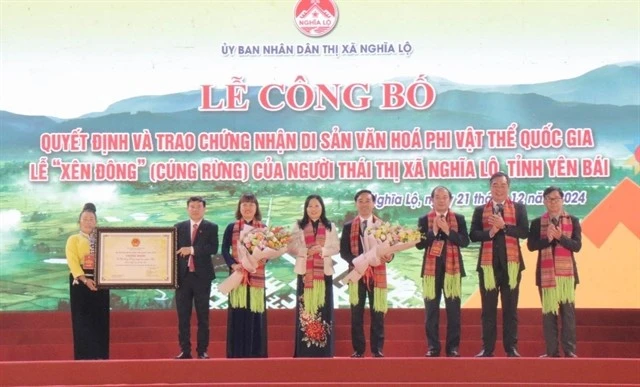
A ceremony to grant the national intangible cultural heritage recognition to the Xen Dong festival, known as the forest worship ritual, of the Thai in Nghia Lo town takes place in Lai Chau on December 21. (Photo: VNA)

Yen Bai (VNS/VNA) - The Xen Dong festival, known as the forest worship ritual, of the Thai in Nghia Lo town in the northern province of Yen Bai, has been recognised as a national intangible cultural heritage.

A ceremony to receive the honour was held by the People's Committee of Nghia Lo town on December 21, with the attendance of Deputy Director of the provincial Department of Cultural Heritage Nong Quoc Thanh and representatives of local authorities.

Deputy Chairman of the People's Committee of Nghia Lo town Luong Manh Ha emphasised that the recognition was a source of great pride not only for the Thai people of Nghia Lo but also for the ethnic groups of Yen Bai province.

Nghia Lo town, as the western gateway of Yen Bai province, is not only a land rich in revolutionary tradition, but also a place where diverse cultural features of ethnic groups converge. Among these, the Thai ethnic group constitutes the majority, with a long-standing cultural heritage that is deeply imbued with profound human values.

Nghia Lo currently has five historical sites recognised as national and provincial heritage sites. Notably, the town boasts three intangible cultural heritage elements, among which the art of Xoe Thai dance has been inscribed by UNESCO on the Representative List of the Intangible Cultural Heritage of Humanity.

On the 12th day of every lunar new year, the Thai people celebrate Xen Dong, known as the forest worship ritual, to honour their ancestors and seek blessings for the village to secure peace, prosperity and happiness.

This is not only a spiritual activity but also an opportunity for the community to interact, strengthen bonds and preserve and promote the precious traditional cultural identity of their ethnic group.

With its exceptional historical, cultural and artistic values, the Xen Dong Festival has been recognised by the Ministry of Culture, Sports, and Tourism as a National Intangible Cultural Heritage.

“The People's Committee of Nghia Lo town is committed to continuing practical activities to promote and practise the heritage. The town will enhance communication and promotion of the Xen Dong festival in connection with the development of community tourism, contributing to making Nghia Lo an attractive destination,” Ha said.

“The committee will continue to support and create conditions for the Thai community to pass on the knowledge about the traditional ritual. The role of the community in safeguarding and protecting the heritage will also be upheld, ensuring that this cultural beauty is passed down for generations to come.”

The Xen Dong festival consists of both ceremonial and festive parts. It features various forms of folk art performances such as Xoe dancing, Khap singing, bamboo dancing, instrumental performances and traditional folk games of the Thai community in the Muong Lo region of Nghia Lo town.

For the Thai people, preserving the sacred forests has long been a tradition. Protecting the trees is considered a duty and responsibility of everyone and over time, it has become a fundamental rule of their village.

So the festival holds significant spiritual value. It plays a positive role in forest conservation, protecting nature, regulating water sources and maintaining ecological balance, all aimed at fostering a green, harmonious and sustainable living environment./.
VNA

See more

UNESCO Director-General Khaled El-Enany (Photo published by VNA)

UNESCO, countries welcome Vietnam-led cultural initiative

UNESCO Director-General Khaled El-Enany hailed the UN General Assembly’s proclamation of the International Decade of Culture for Sustainable Development (2027–2036), thanking Vietnam for promoting the initiative, as well as all co-sponsoring countries, members of the core group and the Group of Friends for Culture at the UN for their support.

The Miss World 2026 event in Nha Trang is a showcase of global cultures. (Photo: Miss World 2026 Organising Board)

Miss World 2026 contestants showcase global cultures in Nha Trang

Hosting the final activities and grand final of Miss World 2026 offers Khanh Hoa an opportunity to promote its natural landscapes, cultural heritage and people to international audiences, while attracting visitors to Nha Trang during the National Day holiday.

Border residents and visitors join cultural, sports and tourism activities in Long Sap commune, Son La province. (Photo: QuVNA)

Vietnam-Laos border communities strengthen bonds of friendship

Through the programme, Son La aims to showcase the nature, culture and people of Long Sap, promote traditional cultural values alongside sustainable tourism, boost tourism and trade, and foster stronger cooperation contributing to sustainable socio-economic development in Long Sap and the Moc Chau National Tourism Area.

Young girls at a buckwheat flower valley in Tuyen Quang province. (Photo: VNA)

Culture industries open new growth opportunities for Tuyen Quang

Following its administrative merger, Tuyen Quang is home to 46 ethnic groups, with ethnic minorities accounting for more than 70% of its population. The province has 794 historical and cultural relic sites and 871 intangible cultural heritage items, including 53 recognised as national intangible cultural heritage.

Visitors explore Hà Nội’s master urban plan through a 3D mapping display at the Hà Nội Museum. (Photo: VNA)

Museums enter the digital age

From 3D displays and virtual tours to AI assistants and digital collections, museums across Vietnam are rethinking how heritage is preserved, presented and experienced, with technology opening new ways for the public to connect with the past.

Vietnam’s women’s sepak takraw team celebrate the gold medal at the 2023 Asian Games in Indonesia. (Photo: VNA)

Vietnam to send 498-member delegation to 20th ASIAD in Japan

The delegation comprises top athletes competing in key sports including athletics, shooting, swimming, martial arts (wushu, karate, taekwondo and jujitsu), sepak takraw, rowing, canoeing, football, volleyball, golf, fencing and weightlifting. It will also include officials, doctors and international experts.