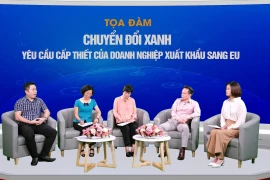
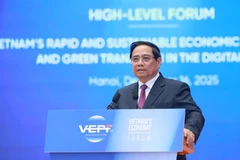
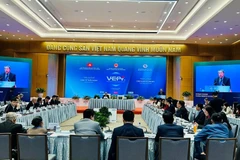
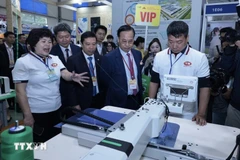
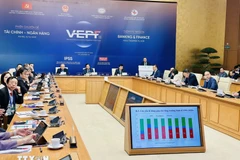
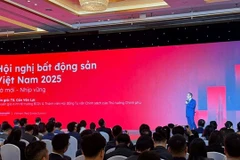
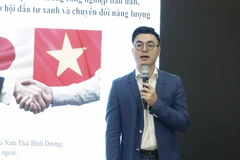
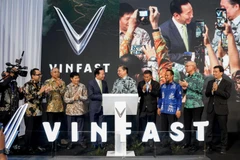
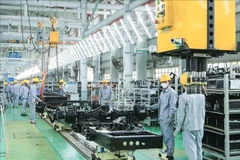
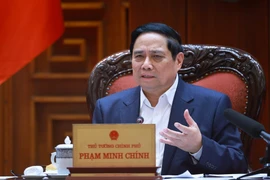
The Vietnam Export Forum 2023 focuses on green export promotion. (Photo: VNA)
 The event, held by the TradePromotion Agency under the Ministry of Industry and Trade and the projectssupported by the Swiss Government, aimed to provide a platform for enterprisesto share experience in developing green production and sustainable export.
Delivering the opening remarks,Deputy Minister of Industry and Trade Do Thang Hai said green growth, greendevelopment, and circular economy are becoming a global trend as a positivesolution to cut greenhouse gas emissions, improve economies’ resilience and creativity,and work towards carbon neutrality and sustainable development.
In Vietnam, green and sustainabledevelopment is an important task identified in the socio-economic developmentstrategy for 2021 - 2030, the goods export and import strategy by 2030, and thenational green growth strategy for 2021 - 2030 with a vision to 2050. Recently,the Prime Minister issued a national action plan on perfecting policies andlaws to promote responsible business practices in the country for the 2023 -2027 period, he noted.
Manydeveloped economies in the world have set stricter regulations related toimports such as the European Green Deal and relevant mechanisms such as the CarbonBorder Adjustment Mechanism (CBAM), the Farm to Fork Strategy, the CircularEconomy Action Plan, and the Biodiversity Strategy for 2030.
Therefore, Hai said, to not be leftbehind due to importing markets’ high environmental and social standards,exporting countries need to change their mindset and pay more attention to thegreenness of supply chains and international trade.
 Deputy Minister of Industry and Trade Do Thang Hai addresses the Vietnam Export Forum 2023 in Hanoi on November 24. (Photo: VNA)
 However, he noted, it is not easy forenterprises to do that because a green steel industry requires financial andtechnological resources as well as their own activeness, especially as theregulations on carbon emission cuts were issued just recently.
Thesteel industry and its enterprises have been coordinating with relevant partiesto take actions to meet the CBAM of the EU, he continued, adding that hisassociation will work out more measures and an implementation roadmap to securea competitive and green steel industry.
Apart from enterprises’ efforts,authorities should also simplify procedures for receiving and reporting dataabout CO2 emissions, encourage companies to adopt action strategies and plans torespond to the CBAM, and provide more detailed guidance on carbon footprintcertification, Thai said.
LeVan An, Vice Chairman of the Vietnam Association of Mechanical Industry,suggested that during the green transition process, businesses can developrenewable energy by making use of irrigation lakes and canals to produce solarpower, or grow bamboo around those lakes since it is helpful for conservingsoil and water, trading carbon credit, and producing bamboo charcoal pelletsfor biomass power generation.
Green production opportunities dependmuch on enterprises, and the transition needs time and detailed guidance sothat they can satisfy importers’ requirements, he opined./.
VNA