Ha Giang province awaits tourism boom

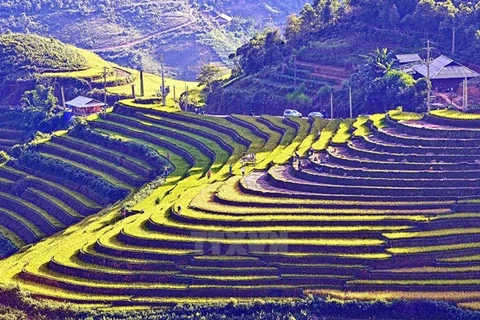
The northeastern border province of Ha Giang boasts majestic scenery, geological features, a diverse eco-system, rare fauna and flora, and the unique cultures of 22 ethnic minorities, but has yet to realise its enormous tourism potential, tourism officials said.
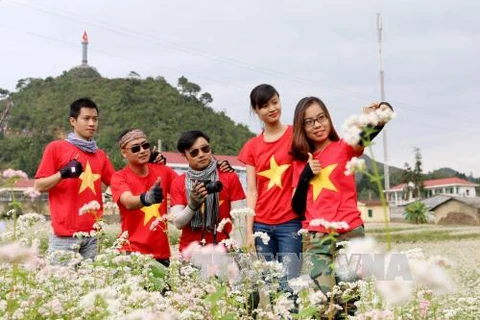
Ha Giang province awaits tourism boom ảnh 1Ha Giang province in buckwheat flower season - Illustrative photo (Photo: VNA)
 
HCM City (VNA) - The northeasternborder province of Ha Giang boasts majestic scenery, geological features, adiverse eco-system, rare fauna and flora, and the unique cultures of 22 ethnicminorities, but has yet to realise its enormous tourism potential, tourismofficials said. 

The province has seen average annual growth of32 percent in the number of tourist arrivals in the past few years, said NguyenVan Son, Chairman of the provincial Ha Giang People’s Committee.

Last year arrivals numbered nearly 854,000,including 176,500 foreigners.

Revenue from tourism was estimated at 795billion VND (35 million USD), a year-on-year increase of 13 percent.

In the first six months of this year, there weremore than 470,000 tourists, with visitors from Ho Chi Minh City accounting for35 percent.

But, speaking at recent event to promote HaGiang as a tourist destination in HCM City, Son said: “The province’s tourismsector is at an early stage of development and faces obstacles like limitedhuman resources and infrastructure.”

“The province promises to offer favourableconditions for domestic and international investors to develop tourismprojects.”

Tran The Dung, deputy director of Young Generation– a tourism company in HCM City, said the province should offer other tourismproducts besides the Dong Van Karst Plateau Geopark to attract more tourists.

He suggested adventure travel in the Tu Sanalley area, Hoang Su Phi terraced fields, the Gam River and festivals of ethnicgroups.

The province’s tourism authorities shoulddevelop closer co-operation with travel agents and inform them early aboutactivities like festivals to enable them to make tour plans, he added. 

In October 2010 the geopark was recognised as amember of the Global Geopark Network, the first in Vietnam and second inSoutheast Asia to achieve the status.

It covers an area of 2,356sq.km and with anaverage altitude of 1,400-1,600 metres, enjoys a cool climate and a range ofdifferent terrains.

There are many grand, deep canyons. Ma Pi LengPass, recognised as the deepest canyon in Vietnam, is 700-800m deep and 1.7 kmlong.

Lung Cu flagpole, the northernmost point of Vietnam,is a must-see tourism destination for not only Vietnamese overseas who comeback for a visit but also for many locals across the country.

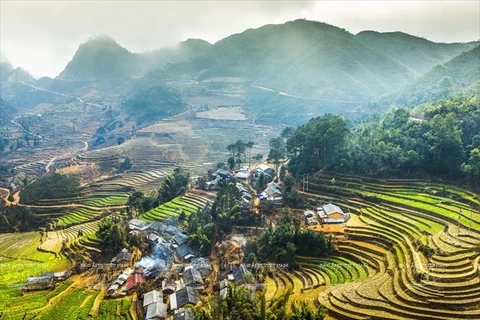
The Hoang Su Phi terraced fields, recognised asnational heritage, is considered one of the most beautiful landscapes in thewhole country.

Khau Vai love market, where people can meet upwith their old flames for a chat takes place once a year on the evening of 26thand morning of 27th in the third lunar month in Meo Vac district’s Khau Vai commune.Due to excessive tourism and intruding photographers, locals said they havemoved further to find their own quiet space to meet up with their onceloved-ones.

With its inherent appeal, the market has becomea unique cultural identity of the ethnic minorities in the region.

The province hopes to welcome 1.5 milliontourists by 2020, including 600,000 foreign visitors.-VNA
VNA

See more

Visitors explore and experience the cultural space of Lo Lo Chai village in Lung Cu commune, Tuyen Quang province. (Photo: qdnd.vn)

Administrative expansion unlocks new momentum for tourism development

Nguyen Thi Hoai, Deputy Director of the Department of Culture, Sports and Tourism of Tuyen Quang, said the expansion of administrative boundaries has opened up new development space for the province, with key tourism products including cultural-historical tourism, ethnic cultural experiences, community-based tourism linked to scenic sites, spiritual tourism, and other distinctive experiential offerings.

At Thung Nham ecological tourism site in Ninh Binh province. (Photo: VNA)

Vietnam’s tourism defies fuel price shock with record Q1 “hat-trick”

According to data released by the National Statistics Office, foreign arrivals in March reached nearly 2.1 million, up 1.3% year-on-year. In total, Vietnam welcomed an estimated 6.76 million foreign tourists in the first quarter, a more than 12% jump from the same period in 2025 and the highest Q1 figure ever recorded.

Visitors scan QR codes at Km0 Ha Giang to access tourism information. (Photo: VNA)

Technology powers tourism growth in mountainous province

Last year, Tuyen Quang welcomed over 3.9 million visitors, and is aiming to attract around 4.1 million arrivals, including around 600,000 foreigners, this year. Tourism continues to be identified as a key economic sector, with development oriented toward sustainability, green growth, and enhanced competitiveness through digitalisation.

Tourists enjoy a rickshaw tour of Hoi An Ancient Town, Da Nang city. (Photo: VNA)

ITE HCMC 2026 to promote Vietnam’s tourism on global map

With its large scale, the ITE HCMC 2026 aims to promote tourism cooperation between Vietnam and priority markets such as Northeast Asia, Western Europe, North America, Southeast Asia, and Oceania while also boosting visitor arrivals from the Indian market

The organisers of VITM 2026 honour sponsors. ( Photo: VNA)

VITM 2026 boosts tourism demand ahead of peak season

According to the organisers, around 4,500 representatives from Vietnamese and international tourism enterprises attended the event, generating more than 25,000 business meetings and partnership exchanges. Approximately 15,000 discounted tours and travel products were offered to visitors.

Traditional dragon procession held on the river in Ninh Binh. (Photo: VNA)

Cultural heritage drives sustainable tourism growth in Ninh Binh

In the first two months of 2026, Ninh Binh welcomed over 5.4 million visitors, up 9.9% year-on-year, generating nearly 5.84 trillion VND (221 million USD) in tourism revenue, up 15.9%. During the 2026 Lunar New Year holiday alone, the province received 2.38 million visitors, an 81.4% increase from the previous year, ranking second nationwide.

Outstanding individuals and firms honoured at VITM 2026 (Photo: VNA)

Outstanding individuals, firms honoured at Vietnam International Travel Mart 2026

In 2025, Vietnam’s tourism sector recorded its highest-ever number of visitors, welcoming more than 21.5 million international arrivals, up more than 20% from 2024, and serving over 135.5 million domestic travellers. Tourism revenue also surpassed 1 quadrillion VND (nearly 38 billion USD). The sector has become a bright spot of the economy, with Vietnam ranking among the world’s fastest-growing tourism destinations.

The Ba Trieu Temple in Thanh Hoa province (Photo: VNA)

Thanh Hoa taps digital transformation to boost heritage tourism

With 28 nationally-recognised intangible cultural heritage elements, Thanh Hoa province has prioritised integrating conservation with tourism development. Digital transformation, in particular, is seen as a crucial bridge connecting tradition with innovation, helping heritage sites become more accessible and engaging.

Pristine white-sand beach on Cu Lao Cham Island, Da Nang city, is a magnet for visitors. (Photo: VNA)

Vietnam – a safe destination amid global uncertainties

Despite global tourism headwinds linked to geopolitical conflicts, transport disruptions and surging travel expenses, Vietnam’s tourism sector has sustained strong growth, underscoring the destination’s resilience and rising international profile.

A border guard at the Mong Cai International Border Gate processes exit procedures for passengers at the Bac Luan 1 border gate in Quang Ninh province. (Photo: VNA)

Vietnam, China promote AI application in cross-border tourism cooperation

During the programme, participants will attend intensive courses delivered by AI technology experts, China–ASEAN policy researchers, and tourism specialists. The curriculum focuses on the application of big data in tourism policy planning, the development of cross-border tourism products, and the building of joint tourism brands.