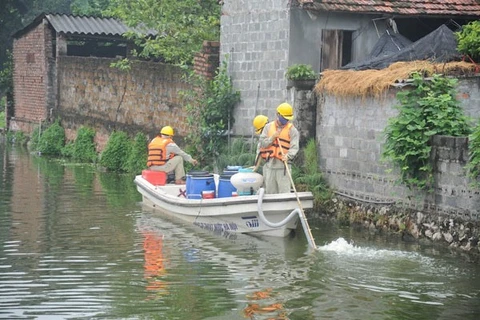
Water from Nhue river (Photo: VNA)
 Hanoi (VNS/VNA) - The quality of surface water in many lakes and rivers in the north has improved, but 15 monitoring areas of 185 that have been monitored remain heavily polluted, mainly on the Cau and Nhue-Day rivers.
River water in the capital city of Hanoi was also seriously polluted. The water quality monitoring assessment was carried out in May at 185 monitoring points in five river basins by the Centre for Environmental Monitoring in the North.
According to the report, the water quality in the Cau River has improved compared to the same period of last year.
At the monitoring points in the upstream area in northern Bac Kan province, river water was deemed clean enough for daily use with the water quality index (WQI) in a good range between 89-92.
On the Cau River running through Bac Giang and Bac Ninh provinces, most of the WQI of the monitoring points were at an average of 50-70, except for some points in downstream areas, meaning the water can be used for aquaculture.
On the tributaries of Nghinh Tuong, Du and Thuong rivers, the water was at a good to a very good level of between 91-100, making it clean enough for daily use.
The water on the Cong River has a moderate level of between 51 and 57, which can only be used for traffic waterway activities due to the discharge of domestic wastewater. Some of the monitoring points have been recorded as qualified for irrigation and aquaculture purposes.
Meanwhile, parts of the water surface in the Cau River basin in Cau Dao Xa and Cau Bong Toi monitoring points were recorded as polluted and have seen no signs of improvement.
The pollution was blamed on the discharge of domestic wastewater as well as wastewater from craft villages in Bac Ninh province and Thai Nguyen city.
In the Nhue-Day River basin – one of the river basins with the poorest water quality in the north, up to 62 per cent of the monitoring points recorded a WQI of below 50, with almost a third of those below 25.
As for the section of the Nhue River passing through Hanoi, pollution continued to occur from Phuc La to Cong Nhat Tuu with the WQI index of between 10-25 due to the discharge of wastewater from craft villages in the city.
Apart from the Hong (Red), Thai Binh and Da rivers, the rivers in the inner city remained seriously polluted with a WQI from 12-28 and showed no signs of improvement compared to the same period last year. The water cannot be used for cooking, drinking or production activities./.
River water in the capital city of Hanoi was also seriously polluted. The water quality monitoring assessment was carried out in May at 185 monitoring points in five river basins by the Centre for Environmental Monitoring in the North.
According to the report, the water quality in the Cau River has improved compared to the same period of last year.
At the monitoring points in the upstream area in northern Bac Kan province, river water was deemed clean enough for daily use with the water quality index (WQI) in a good range between 89-92.
On the Cau River running through Bac Giang and Bac Ninh provinces, most of the WQI of the monitoring points were at an average of 50-70, except for some points in downstream areas, meaning the water can be used for aquaculture.
On the tributaries of Nghinh Tuong, Du and Thuong rivers, the water was at a good to a very good level of between 91-100, making it clean enough for daily use.
The water on the Cong River has a moderate level of between 51 and 57, which can only be used for traffic waterway activities due to the discharge of domestic wastewater. Some of the monitoring points have been recorded as qualified for irrigation and aquaculture purposes.
Meanwhile, parts of the water surface in the Cau River basin in Cau Dao Xa and Cau Bong Toi monitoring points were recorded as polluted and have seen no signs of improvement.
The pollution was blamed on the discharge of domestic wastewater as well as wastewater from craft villages in Bac Ninh province and Thai Nguyen city.
In the Nhue-Day River basin – one of the river basins with the poorest water quality in the north, up to 62 per cent of the monitoring points recorded a WQI of below 50, with almost a third of those below 25.
As for the section of the Nhue River passing through Hanoi, pollution continued to occur from Phuc La to Cong Nhat Tuu with the WQI index of between 10-25 due to the discharge of wastewater from craft villages in the city.
Apart from the Hong (Red), Thai Binh and Da rivers, the rivers in the inner city remained seriously polluted with a WQI from 12-28 and showed no signs of improvement compared to the same period last year. The water cannot be used for cooking, drinking or production activities./.
VNA