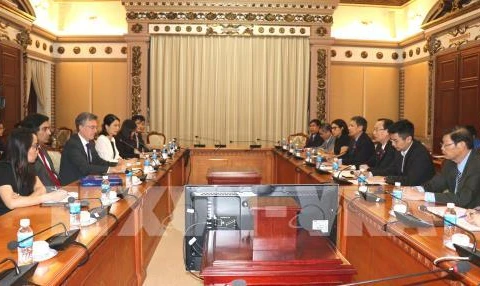
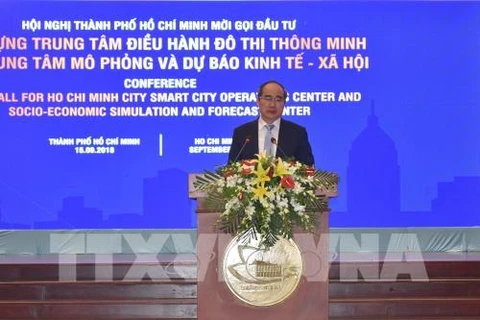
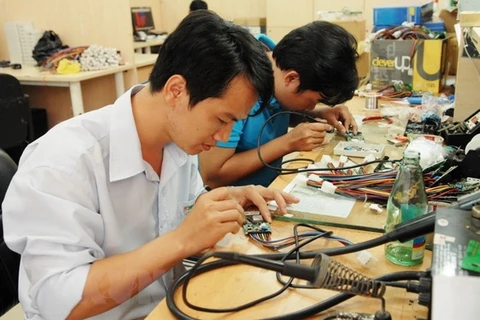
HCM City should learn from other cities’s experiences in building a smart city, experts said at a seminar on September 28 (Photo: kienviet.net)
 HCM City (VNS/VNA) – Ho Chi Minh City should learn lessons from major cities in developed countries on how to become a smart city, speakers said at an international conference held in the city on September 28.
Nearly 200 delegates, including those from the US, Singapore, Malaysia, Thailand and the Philippines, discussed ways to help HCM City build a smart city.
David Koh, Singaporean researcher at the Cambodian Institute for Cooperation and Peace, said the Singaporean approach could be adopted by HCM City.
“Open your door to technologies that can help you build a smart city,” he said. “A smart city is desired all over the world because of a few imperatives: greenness, competition, and efficiency.”
The process to achieve a smart city can take many years. However, even though a smart city will rely heavily on technology, it might ignore or sideline the human element on which development should be centered, according to Koh.
“All of us are familiar with an SMS sent from one room to the next when a brief walk to talk to the person would do,” he said.
Smart cities are driven by data collection from different types of sensors, including coordination and integration of dates and deliveries to consumers, and monitoring of public services.
The success of smart cities will come from the will of the Government to bring resources of different departments and interests to bear on development.
Good governance is the most important factor in achieving efficiency, according to Koh.
He noted that Singapore had always been on the cutting edge of trends, especially technology, which had been important in its success and business growth.
Nguyen Thanh Trung, Vice President of the Vietnam Fatherland Front Committee in HCM City, said that HCM City aimed to become a smart city in the near future by implementing IoT (the Internet of Things), Artificial Intelligence (AI) and Big Data.
The city faced challenges such as flooding, traffic jams, unstable competitiveness, inadequate infrastructure, and limited resources for development, among others, he noted.
To become a smart city, HCM City should develop an open data ecosystem and build a centre for the simulation of forecasts for development strategies, as well as an information security and safety centre, according to Trung.
Healthcare, food safety, and social order and safety will all benefit from a smart city approach.
“It’s also important to raise residents’ awareness so they can prepare and adapt to live in a smart city,” he said.
Phan Thi Hong Xuan, dean of the Faculty of Urban Studies at the University of Social Sciences and Humanities, said under a Government plan, HCM City would become “a civilised, modern and humane city” with a high quality of life.
Under the plan, the city’s Districts 2 and 9 will be developed into “creative urban areas”.
Besides Singapore, the city should learn from the experiences of Seoul, Bangkok, Kuala Lumpur and Shanghai in building smart cities, she said.
Philippe Leonard, executive director of Smart Cities Council of Europe, said: “A smart city is not a technological issue. It’s about using technology to make a city smarter. A smart city improves the quality of life.”
"Smart cities have residents who embrace creativity and an inclusive society and advanced education," he said.
"Such cities also include smart mobility (clean and non-motorised options), smart economy (innovative entrepreneurship), smart Government (application of ICT and e-Government) and smart living (green planning and building and green energy)," he added.
Singapore targets becoming a smart nation by 2030, Seoul by 2030, Bangkok by 2032, Kuala Lumpur by 2020, and Shanghai by 2050.
Top European smart cities include London, Paris, Amsterdam, Geneva, Copenhagen and others.
The seminar was organised by the Vietnam Fatherland Front Committee in HCM City in collaboration with Friedrich Ebert Stiftung, Vietnam Union of Friendship Organisations, Vietnam-Southeast Asia Friendship Association and the University of Social Sciences and Humanities.-VNS/VNA
Nearly 200 delegates, including those from the US, Singapore, Malaysia, Thailand and the Philippines, discussed ways to help HCM City build a smart city.
David Koh, Singaporean researcher at the Cambodian Institute for Cooperation and Peace, said the Singaporean approach could be adopted by HCM City.
“Open your door to technologies that can help you build a smart city,” he said. “A smart city is desired all over the world because of a few imperatives: greenness, competition, and efficiency.”
The process to achieve a smart city can take many years. However, even though a smart city will rely heavily on technology, it might ignore or sideline the human element on which development should be centered, according to Koh.
“All of us are familiar with an SMS sent from one room to the next when a brief walk to talk to the person would do,” he said.
Smart cities are driven by data collection from different types of sensors, including coordination and integration of dates and deliveries to consumers, and monitoring of public services.
The success of smart cities will come from the will of the Government to bring resources of different departments and interests to bear on development.
Good governance is the most important factor in achieving efficiency, according to Koh.
He noted that Singapore had always been on the cutting edge of trends, especially technology, which had been important in its success and business growth.
Nguyen Thanh Trung, Vice President of the Vietnam Fatherland Front Committee in HCM City, said that HCM City aimed to become a smart city in the near future by implementing IoT (the Internet of Things), Artificial Intelligence (AI) and Big Data.
The city faced challenges such as flooding, traffic jams, unstable competitiveness, inadequate infrastructure, and limited resources for development, among others, he noted.
To become a smart city, HCM City should develop an open data ecosystem and build a centre for the simulation of forecasts for development strategies, as well as an information security and safety centre, according to Trung.
Healthcare, food safety, and social order and safety will all benefit from a smart city approach.
“It’s also important to raise residents’ awareness so they can prepare and adapt to live in a smart city,” he said.
Phan Thi Hong Xuan, dean of the Faculty of Urban Studies at the University of Social Sciences and Humanities, said under a Government plan, HCM City would become “a civilised, modern and humane city” with a high quality of life.
Under the plan, the city’s Districts 2 and 9 will be developed into “creative urban areas”.
Besides Singapore, the city should learn from the experiences of Seoul, Bangkok, Kuala Lumpur and Shanghai in building smart cities, she said.
Philippe Leonard, executive director of Smart Cities Council of Europe, said: “A smart city is not a technological issue. It’s about using technology to make a city smarter. A smart city improves the quality of life.”
"Smart cities have residents who embrace creativity and an inclusive society and advanced education," he said.
"Such cities also include smart mobility (clean and non-motorised options), smart economy (innovative entrepreneurship), smart Government (application of ICT and e-Government) and smart living (green planning and building and green energy)," he added.
Singapore targets becoming a smart nation by 2030, Seoul by 2030, Bangkok by 2032, Kuala Lumpur by 2020, and Shanghai by 2050.
Top European smart cities include London, Paris, Amsterdam, Geneva, Copenhagen and others.
The seminar was organised by the Vietnam Fatherland Front Committee in HCM City in collaboration with Friedrich Ebert Stiftung, Vietnam Union of Friendship Organisations, Vietnam-Southeast Asia Friendship Association and the University of Social Sciences and Humanities.-VNS/VNA
VNA