Ho Chi Minh City Ao Dai Festival opens

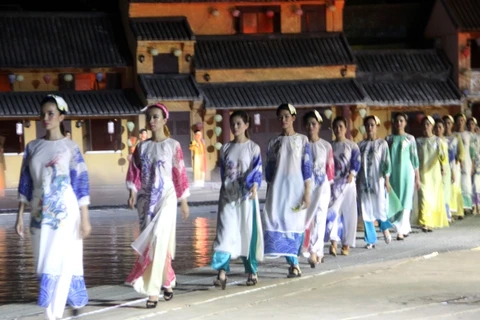
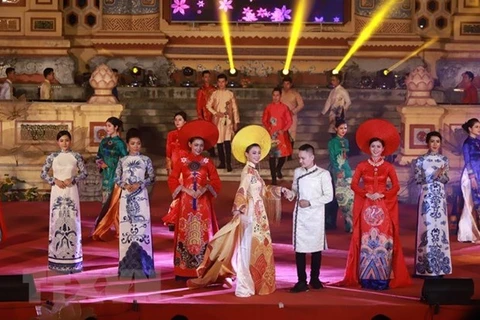
The seventh Ho Chi Minh City Ao Dai (traditional long dress) Festival kicked off on October 11 at the Vietnam History Museum in district 1, with many excellent collections of famous designers on show.
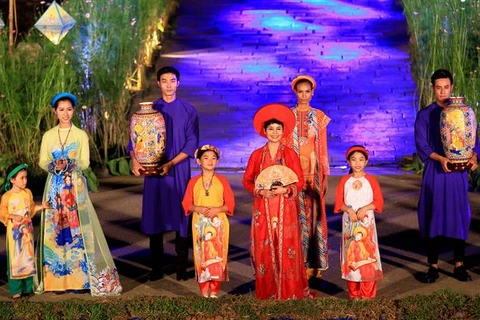
Ho Chi Minh City Ao Dai Festival opens ảnh 1The "Vietnamese Heritage" collection by Do Trinh Hoai Nam  (Photo: tuoitre.vn)

HCM City (VNA) – The seventh Ho Chi Minh City Ao Dai (traditionallong dress) Festival kicked off on October 11 at the Vietnam History Museum in district1, with many excellent collections of famous designers on show.

The event aimed at honouring traditional cultural values and the love for AoDai – the country’s intangible cultural heritage. Particularly, it is part ofactivities to welcome the city’s 11th Party Congress for the2020-2025 tenure.

Besides popularising Ao Dai, the festival is expected to introduce HCM City’stourist sites and people to domestic and international friends.

In his opening remarks, Chairman of the municipal People’s Committee NguyenThanh Phong said the annual festival contributes to preserving and promotingthe nation’s traditional values, and it is held in response to the “Ao dai –Vietnam’s cultural heritage” event, organised by the Vietnam’s Women Union incollaboration with the Ministry of Culture, Sports and Tourism.

Phong highlighted the necessity to preserve the beauty of Ao Dai, explaining itwill help build a modern Vietnamese culture.

This year’s event drew the participation of 14 designers, including NguyenTuan, Viet Hung, Vo Viet Chung, Ella Phan, Tuan Hai, Nhat Dung and Do TrinhHoai Nam.

The HCM City Ao Dai Festival was initiated in 2014 as an outstanding culturaland tourism event of the city. It is also a key tourism product, which wasidentified while HCM City studied and built its tourism development strategyuntil 2030./.
VNA
See more

A calligraphy booth at the festival (Photo: VNA)

Spring Calligraphy Festival 2026 opens in Hanoi

A central attraction remains the traditional New Year calligraphy request activity, featuring 35 booths staffed by calligraphers selected through a rigorous, transparent evaluation process.

A ritual to welcome new year of Muong people in Phu Tho (Photo: nhandan.vn)

Unique Lunar New Year traditions on display

Each ethnic group brings its own unique Tet customs to the Vietnam National Village for Ethnic Culture and Tourism on the outskirts of Hanoi, creating a rich and colourful cultural mosaic.

Polish Ambassador to Vietnam Joanna Skoczek (R) attends a cultural event in Vietnam (Photo: VNA)

Cultural, people-to-people interactions anchor Vietnam–Poland relations: diplomat

Skoczek also pointed to striking similarities between Vietnam’s Tet and Poland’s Christmas Eve traditions, particularly the emphasis on family reunions, symbolic meals and shared rituals passed down through generations. Despite differences in customs and cuisine, she said the essence of the celebrations remains universal: bringing loved ones together to welcome a new start.

A Tet flower street is held for the first time at the Thang Long Imperial Citadel during the Lunar New Year 2026. (Photo: VNA)

Tet flower street held for first time at Thang Long Imperial Citadel

More than a seasonal attraction, the flower street also functions as a formal cultural venue for receiving ambassadors, their spouses and representatives of diplomatic missions attending the Vietnam Discovery Day 2026 programme. Its linkage with an external event further reinforces the Thang Long Imperial Citadel’s position as a key platform for introducing Vietnam’s cultural identity to international friends.

The recreation of Tien lich (calendar presentation ceremony), an important year-end ritual in which the royal court presented the new calendar for the coming year to the king, within a programme at the Thang Long Imperial Citadel in Hanoi on February 10. (Photo: VNA)

Hanoi recreates Lunar New Year court ritual at Thang Long Imperial Citadel

Organised by the municipal People’s Committee in coordination with the Vietnam National Commission for UNESCO, the programme recreated a range of ceremonial practices once performed in the royal court. These included the Tien lich ritual, in which calendars were formally distributed to the court and the public; the Thuong tieu ceremony featuring the ceremonial New Year pole erected to ward off evil spirits and welcome spring; the ritual release of carp to send the Kitchen Gods to heaven; and the solemn changing-of-the-guard ceremony inside the imperial citadel. Together, the activities helped audiences better understand the cultural, spiritual and ceremonial order of Vietnam’s feudal past.

Illustrative image (Photo: VNA)

Fireworks, festive events usher in Year of the Horse across Vietnam

Local residents and visitors can enjoy spectacular fireworks displays at locations like the Hanoi Post Office in Hoan Kiem ward; Coconut island in Thong Nhat park, Hai Ba Trung ward; the F1 racetrack area in Tu Liem ward; Lac Long Quan flower garden in Tay Ho ward; Van Quan lake in Ha Dong ward; and the Son Tay Ancient Citadel in Son Tay ward.

People visit the Spring Fair 2026. (Photo: VNA)

Spring Fair 2026: Celebration of Vietnamese Tet flavours, cultural memory

Food has long occupied a central place in Vietnamese Tet culture, symbolising abundance, harmony and gratitude. At the Spring Fair 2026, traditional Tet delicacies are presented in a modern setting while retaining their familiar essence, allowing visitors to experience both nostalgia and renewal.

(Photo: baoquocte.vn)

Spring Fair 2026 features imperial spring colours, heritage imprints

Beyond cultural impressions, the fair created tangible opportunities for Hue enterprises and artisans to promote brands, connect partners and expand markets, laying foundations for deeper participation in value chains and long-term sustainable development aligned with Hue’s green growth and international integration strategy toward 2030, with a vision to 2045.

The horse-themed stamp set and commemorative coin. (Photo: VNA)

Stamp set, coin issued to mark Year of the Horse

In traditional beliefs, the horse is a sacred animal symbolising loyalty, vigour, patience and perseverance, and is also believed to bring good fortune and prosperity. Drawing on this symbolism, the stamp set is presented in a contemporary folk-art style and, for the first time, features the image of the “Nine Red-Maned Horse” on Vietnam’s Tet stamps.

Vietnamese Ambassador to Japan Pham Quang Hieu commends collectives that have made significant contributions to community work in 2025 (Photo: VNA)

Vietnamese in Australia preserve traditional Tet celebrations

The “Homeland Spring” programme in Australia left lasting impressions, bringing the warmth of Tet to overseas Vietnamese and reaffirming that wherever they may be, Vietnamese people share common roots and an aspiration for a prosperous future.