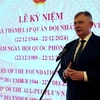
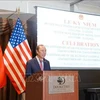
At the event (Photo: Quocte.vn)
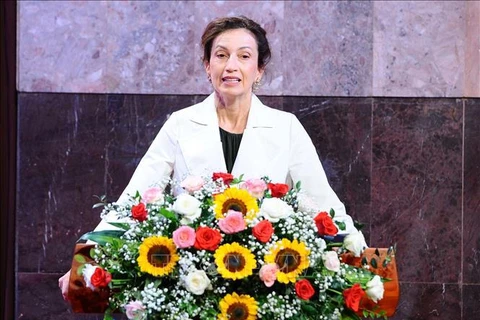
 Hanoi (VNA) – Dr Tilottama Mukherjee, Assistant Professor and head of the Department of Political Science at Syamaprasad College, Kolkata, India, has delivered a remark at an international conference recently held on the occasion of the 35th anniversary of UNESCO’s Resolution honouring President Ho Chi Minh as a Hero of National Liberation and a Great Man of Culture of Vietnam.
Following is the full text of her remark.
Ho Chi Minh visited India three times- first in 1911, then in 1946 while he was going to France for peace dialogues and then finally in 1958 as an official visit as the President of the Democratic Republic of Vietnam. Prime Minister of India Jawaharlal Nehru welcomed him as a “great revolutionary leader”. He further remarked that “We have met a person who is part of Asian history. We meet such a great man, and we meet a period of history. Therefore, we not only enrich our thoughts but also feel more honored. Meeting President Ho is such an experience.”
However brief, a mention must also be made of the fact that India was the Chairman of the International Commission for Supervision and Control (ICSC); which was formed pursuant to the Geneva Accords to facilitate the peace process in Vietnam after the First Indo- China War. A new nation that was India supported Vietnam’s independence from France, viewing it as being similar to India’s own struggle against British colonialism. The then Prime Minister of India Nehru embarked on a tour of China and Indochina in 1954 during which he visited North and South Vietnam. He was one of the first visitors to North Vietnam after its victory against the French at Dien Bien Phu. Nehru sent a detailed report describing his tour to Burmese Prime Minister U Nu on 16th November 1954. He wrote, “The person who impressed me most was Dr Ho Chi Minh of the Democratic Republic of Vietnam, who came to see me at Hanoi. Hanoi had passed into his hands just five days previous to my arrival. This was a peaceful and very disciplined transfer from the French to the Viet Minh. Dr Ho Chi Minh impressed me as an unusually frank, straight- forward and likable person. Although he was engaged in a war for seven years, against the French, he was the very reverse of a war- like person. He struck me as a man of peace and goodwill. He did not say a word against the French to me. It was evident that Viet Minh was well- organized and disciplined.”
At that time despite the fact that India was the Chairman of the International Commission of Control and Supervision, which demanded strict impartiality in dealing with North and South Vietnam, for implementing the peace process, India seemed ideologically clearly tilted in favor of Viet Minh and President Ho. India established consular relations with North Vietnam as early as in 1956. The charisma of President Ho was such that he was accepted, loved and respected as one of our own and the cause of Vietnamese people and their struggles were ours. This is why Mrs Rameshwari Nehru, Chairwoman of the President Ho Chi Minh Reception Committee, while welcoming President Ho during his official visit to India in February 1958 to bolster solidarity among countries in Asia and Africa remarked, “You are loved and respected by us, the citizens of India as much as by your own people.” During the U.S. occupation in Vietnam, accessories, shoes and sandals and shirts bearing the photos of President Ho would feature prominently across the country, particularly in Kolkata.
President Ho Chi Minh’s and Vietnam’s conviviality with India intensified even further when Mrs Indira Gandhi came to power. During her visit to Soviet Union in July 1966, she became extremely vocal about U.S. bombing in Vietnam. Few years later, after the heroic victory of Bangladesh Liberation War, Mrs. Gandhi visited Moscow in 1971. There she pledged India’s support and commitment to fight for the “inalienable rights of all peoples, especially those of Vietnamese people, to national independence and freedom.” On 26 April 1972, Mr. Swaran Singh during his speech in Lok Sabha stated, “The liberation of Bangladesh was a great heroic event. The liberation of Vietnam will be an equally heroic and great event.” India wholeheartedly welcomed the Paris Peace Accord, which was signed on 27 January 1973 for the purpose of re-unification of the 2 Vietnams- North and South.
With the defeat of the West in Saigon and the completion of the re-unification of Vietnam in January 1976, and the creation of the Socialist Republic of Vietnam, Mrs. Gandhi retorted, “The West had not been able to assess the power of nationalism, even where forced to yield to it. This explains the paradox of West’s involvement and failure in Asia in past two decades.” Therefore, the Indian leadership did not hesitate even to invite the wrath of the U.S. at a time when the Cold War was at its peak, for the sake of expressing a rare solidarity as two Asian countries sharing very old civilizational linkages and ideological affinities. Though both Chacha Nehru and Uncle Ho passed away in 1960s, the foundation on which they had established Indo- Vietnam relations was laden with honest fraternal feelings and a strong commitment for future joint endeavors to bring in peace and prosperity for its peoples.
Vietnam supports India’s plea for permanent membership in the United Nations Security Council. Vietnam understood that in 1998 when India had to go nuclear, there were obviously good reasons for it and at a time when the world put sanctions on India, Vietnam stood by India. Vietnam understands India’s border dispute with China, as Vietnam itself was a victim of Chinese aggressiveness and unfounded claims on its own borders. On matters of terrorism too, Vietnam unequivocally supports India’s zero tolerance policy, at a time when India is surrounded by neighbors who are known to harbor terrorists on their soil to sabotage India’s peace and growth story. As we all know that China was vetoing, time and again, India’s bid at the UN to list Pakistan- based Maulana Mazood Azhar, Chief of Jaish-e- Mohammed as a global terrorist. From openly condemning the Mumbai attacks to extending cooperation for working in anti-terrorism activities, Vietnam has been a steadfast partner of India in this regard too.
India and Vietnam share similar apprehensions and ramifications of being lower riparian countries of Brahmaputra and Mekong respectively and have voiced concerns about China’s rampant dam-building activities in the upper streams. India is involved in the exploration activities in the South China Sea at the behest of good friend Vietnam, much to the chagrin of the PRC and both India and Vietnam support free and open Indo- Pacific with freedom of navigation and over-flight, turning the East Sea and Asia- Pacific into a stable, cooperate and developed region. Vietnam understands India’s apprehensions about China’s Belt and Road Initiative, and its reservations about and opposition to the China- Pakistan Economic Corridor, which is an integral part of the BRI. Furthermore, the Quadrilateral Security Dialogue or the Quad comprising U.S., Japan, Australia and India which is playing an instrumental role of cooperation in the Asia- Pacific region now is actively supported by Vietnam, to the extent of being called a “shadow member”. Vietnam supports India Project Mausam and Vision SAGAR which envisage to deepen connectivity of India with other littorals in the Indian Ocean region and are pet projects of the present government. Vietnam has participated in the MILAN naval exercises in 2010 and 2018 in the Indian Ocean. In May 2018, India and Vietnam conducted their first ever joint naval exercise.
During the period 2016-2021, there have been 7 high- level visits between Vietnam and India. This is the highest number of visits by Vietnam with any other country in the world during this period. In 2016, Vietnam’s relations with India were elevated to the level of Comprehensive Strategic Partnership from Strategic Partnership. For the first time in the history of India- Vietnam relations, a Vietnamese ship participated in the International Fleet Review at Vishakhapatnam in February 2016. In that year, both Vietnam and India wholeheartedly welcomed a tribunal ruling of the Permanent Court of Arbitration which rejected China’s 9 dash line historical claims in the South China Sea. In 2017, India and Vietnam celebrated the year of friendship to mark the 45th anniversary of the establishment of the establishment of their diplomatic ties and 10th anniversary of their Strategic Partnership. In 2018, Vietnamese Prime Minister Nguyen Xuan Phuc visited India and their Delhi Declaration committed them to work closely together of common regional and international security issues of mutual concern and ensure an open, transparent, inclusive and rules-based regional architecture through ASEAN-led frameworks with India such as ADMM Plus, ARF, EAS, PMC+1, etc. President Tran Dai Quang visited India in March 2018 and especially urged the Indian companies to avail of opportunities in the Continental Shelf, Exclusive Economic Zones, midstream and downstream sectors, renewable energy and energy conservation projects in Vietnam. In August 2018, the 3rd Indian Ocean Conference was held in Hanoi and the then External Affairs Minister of India, Smt. Sushma Swaraj attended the Conference and stated, “We intend to accelerate the establishment of direct shipping routes between the sea ports of India and Vietnam. We agreed on the importance of the early conclusion of an ASEAN-India Maritime Transport Cooperation Agreement. India and Vietnam are connected not only by common waters that was our shores but also by a shared vision for peace and prosperity.” After assuming office as the President of India, Shri Ram Nath Kovind chose Vietnam for his first official visit to any Southeast Asian country in 2018. In 2019, Vietnam published a defense white paper giving out a strong message to China, without naming China of course, about its activities in the East Sea. India supported such a stance by Vietnam, as she herself believed that China had a major role to play behind Nepal publishing a new map in 2020 claiming parts of Uttarakhand in India as their territories.
The new emerging areas of cooperation between India and Vietnam are Science and Technology, Human Resource Development, cooperation between Indian Space Research Organization and Vietnam’s National Remote Sensing Department, nuclear cooperation, shared vision in line with India’s Indo- Pacific Oceans Initiative and the ASEAN’s Outlook on Indo- Pacific to achieve shared security, prosperity and growth. In December 2020, the Indian Navy took part in the passage exercise with the Vietnamese Navy in the South China Sea, a very bold gesture indeed.
India’s economic relations with Vietnam need immediate attention. In April-January 2021-2022 period, India’s bilateral trade with Vietnam was 11331.15 million USD, and the balance of trade was negative for India to the tune of 191.29 million USD. This is the first time in the history of India- Vietnam relations recorded in modern times that India is suffering a negative balance of trade vis-à-vis Vietnam. According to the UNDP, Vietnam has created a legendary story in poverty reduction, with a Human Development Index of 0.63 in 2019. It also ranked Vietnam 8th on a list of the world’s best economies to invest. According to the UN Sustainable Development Report 2020, Vietnam is the only Southeast Asian country to achieve UN action targets and recorded a positive economic growth even during the peak of COVID.
To conclude, I would like to say that the past of India-Vietnam relations was determined by people to people relations, solidarity and similar views on world issues and the future of India- Vietnam relations will also be singularly determined by people to people contact. India is well aware of it and offers Vietnamese a host of scholarships such as under Indian Technical and Economic Cooperation Programs, Civilian and Technical Cooperation Scheme of Colombo Plan, ICCR Scholarships, Education Exchange Programs, Cultural Exchange Programs, Mekong Ganga Cooperation Scholarship Scheme, General Scholarship Scheme and Scholarships for Buddhist and Sanskrit Studies. The recent initiative of the Government of India which was launched in October 2019 to offer PhD fellowship program in association with 23 IITs for 1000 students from ASEAN countries, is also getting good response from Vietnam. Vietnam has proposed to establish the Vietnam Cultural Centre in India. India is also providing technical assistance worth 2.25 million USD for conservation and restoration of ancient Cham monuments in Quang Nam Province of Vietnam. During COVID, Indian Navy Ship delivered oxygen and oxygen concentrators for Vietnamese people. Such solidarity and fraternal ties along with deepening of their economic relations and ensuring timely implementation of the grants-in-aid and lines of credit that have been announced in various sectors hold the key to a prosperous Indo-Vietnam relations./.