Indonesia seeks solutions to food crisis

Indonesia is facing challenges in ensuring food security as its population is expected to continue to grow.

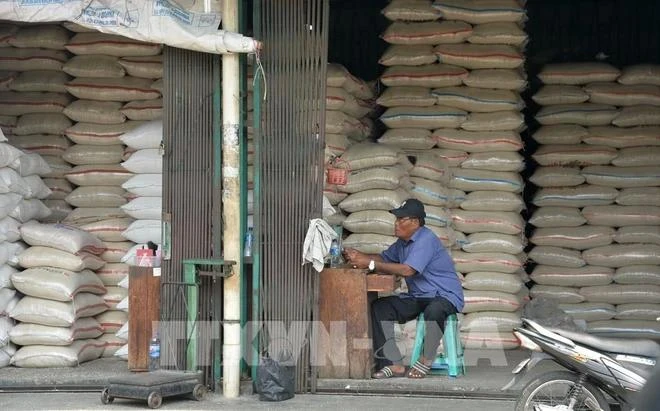
A rice shop in Jakarta, Indonesia (Photo: AFP/VNA)

Jakarta (VNA) – Indonesia is facing challenges in ensuring food security as its population is expected to continue to grow.

With a projected population increase of 50 million people over the next 20 years, Indonesia's food supply is likely to face serious shortages. This is partly due to a decline in soil quality and the number of farmers, leading to reduced yields and rising food prices.

According to data from the Indonesian National Logistics Agency (Bulog), the risk of a food crisis in the country is increasingly felt, especially with the decline in food production. The country's rice production from January to April 2024 decreased by 17.74% compared to the same period last year from 22.55 million tonnes to 18.55 million tonnes.

Indonesia's rice import plan for this year has been adjusted from the initial 2 million tonnes to 3.6 million tonnes, making it the second largest rice importer in the world after the Philippines, and becoming dependent on imported rice.

Despite its efforts in improving the situation, it seems that the Southeast Asian nation is still confused about the direction.

To reduce its dependence on food imports, Indonesia plans to invest in a producer instead of constantly importing rice from neighbouring countries to ensure sufficient rice reserves. Indonesia has also encouraged people to change their habit of consuming a lot of rice and replace it with other types of food available domestically.

However, experts held that in order to deal with the food security problem, the 280-million-strong country must promote domestic production.

They asserted that biotech seeds, produced through genetic engineering method, are a hope and answer to Indonesia's food problems, including food crisis. In the 1996-2018 period, biotechnology helped increase the value of agricultural production by up to 225 billion USD.

According to Indonesian biotechnology experts, adopting biotech seeds also allows farmers to reduce potential yield losses by up to 10%./.


VNA

See more

Indonesia restarts research reactor after nearly 14 years.

Indonesia restarts research reactor after nearly 14 years

Under its national energy development plan, Indonesia aims to commission its first nuclear power plants with a combined capacity of about 500 MW in the early 2030s, before expanding nuclear generation to 7-8 GW in the 2040s and 35-37 GW by the 2060s to diversify energy supplies and meet growing electricity demand.

An article published on July 9, 2026 by Auto Plus, one of France's leading automotive magazines, gives a positive assessment of VinFast's VF 2 mini electric car. (Photo published by VNA)

French magazine highlights VinFast's rapid growth

According to L'Automobile, VinFast sold 115,916 vehicles in the first six months of 2026, its highest figure since the company began operations. The result also made VinFast the first Vietnamese automaker to surpass 100,000 vehicle sales in the first half of a year.

Thailand–EU FTA talks advance in Brussels

Thailand–EU FTA talks advance in Brussels

The two sides agreed to expedite FTA negotiations and work toward resolving outstanding issues in agricultural products, industrial goods, government procurement, energy and raw materials, digital trade, and regulatory matters, including intellectual property.

Indonesia attracts 5.8 billion USD in foreign inflows after rate hikes

Indonesia attracts 5.8 billion USD in foreign inflows after rate hikes

Data from the central bank showed that after recording net foreign outflows in the first quarter of 2026, Indonesia's government bond market rebounded with net inflows of 17.7 trillion IDR. Meanwhile, cumulative foreign investment in Bank Indonesia Rupiah Securities reached 174 trillion IDR.

Firefighters strive to extinguish a forest fire in Kampar of Indonesia's Riau province on July 20, 2025. (Photo: Xinhua/VNA)

Indonesia strengthens forest fire prevention mechanisms

Under the approach, competent agencies will review existing regulations, strengthen inspections of fire prevention and firefighting systems, and implement measures including weather modification through cloud seeding, monitoring water levels in peatland areas, and pre-positioning personnel and equipment in high-risk locations.

Malaysia moves to enact landmark climate change law

Malaysia moves to enact landmark climate change law

Once passed, the bill will make Malaysia the second ASEAN country, after the Philippines, to enact a dedicated climate change law, and the 60th country in the world to have a standalone legal framework in this area.

Indonesia shifts strategy to combat online gambling

Indonesia shifts strategy to combat online gambling

Minister of Communication and Digital Affairs Meutya Hafid announced on July 14 that the new strategy marks a shift from focusing primarily on blocking gambling websites to a more comprehensive approach targeting the entire criminal ecosystem.

Passengers at the international airport in Bangkok, Thailand (Photo: Xinhua/VNA)

Thailand adjusts visa policy to balance tourism and security

The adjustments aim to ensure that entry facilitation measures for foreign visitors reflect current circumstances while closing security loopholes, preventing misuse, and reducing overlapping entitlements under the principle of “one country, one entitlement”.

​Indonesia's Finance Minister Purbaya Yudhi Sadew (Photo: VNA)

S&P retains Indonesia's BBB credit rating with stable outlook

According to S&P, Indonesia's economic fundamentals remain solid thanks to prudent fiscal and monetary policies, political stability, relatively low public debt compared with other countries in the same rating category, and positive medium-term growth prospects.

A port in Singapore. The country's GDP expanded by 5.7% year-on-year in the April–June period, easing from the 6.3% growth recorded in the first quarter (Photo: Xinhua/VNA)

Singapore's economic growth slows amid Middle East conflict

Singapore's core inflation remained unchanged at 1.4% in May from the previous month. However, economists warned that persistently high energy prices could continue to push up production and transportation costs, as well as the prices of imported goods, posing risks to the country's economic growth outlook.