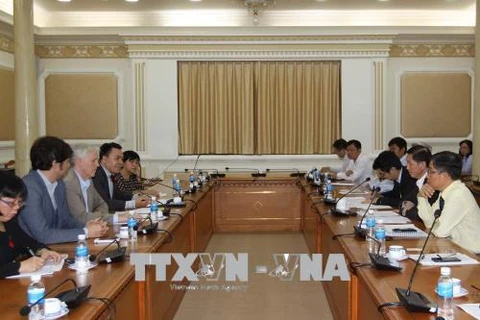
Prime Minister Nguyen Xuan Phuc speaks at the conference (Photo VNA)
 Hanoi (VNA) – The development of physical infrastructure as well as educational and health infrastructure is essential to improve the living standards of people across the country, Prime Minister Nguyen Xuan Phuc has said.
He made the statement at a conference in Hanoi on February 28 to review the implementation of the Communist Party of Vietnam Central Committee’s Resolution No.13-NQ/TW dated January 16, 2012 on building a synchronous infrastructure system in order to turn Vietnam into a modernity-oriented industrial country by 2020.
The resolution requires focusing investment on transport infrastructure, electricity supply, irrigation networks, climate change adaptation and urban development.
From 2012, the Government promulgated an action programme to realise this resolution.
PM Phuc recognised infrastructure development over the past years, but pointed out shortcomings in the field such as asynchronous planning and snail-speed implementation of some projects.
Poor infrastructure also hinders the country’s development with urgent issues like traffic congestions and hospital overload.
The supplementation, revision and reform of mechanisms and institutions are needed to develop infrastructure, the PM said, underlining the proposal of the Ministry of Planning and Investment to promote public-private partnership (PPP) form.
He noted that when the economic scale has increased to over 5 quadrillion VND (218 billion USD) and the public debt reduced to 61 percent, it is necessary to weigh measures to seek financial resources from official development assistance (ODA), Government bonds, and international bonds for infrastructure development.
Vietnam's public and private sector infrastructure investment averaged 5.7 percent of gross domestic product in recent years, the highest in Southeast Asia and compares with 6.8 percent in China, according to the Asian Development Bank. Indonesia and the Philippines spend less than 3 percent, while Malaysia and Thailand spend even less at under 2 percent.
The ADB estimates that emerging economies in the region will need to invest as much as 26 trillion USD through 2030 to build transport networks, boost power supply and upgrade water and sanitation facilities. Vietnam, among the fastest-growing nations in the world, is boosting infrastructure to lure more foreign investors as it positions itself as Asia's next Tiger Economy.
Vietnam needs about 480 billion USD through 2020 to construct 11 power plants with total capacity of 13,200 megawatts and about 1,380 kilometres of highways as well as carry out other environment, health and education projects.-VNA