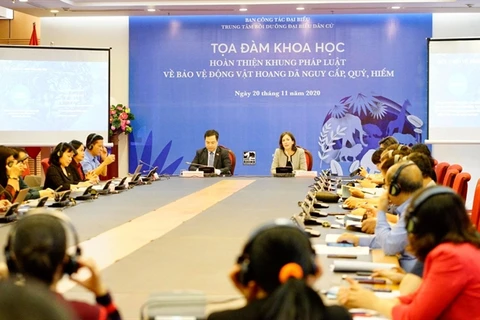
Sarah Ferguson, Director of TRAFFIC’s Vietnam office, speaks at the launching ceremony of a social marketing programme to reduce demand for tiger products in the country on December 10 (Photo: VNA)
 Hanoi (VNS/VNA) - Wildlife trade monitor network TRAFFIC on December 10 launched a three-year social marketing programme with an aim to reduce demand for tiger products in Vietnam.
The project will draw upon the latest in behavioural science to discourage the medicinal use of tiger products in the country, which is recognised as a main destination market for the illegal tiger trade.
“Vietnam has the power to make a huge impact on the future of tigers. This project will not only work to discourage tiger product consumption, but it will also seek to facilitate the country’s leadership on global conservation issues,” said Sarah Ferguson, Director of TRAFFIC’s Vietnam office.
The initiative will work to reduce individual consumption demand through a multimedia behaviour change campaign while calling on government partners, such as the National Assembly, Ministry of Health and the Central Party Committee of Communication and Education, to strengthen wildlife protection policies. Partners within the traditional medicine sector will be key project allies as they mobilise their peers against the prescription of illegal wildlife products and promote legal alternatives.
“We support this project as a positive effort to protect the reputation, credibility, and sustainable future development of the traditional medicine sector in Vietnam,” said Dr. Tran Xuan Nguyen, Head of Medical Professionalism Department of the Vietnam Oriental Traditional Medicine Association.
Despite legal protections for tigers, demand for tiger products in Vietnam remains strong, with a TRAFFIC consumer survey from 2017 finding that 6 percent of Vietnam’s urban population had used tiger products and that 64 percent of them would recommend tiger products to others. Tiger bone glue was revealed to be the most popular tiger product and will be the focus of the project.
The project is being funded by the UK government through the Illegal Wildlife Trade Challenge Fund./.
VNA