Investment for mega port project in Ba Ria - Vung Tau approved

The project will require an investment of over 2.38 trillion VND and will be implemented on a land area of approximately 41.65 hectares.

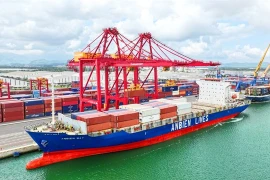
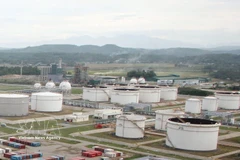
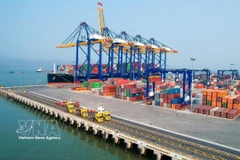
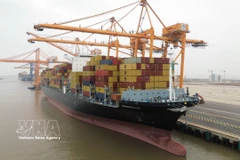
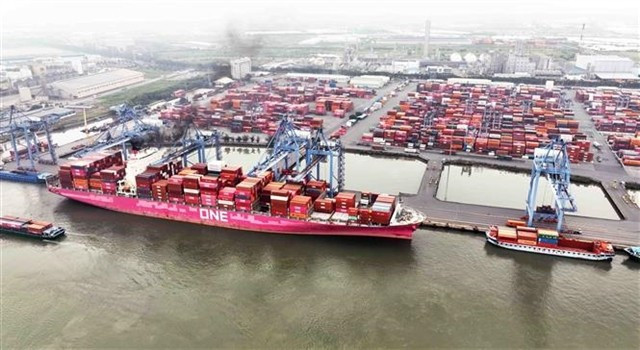
Cai Mep-Thi Vai International Port in the southern province of Ba Ria - Vung Tau. Illustrative image. (Photo: VNA)

Hanoi (VNS/VNA) - Deputy Prime Minister Tran Hong Ha has signed Decision No 650/QD-TTg, approving the investment policy for the Long Son My Xuan General Port Project, with a total investment of over 2.38 trillion VND (93.3 million USD).

Accordingly, the Long Son My Xuan General Port Project will be built in the Thi Vai port area in My Xuan ward, Phu My town, Ba Ria - Vung Tau province.

Its development is part of a broader plan to complete the Thi Vai port area in accordance with the approved master plan.

The project will require an investment of over 2.38 trillion VND and will be implemented on a land area of approximately 41.65ha.

The investor responsible for the project is Long Son Co., Ltd.

The construction of the general port aims to support economic activities, facilitate the operations of industrial zones within the province and surrounding areas and meet the growing demand for construction materials in the region.

Additionally, the project seeks to maximise the advantages of the region’s natural conditions, geographical location and ongoing transportation infrastructure developments. This will contribute to socio-economic growth in Ba Ria - Vung Tau province, as well as the southern region.

The Long Son My Xuan General Port Project will include a main berth with a length of 270m, capable of accommodating general cargo ships of up to 30,000 DWT, four barge berths with a combined length of 530m, capable of receiving ships and barges with a capacity of up to 7,500 DWT and a warehouse system and a cement grinding facility with a production capacity of 2.3 million tonnes per year.

Under the decision, the Ministry of Finance will be responsible for assessing the investment policy, providing recommendations and ensuring compliance with State management regulations in accordance with investment laws and relevant legal frameworks.

Other ministries, Government agencies and the People's Committee of Ba Ria - Vung Tau province will be responsible for evaluating the investment policy within their respective jurisdictions. Their assessments and approvals must comply with the Investment Law and other applicable legal provisions.

The provincial People's Committee is tasked with allocating land in accordance with the approved land-use plan, port development plans and regulations issued by competent authorities. This will ensure that the investor can implement the project in compliance with land laws.

The provincial People's Committee of Ba Ria - Vung Tau must ensure that sufficient land is allocated for reforestation efforts to maintain a balance between environmental protection and economic development.

The conversion of land for other purposes will only be permitted if all conditions specified in Article 19 of the Forestry Law are met. The local authorities must strictly protect forest areas designated for conversion and only allow land-use changes once all legal procedures are completed.

The People's Committee must also monitor and supervise the investor throughout the process of converting forest land for alternative uses. Additionally, they must oversee the project's implementation to ensure compliance with legal regulations, including financial mobilisation activities.

The Ministry of Construction is required to urgently approve the detailed zoning plan for port land and water areas in the province. This zoning plan will provide the legal foundation for project implementation. Furthermore, the ministry must guide the investor in reviewing and finalising project documentation for the feasibility study phase.

The Ministry of Agriculture and the Environment must assist and guide the People's Committee in matters related to land allocation, land leasing and the conversion of forest land for other uses. These processes must align with approved planning guidelines and legal regulations.

Additionally, the ministry must support the investor in completing the required environmental impact assessments. The investor must adhere to all environmental protection regulations, including those concerning water resource management, throughout the project’s implementation./.

VNA
See more

Thanks to digital transformation among local officials, Tam Dao commune of Phu Tho province has achieved an almost 100% on-time rate for processing administrative applications, helping improve public services for residents. (Photo: VNA)

Institutional reform fuels private sector's growth in Phu Tho province

The private sector is increasingly emerging as a key growth engine of the economy. To unleash its potential and ensure sustainable development, the northern province of Phu Tho is stepping up institutional and administrative reforms to cut costs, shorten procedures, and build a more transparent, business-friendly investment climate.

Hoa Phat Wharf inside the Dung Quat Economic Zone (Photo: VNA)

Dung Quat EZ, Quang Ngai IPs draw nearly 19.4 bln USD

The Dung Quat Economic Zone and Quang Ngai industrial parks have so far attracted 441 projects worth around 19.4 billion USD, according to the Dung Quat Economic Zone and Quang Ngai Industrial Parks Authority (DEZA).

The Kim Long Motor Hue factory (Photo: VNA)

Hue courts capital to turn industrial zones into growth engine

The economic and industrial zones in Hue city host more than 200 active investment projects worth over 152 trillion VND (5.84 billion USD), with 139 already operational. Since the start of 2026, they have generated about 32 trillion VND, contributed 4.2 trillion VND to the state budget and brought in 730 million USD in exports, while employing more than 46,000 workers.

Processing cashew nuts for export at Nguyen Thong Co., Ltd. in Dak Lak province. (Photo: VNA)

Vietnam’s exports to New Zealand post strong growth

According to the Customs Department, two-way trade reached 844 million USD in the first half of 2026, of which Vietnam’s exports to New Zealand totaled 399.7 million USD, up 18.8% year-on-year, while imports stood at 444 million USD.

Starting from September 2026, agricultural products from the Mekong Delta are expected to be transported directly from Cai Cui Port to Guangxi, China. (Photo: VNA)

Investing in logistics to boost agricultural production and exports

Logistics is increasingly becoming a major bottleneck for exports as transport costs rise and requirements for data management, low emissions and supply chain transparency become more stringent, requiring coordinated investment in logistics infrastructure, data infrastructure and transport capacity.

Harvesting rice in the Mekong Delta (Photo: VNA)

Vietnam seen as gateway for Canadian farm produce to ASEAN

As Canada steps up trade diversification and seeks to reduce its dependence on the North American market, Vietnam could serve both as a market for Canadian goods and a base for Canadian businesses to build production capacity and expand operations in the region.

Illustrative image (Photo: VNA)

Turkish cooperatives open sourcing channel for Vietnamese businesses

The Vietnam Trade Office recommended that Vietnamese businesses in agriculture and food actively study cooperative networks in different localities in Türkiye and consider them an additional channel for accessing raw materials, processing partners, and distribution networks.

Delegates at the signing ceremony (Photo: VNA)

VPI, Beicip-Franlab Asia deepen oil, gas cooperation

Under the MoU, VPI and Beicip-Franlab Asia will undertake advanced studies in geology, geophysics, and reservoir engineering to support exploration, field development, and oil and gas resource assessment.

A visitor explores Vietnamese coffee at the expo. (Photo: VNA)

Vietnam pushes coffee, farm produce at Hong Kong food expo

After nearly 200 years, especially since the Doi Moi (renewal) began in 1986, Vietnamese coffee is now exported to more than 100 countries and territories and supports about 2.6 million jobs. Vietnam remains the world’s second largest coffee exporter, holding roughly 19-21% of the global market, and is the top producer of Robusta coffee.