Japan helps improve medical equipment at national cancer hospital

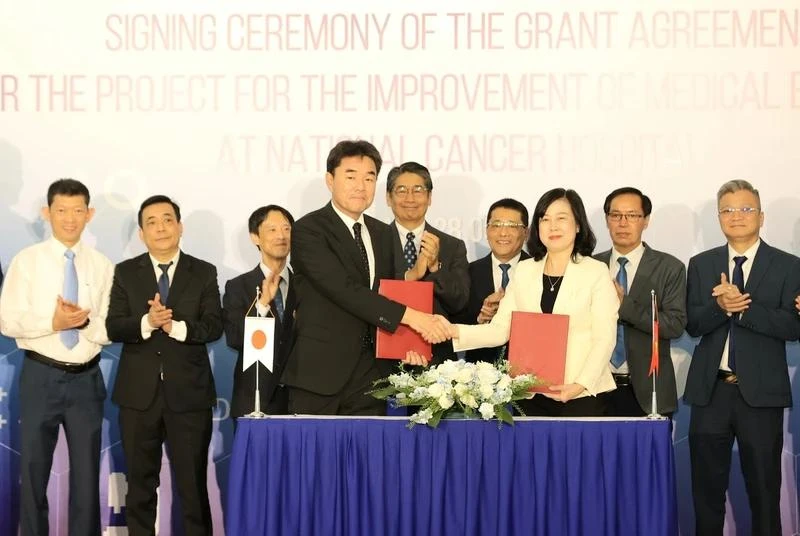
Health Minister Dao Hong Lan and Chief Representative of the Japan International Cooperation Agency (JICA) – Vietnam Office Sugano Yuichi on May 28 signed an agreement on grant worth 300 billion VND (11.78 million USD) for a project on improving medical equipment at National Cancer Hospital in Hanoi.

Health Minister Dao Hong Lan and Chief Representative of the Japan International Cooperation Agency (JICA) – Vietnam Office Sugano Yuichi at the signing ceremony. (Photo: nhandan.vn)

Hanoi (VNA) – Health Minister Dao Hong Lan and Chief Representative of the Japan International Cooperation Agency (JICA) – Vietnam Office Sugano Yuichi on May 28 signed an agreement on grant worth 300 billion VND (11.78 million USD) for a project on improving medical equipment at National Cancer Hospital in Hanoi.

Speaking at the signing ceremony, Lan thanked the Japanese Embassy in Vietnam, JICA and Japanese experts for their support to Vietnam's healthcare sector in the past time. She said she hopes the embassy and the agency will support the hospital to implement the project in the coming time.

The minister asked the hospital to closely cooperate with the Japanese side and relevant agencies to complete procedures, receive and use the equipment effectively.

In Vietnam, non-communicable diseases cause 77% of the total deaths each year, and cancer is the second leading cause.

According to estimates by the Global Cancer Organisation (GLOBOCAN), in 2022, Vietnam had more than 180,000 new cancer cases and about 120,000 deaths due to cancer./.

VNA

See more

Delegates at the conference. (Photo: VNA)

Vietnam to produce first homegrown next-generation vaccines from 2028

Under the agreement, Sanofi will transfer technology to VNVC to manufacture selected high-demand vaccines for children and adults at VNVC Vaccine and Bioproduct Plant. The first next-generation vaccines produced in Vietnam are expected to roll off production lines in 2028.

Eric and Alysha joyfully welcome their baby through Mini IVF after more than 10 years of waiting. (Photo: Hong Ngoc Phuc Truong Minh General Hospital)

Vietnam - a destination for journeys to parenthood

An increasing number of international families are choosing Vietnam for infertility treatment, embarking on journeys to parenthood that transcend geographical distance and differences in nationality.

Prime Minister Le Minh Hung delivers remarks at the inauguration ceremony for Viet Duc University Hospital's second campus in Ninh Binh province. (Photo: VNA)

PM urges modern restructuring of healthcare network

The PM stressed that throughout the country’s development process, people have consistently been regarded as the centre, the driving force, the objective and the most important resource for national development. Sustainable and rapid development requires not only a healthy, knowledgeable and skilled population but also a modern, equitable, efficient, sustainable and accessible healthcare system.

Thu Duc General Hospital, with a capacity of 1,000 beds, was inaugurated and put into operation in April 2025 (Photo: VNA)

Ho Chi Minh City moves to expand robotic surgery to gateway hospitals

According to the municipal Department of Health, developing gateway hospitals is a key pillar of the city's strategy to establish a regional specialised healthcare system. The network is designed to permanently relieve overcrowding at major downtown hospitals while strengthening strong inter-regional emergency care and treatment network.

Doctors conduct health screenings for children in Tru Van Tho commune, Ho Chi Minh City. (Photo :VNA)

Ho Chi Minh City moves closer to universal health check-ups

Achieving universal health check-ups in 2026 will lay the foundation for a new healthcare model in which every resident has an electronic health record, receives regular screenings, benefits from lifelong health management and gains access to early intervention through primary healthcare services.

Illustrative photo: Internet

Dengue cases rise, outbreaks become more unpredictable

Vo Hai Son, Deputy Director of the ministry's Administration of Disease Prevention, said dengue fever is no longer following previous epidemiological trends. In 2025, infections remained elevated through November and December rather than declining at the end of the year as had traditionally been the case, indicating a shortening outbreak cycle.