Kien Giang: Endangered species need protecting

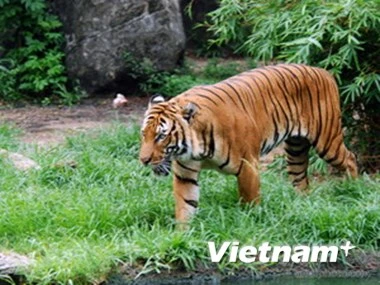
As many as 21 animals and one plant in the southern province of Kien Giang have been classified as endangered species that need to be better protected.
Kien Giang: Endangered species need protecting ảnh 1White-cheeked douc langur is among the endangered species that need to be better protected (Photo: khoahoc.tv)

Kien Giang (VNA) – As many as 21 animals and one plant in the southern province of Kien Giang have been classified as endangered species that need to be better protected, according to the provincial Department of Agriculture and Rural Development.

The threatened species include the hopea pierrei (Phu Quoc district), flying lemur, white-cheeked douc langur, European otter, sirenia, great hornbill, king cobra, yellow-cheeked gibbon, sun bear, Asian black bear (Hon Dat district), sunda slow loris, pygmy slow loris, hawksbill sea turtle, olive ridley sea turtle (Hon Dat and Phu Quoc districts), hairy-nosed otter, fishing cat, darter and woolly-necked stork (U Minh Thuong district), oriental small-clawed otter, sunda pangolin, lesser adjutant and sarus crane (Hon Dat and Giang Thanh districts).

The province needs to set up scientific research and preservation programmes with the involvement of State and local authorities, aiming to manage and protect endangered species while conserving biodiversity, said Department Vice Director Quang Trong Thao.

The provincial authorities also detected some species belonging to primates, testudines and squamata and recommended them be added to the list of rare animals that need prioritised protection. That list comprises the crab-eating macaque (Hon Dat and Phu Quoc districts), macaca nemestrina, Mekong snail-eating turtle, yellow-headed temple turtle, Bengal monitor (Hon Dat district) and Indochina silver langur (Kien Luong district).

Vietnam’s first safari zoo, featuring more than 150 rare and endangered species, opened late last year on Phu Quoc Island.

The zoo’s unique natural environment is also home to 200 flamingoes, 100 rhinos and 60 giraffes. It is the only place in Vietnam breeding large numbers of wildlife herds.

The safari zoo will strengthen wildlife preservation and environmental protection through scientific research conducted in the park.-VNA
VNA

See more

Sunda pangolins (Manis javanica), also known as the Javan pangolin, are listed in Group IB – critically endangered and strictly protected from all commercial exploitation (Photo: VNA)

Quang Ngai releases rare pangolin back into nature

Initial verification showed that the animal weighed 3.7kg and measured over 60cm. It was identified as a Sunda pangolin (Manis javanica), also known as the Javan pangolin, listed in Group IB – critically endangered and strictly protected from all commercial exploitation.

Residents of Tuyen Quang province take part in the One Billion Trees Programme. (Photo: VNA)

Tree-planting programme exceeds one-billion-tree goal

The total comprises 573.9 million scattered trees and 865.2 million trees grown in concentrated plantations, equivalent to 429,125 hectares of forest. Provinces posting the strongest results include Phu Tho with 177.9 million trees, Lao Cai with 108.8 million, and An Giang with 98.5 million.

Construction activity is one of the causes of air pollution in Hanoi. (Photo: VNA)

Hanoi takes urgent measures to curb air pollution

The city requires the enhanced application of advanced technologies and remote monitoring systems, including satellite remote sensing, drones, and AI-integrated traffic cameras, to monitor, detect, and strictly address the illegal burning of garbage, straw, and agricultural by-products.

The World Bank delegation holds working session with Can Tho city People's Committee and relevant units (Photo: VNA)

World Bank delegation surveys Can Tho urban resilience project

The project is jointly financed by the WB with up to 250 million USD and a 10-million-USD non-refundable grant from the Swiss State Secretariat for Economic Affairs (SECO), along with counterpart funding from the Vietnamese Government. Its goal is to build a climate-resilient and sustainable city that can drive socio-economic growth across the Mekong Delta, mitigate flood vulnerability in central Can Tho, and improve inter- and intra-regional transport connectivity.

The direction of Storm Koto as of 04:00 on November 27. (Photo: VNA)

Lam Dong province’s coastal localities brace for Storm Koto

Local authorities have activated round-the-clock duty operations, continuously updated storm warnings and flood information and intensified inspections of riverside and seaside areas, low-lying zones, and locations at high risk of landslides and deep flooding.

Border guard officers at Ky Ha Port Border Gate are assisting residents in securing their boats. (Photo: VNA)

VPA General Staff directs urgent response to Storm Koto

Military Regions 4, 5 and 7 were tasked with directing provincial military commands to advise local authorities, review response plans, and coordinate with relevant departments and sectors to identify disaster-prone areas, including locations at risk of flash floods, landslides, major dykes, embankments and reservoirs, and flood-prone zones, particularly those heavily affected by recent rains.

In 2024–2025, the project has implement seven pilot models in Can Tho city and the provinces of Vinh Long, Dong Thap, and An Giang. (Photo: VNA)

One-million-hectare high-quality, low-emission rice project changes mindset of producers

A project on sustainable development of one million hectares of high-quality, low-emission rice cultivation associated with green growth in the Mekong Delta by 2030 has so far helped shift the awareness and mindset of rice producers toward greater responsibility and toward adopting production trends aligned with global orientations for “green development.”

Two rangers check a camera trap in jungle of the Saola Nature Reserve in Hue city. (Photo: VNA)

Vietnam’s forests show signs of wildlife recovery

Vietnam’s forests are among the world’s most biodiverse, yet wildlife remains threatened by habitat loss and snaring. A new WWF-Vietnam survey, using 350,000 camera-trap days across 21 forests, reveals urgent conservation needs and signs of recovery.