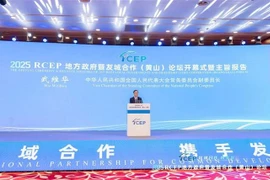
Hanoi (VNA) - After four years of implementation, the Regional Comprehensive Economic Partnership (RCEP) has made an important contribution to boosting Vietnam’s exports of agricultural, forestry and fishery products amid strong fluctuations in global trade flows.
Accounting for nearly 30% of global GDP and population, RCEP is currently regarded as the world’s largest free trade area, opening up vast market space for the country’s agro-forestry-fishery products.
According to Le Hang, Deputy Secretary General of the Vietnam Association of Seafood Exporters and Producers (VASEP), seafood exports to RCEP markets now account for more than 50% of the sector’s total export value. In 2025, seafood exports to China alone exceeded 2.2 billion USD, up about 33% compared to 2024. Shipments to Japan fetched nearly 1.7 billion USD, a year-on-year increase of 14.6%, while those to the Republic of Korea and Australia grew by 9.6% and 3.2%, respectively.
Besides, fruits and vegetables have also recorded rapid growth in RCEP markets. Data from the Vietnam Fruit and Vegetable Association shows that China remains the largest market, accounting for about 65% of total exports, with turnover exceeding 5 billion USD in 2025.
Notably, fruit and vegetable exports to Malaysia surged by nearly 80%, while those to Australia rose by around 30%. Many businesses attribute this growth to RCEP’s flexible rules of origin, which have significantly facilitated exports.
Unlike several other free trade accords that require products to have purely domestic origin to qualify for tariff preferences, RCEP allows for regional cumulation. Accordingly, agro-forestry-fishery raw materials imported from one or more RCEP member countries can be processed in Vietnam and still qualify for certificates of origin to enjoy preferential tariffs.
However, exports to the RCEP region have also revealed new bottlenecks, particularly as imports have slowed or declined in some ASEAN markets.
Nguyen Chanh Trung, Director of Hung Viet Rice Co., Ltd., noted that rice exports in 2025 no longer maintained the strong growth seen in previous years, as key markets such as Indonesia and the Philippines sharply reduced imports, a trend expected to continue.
To better leverage RCEP advantages, enterprises need to shift towards markets such as Japan, the Republic of Korea and China with high-quality rice, specialty rice and deeply processed rice products.
Another major challenge lies in the high similarity in product structures among RCEP members, leading to increasingly intense competition. Vietnam faces direct competition from Thailand, Malaysia, the Philippines, Laos and Australia in products traditionally seen as its strengths, including rice, seafood and tropical fruits.
According to the Agency of Foreign Trade under the Ministry of Industry and Trade, while Thailand and Vietnam dominate most of China’s durian market, Malaysia, Myanmar and Laos are rapidly expanding exports, particularly in processed segments. For pomelo, Laos has emerged as China’s largest supplier, while Vietnam, despite its abundant supply, has yet to achieve a corresponding position.
Within the RCEP space stretching from Northeast Asia and Southeast Asia to Australia, Vietnam’s agricultural exports still have considerable room for growth. However, each market operates with distinct characteristics, requiring enterprises to adopt more targeted strategies by product segment and partner, rather than a uniform approach. China offers a vast but highly competitive market; ASEAN is undergoing demand and supply restructuring; while Australia and New Zealand impose high standards and require long-term commitments.
If these differences are properly understood, the advantages of RCEP will extend beyond tariff preferences and geographic scope to encompass market adaptability, value-chain-based production capacity, and the real competitiveness of each export./.