London - a key destination in President Ho Chi Minh’s 30-year journey abroad

President Ho Chi Minh’s stay in London was the very outset of his revolutionary career, which had a profound effect on him, especially the development of his own thinking, British historian John Callow told the Vietnam News Agency (VNA)’s correspondents in the UK on the occasion of the late leader's 133th birth anniversary (May 19,1890 - 2023).
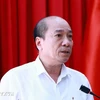
London - a key destination in President Ho Chi Minh’s 30-year journey abroad ảnh 1British historian John Callow (Photo: VNA)
London (VNA) – President Ho Chi Minh’s stay inLondon was the very outset of his revolutionary career, which had a profoundeffect on him, especially the development of his own thinking, Britishhistorian John Callow told the Vietnam News Agency (VNA)’s correspondents inthe UK on the occasion of the late leader's 133th birth anniversary (May19,1890 - 2023).

According to the historian, as part of his greatjourney, in May 1914, President Ho Chi Minh, called Nguyen Tat Thanh at that time, came to London - the power centre of imperialism, the financialcentre of capitalism and the capital of a system that stretched to India throughAfrica. The UK, at that time, was still the workshop of the world, withenormous fleets and armies.

President Ho Chi Minh wanted to learn about secrets ofimperialism, and to have a sense of the developed industrial world. There hadbeen risings against imperialists, colonists and capitalism, but these had allfailed. President Ho Chi Minh wanted to understand reasons behind thosefailures and find out different patterns to development for Vietnamese peopleas a nation.

He arrived in London at time of great industrialunrest with a lot of strikes, such as the one in Liverpool and the Irishpeople’s rising in 1916 to fight for their own independence. According to Callow,this was a crucial period that affected President Ho Chi Minh enormously.

When in London, the President first took a jobshovelling snow in a school playground in the incredibly cold. He then moved toDrayton Court Hotel on the railway line, further to the east, before working atthe Carlton Hotel, where the President washed dishes, and later became askilled worker under the wing of the great pastry chefs. Here he saw the gulfthat separated the rich from the poor.

He was shocked at the waste that therich who ate here, throwing out whole chickens or whole sides of steak. Hecollected these together, and every night dispersed them to the poor who waitedat the back of the building here for something to eat. While being here, PresidentHo Chi Minh joined an organised labour association that brought togetherChinese, Lao and Vietnamese workers.

The British historian said much of what we know about PresidentHo Chi Minh in this period comes from the postcards he sent to his friends andcomrades in Paris, three of which had got intercepted.

The French police’s records also showed reports on aVietnamese worker in London joining the movement of trade unionists. Accordingto Callow, President Ho Chi Minh probably lived in a little flat just at theback of Tottenham Court Road as the French police intercepted some of hiswritings and had the English police raid the address. But he was long gone bythen.

At that time, the British labour movement was verywell developed with a lot of socialist writings. President Ho Chi Minh got alot of social socialism journals, so it was probably the first time heencountered the work of Karl Marx in London.

Callow pointed out that President Ho Chi Minh waswalking in the footsteps of the father of modern socialism.

What he got from Marx would be an explanation for allthe things he saw in this period, the historian said, adding this was thebedrock of the President’s political economy and thought.

But at the very same time, President Ho Chi Minh leftBritain just after the 1917 revolution in Russia and was also incrediblyinfluenced by Lenin's work on the colonial peoples.

Callow said the brilliance of President Ho Chi Minhwas looking at the founders of scientific socialism, of Marx and Angles, butthen updating what they were saying and combining with the new thoughts ofLenin that spoke directly to the peasant workers and peoples of the world anddirectly had an impact on a country like Vietnam which was colonised,brutalised under the thumb of the great trading companies.

The historian said the greatness of Ho Chi Minh washis ability not to follow ideas for their own sake, but to take ideas, tocreate and develop them, and to never lose sight of the need for the nationalliberation of the Vietnamese people to make their lives better, healthier,happier, more decent.

Speaking of President Ho Chi Minh’s thought, Callowsaid its greatness lied with its adaptability, its refusal to turn Marxism intoa dogma, into something to be worshipped, to be nodded at, but to make itapplicable in Vietnam, to never lose sight of the revolutionary conditions.

The President thought every day and every night aboutachieving his goal of revolution, and to have a revolution that would be reallyworthwhile to sweep away the empires that dominated the fates and the lifechances of the Vietnamese people and to put something better and brighter intheir place.

Callow noted that President Ho Chi Minh took the besttraditions of Vietnamese culture, of it's amazing ancient society that existedlong before the City of London, but put it within new times.

His thought gave the Communist Party of Vietnam theadaptability that led them to Doi Moi (Reform).

Speaking of personal qualities of President Ho ChiMinh that made him an outstanding leader, Callow said alongside his enormouspolitical qualities for organisation and inspirational leadership, there wasalso the essential simplicity of the President.

“He had an amazing intellect but he had never lost hiscontact with the people, whether it was the people of London or small farmersof Vietnam that he spoke to directly. He never lost sight of the peoplethemselves and did not let power go to his head. He did not set himself apartfrom the people. He understood the people and was a part of the people, but wasa leader of the world in the true sense,” the historian said.

“He was humble, quiet and unassuming, and brave andhad enormous dignity at the same time. His poetic Prison Diary gave a sense ofthe man himself. His humanity, his calmness under great stress, his creativitythat he used in jail turned out a work of art, a work of poetry and a work tofire the imagination of his comrades in the underground movement.”

The historian concluded that President Ho Chi Minh wasa great world figure who could combine intellect with passion, with decency,with the sense of a man who was absolutely incorruptible and put the people ofhis own nation before everything else in his life. And his work, while it isart or politics, was always there first and foremost at the service of thepeople./.
VNA

See more

National Assembly President Tran Thanh Man speaks at a meeting with Korean friends in Seoul on September 6. (Photo: VNA)

National Assembly President meets Korean friends in Seoul

National Assembly (NA) President Tran Thanh Man stressed that Korean non-governmental organisations, associations, scientists and businesses have contributed significantly to major achievements recorded in Vietnam-RoK relations over the past years.

An overview of the meeting between Prime Minister Le Minh Hung and a delegation of Japanese localities in Hue city on September 6. (Photo: VNA)

Local cooperation a distinctive feature of Vietnam-Japan relations: PM

Prime Minister Le Minh Hung emphasised that local collaboration is an important and distinctive feature of Vietnam-Japan relations, and that the Vietnamese Government considers it a practical and effective channel that contributes to the overall development of bilateral ties.

National Assembly President Tran Thanh Man and his spouse meet with Vietnamese Embassy officials and staff, and representatives of the Vietnamese community in the Republic of Korea in Seoul on September 6. (Photo: VNA)

NA President meets Vietnamese community in RoK

The NA President called on Vietnamese people in the RoK to continue strengthening solidarity, abiding by local laws, and contributing to the host country and bilateral ties, while preserving the Vietnamese language, national cultural identity and traditions.

Myanmar President Min Aung Hlaing and his spouse, Kyu Kyu Hla, lay a wreath at the Monument to Heroic Martyrs on Bac Son Street in Hanoi. (Photo: VNA)

Myanmar President concludes official visit to Vietnam

The visit contributes to strengthening political trust and creating momentum for increasingly substantive and effective cooperation between the two countries, for the benefit of their peoples and development, while contributing to peace, stability and development in the region.

National Assembly President Tran Thanh Man and his spouse Nguyen Thi Thanh Nga arrive in Seoul on the afternoon of September 6 (local time), beginning an official visit to the Republic of Korea. (Photo: VNA)

National Assembly President begins official visit to RoK

The visit aims to promote parliamentary diplomacy between the two countries, contributing to breakthroughs in economic, trade and investment cooperation, particularly by making effective use of the new pillar of science and technology collaboration.

Vietnamese National Assembly President Tran Thanh Man and then-RoK National Assembly Speaker Woo Won Shik sign memorandum of understanding on cooperation between the two legislatures in 2025. (Photo: VNA)

Parliamentary diplomacy helps strengthen Vietnam–RoK comprehensive strategic partnership

The official visit to the Republic of Korea (RoK) by National Assembly President Tran Thanh Man affirms the consistent importance that the Party, State and NA of Vietnam attach to the bilateral Comprehensive Strategic Partnership. It is not only aimed at strengthening political trust, but also at discussing specific measures to translate high-level agreements into concrete outcomes.

National Assembly (NA) President Tran Thanh Man and his spouse, Nguyen Thi Thanh Nga, leave Hanoi on September 6 for official visits to the Republic of Korea (RoK) and Mongolia. (Photo: VNA)

NA President departs for official visits to RoK, Mongolia

The visits affirm Vietnam's commitment and desire to further advance its comprehensive strategic partnership with the RoK and comprehensive partnership with Mongolia in an increasingly substantive, effective and sustainable manner.

General Secretary of the Communist Party of Vietnam Central Committee and President To Lam, Myanmar President Min Aung Hlaing and their spouses in a joint photo with artists at the banquet in Hanoi on September 5 evening (Photo: VNA)

Vietnam–Myanmar cooperation to enjoy new, more substantive strides: Top leader

General Secretary and President To Lam expressed firm belief that building on the fruitful outcomes of their talks and driven by the joint determination of both countries’ leaders and peoples, the Vietnam–Myanmar Comprehensive Cooperative Partnership will record new strides that are more comprehensive, effective, and substantive.

General Secretary of the Communist Party of Vietnam Central Committee and President To Lam (right) receives outgoing Bangladeshi Ambassador Mohammad Lutfor Rahman on September 5. (Photo: VNA)

Top leader receives outgoing Bangladeshi ambassador

Reviewing bilateral ties over the ambassador's tenure, General Secretary and President To Lam noted that more than 50 years since diplomatic relations were established, Vietnam–Bangladesh ties have continued to develop steadily, with high political trust and mutual support at regional and international forums.

Prime Minister Le Minh Hung (right) meets with Myanmar President Min Aung Hlaing in Hanoi on September 5. (Photo: VNA)

PM Le Minh Hung meets with Myanmar President

The two leaders pledged to push for the early resumption of key cooperation mechanisms such as the joint sub-committee on trade cooperation, the security dialogue, and the joint working group on bilateral defence cooperation, thereby creating new momentum for the Vietnam–Myanmar Comprehensive Cooperative Partnership.

Standing Deputy Minister of Foreign Affairs Nguyen Minh Vu (Photo: Ministry of Foreign Affairs)

Vietnam seeks fresh momentum for relations with RoK, Mongolia

The trips, scheduled for September 6–11, are significant to implementing the foreign policy set out by the 14th National Party Congress and Politburo Resolution No. 06-NQ/TW, while concretising the orientations and agreements reached by Vietnam's senior leaders with the two partners.

Vietnamese Ambassador to Mongolia Nguyen Tuan Thanh (Photo: VNA)

Fresh momentum for Vietnam’s cooperation with RoK, Mongolia

The NA leader’s official visits to the RoK and Mongolia are expected to be resounding successes, ushering in a new phase of development that is stronger, more substantive, and more enduring, thereby meeting the aspirations of the leaders and peoples of all three nations.