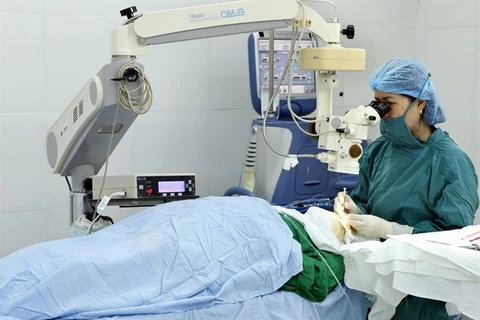
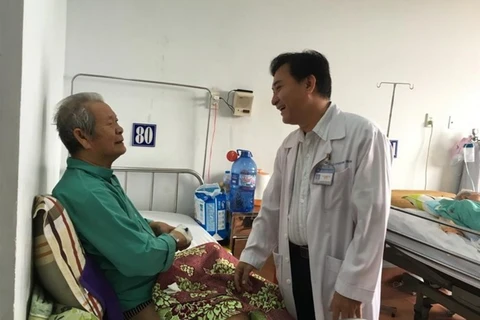
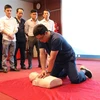
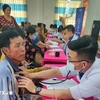
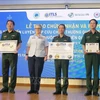
Illustrative image (Source: VNA)
 HCM City (VNA) – Minister of Health Nguyen Thi Kim Tien announced a set of measures to enhance the quality of health care services at commune-level medical stations during an event on July 16.
These include improving the capacity of medical workers; finding new operation methods; investing in human resources and facilities; applying information technology; designing special financial regimes; and enhancing communication work, said Tien at the opening of a training course on chronic disease care at commune-level medical stations held in Ho Chi Minh City.
In the future, services for the treatment, control, and prevention of non-communicable chronic diseases – like diabetes, high blood pressure, cardiovascular, and respiratory diseases – will be predominantly delivered by medical stations at ward and commune levels.
A large network of ward- and commune-level medical stations have been set up across the country but the health sector has yet to make the most of them, she said, adding that it is a waste of resources as upper-level hospitals are becoming more overcrowded.
“This is the time we have to develop primary care services to make drastic changes to the health sector,” the minister stated.
Tien moved on to suggest that ward- and commune-level medical clinics need to pay more attention to developing traditional medicine in order to make it one of their special advantages. She expected that such primary care providers will win public trust with an increasing number of people visiting them over the next 10 years.
Also speaking at the event, Director of the HCM City Department of Health Nguyen Tan Binh said the city is striving to have at least two doctors in each medical station, with larger ones having up to four or five doctors.
The city is also the first in the country to establish satellite practices for district-level hospitals at a number of the city’s ward and communal medical stations, aiming to ease the overcrowding at higher-level health facilities and get people more confident in the primary care system, he added.
According to the Ministry of Health, Vietnam is aiming at having over 90 percent of the population’s health monitored, with 95 percent of the ward- and commune-level medical stations capable of providing preventative and treatment services for a selection of non-communicable diseases by 2025.
To this end, the ministry has opened a number of training courses on improving the quality of family medicine-based care services for chronic diseases at ward- and commune-level medical clinics across the country. Hanoi and HCM City are the first two launching this course.
The course opened in Hanoi on July 9 while others will take place in provinces, such as Ninh Binh, Thanh Hoa, and Ca Mau.-VNA
These include improving the capacity of medical workers; finding new operation methods; investing in human resources and facilities; applying information technology; designing special financial regimes; and enhancing communication work, said Tien at the opening of a training course on chronic disease care at commune-level medical stations held in Ho Chi Minh City.
In the future, services for the treatment, control, and prevention of non-communicable chronic diseases – like diabetes, high blood pressure, cardiovascular, and respiratory diseases – will be predominantly delivered by medical stations at ward and commune levels.
A large network of ward- and commune-level medical stations have been set up across the country but the health sector has yet to make the most of them, she said, adding that it is a waste of resources as upper-level hospitals are becoming more overcrowded.
“This is the time we have to develop primary care services to make drastic changes to the health sector,” the minister stated.
Tien moved on to suggest that ward- and commune-level medical clinics need to pay more attention to developing traditional medicine in order to make it one of their special advantages. She expected that such primary care providers will win public trust with an increasing number of people visiting them over the next 10 years.
Also speaking at the event, Director of the HCM City Department of Health Nguyen Tan Binh said the city is striving to have at least two doctors in each medical station, with larger ones having up to four or five doctors.
The city is also the first in the country to establish satellite practices for district-level hospitals at a number of the city’s ward and communal medical stations, aiming to ease the overcrowding at higher-level health facilities and get people more confident in the primary care system, he added.
According to the Ministry of Health, Vietnam is aiming at having over 90 percent of the population’s health monitored, with 95 percent of the ward- and commune-level medical stations capable of providing preventative and treatment services for a selection of non-communicable diseases by 2025.
To this end, the ministry has opened a number of training courses on improving the quality of family medicine-based care services for chronic diseases at ward- and commune-level medical clinics across the country. Hanoi and HCM City are the first two launching this course.
The course opened in Hanoi on July 9 while others will take place in provinces, such as Ninh Binh, Thanh Hoa, and Ca Mau.-VNA
VNA