Minister: Vietnam’s e-commerce is growing fast in 4IR

Vietnam’s e-commerce sector is growing at a rate of 35 percent a year and predicted to be worth 10 billion USD by 2020.
Minister: Vietnam’s e-commerce is growing fast in 4IR ảnh 1Minister of Industry and Trade Tran Tuan Anh (Photo: VNA)

Hanoi (VNA) – A senior trade official has said that Vietnam’s e-commerce sector is growing at a rate of 35 percent a year and predicted to be worth 10 billion USD by 2020 and that to make this ambitious forecast a reality, a far-reaching domestic approach is essential.

“Vietnam has made it overall national strategies to develop digital market and e-commerce,” Minister of Industry and Trade Tran Tuan Anh told a session on Digital Markets and Global Opportunity that took place on September 13 in Hanoi as part of the ongoing 27th World Economic Forum on ASEAN. “We ensure open environment for all individuals to take part in e-commerce, digital markets,” Anh added. 

According to the minister, Vietnam needs to strike a balance in strategy for development, infrastructure and workforce training.
 
While the foundations are in place, with communication infrastructure covering almost 90 percent of the country, internet users still only make up around 55 percent of Vietnam’s population.

Once internet penetration is achieved across the region, the next step is for owners of small and medium-sized enterprises (SMEs) to learn how to move their business from offline to online.

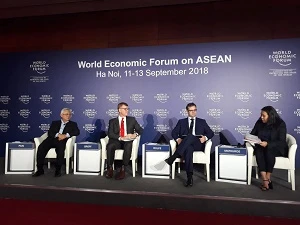
The session saw a panel discussion on how ASEAN digital market drives inclusive growth through building growth in e-commerce, expanding trade in services, and facilitating cross-border data flows.

The panel participants also included Toby Edwards, Chief Executive Officer, Shipa Freight, United Arab Emirates; Gerry A. Mattios, Expert Vice-President, Bain & Company, Singapore; and Bharathi Viswanathan, Chief Information Officer, Asia-Pacific Group, the Coca-Cola Company, Singapore.

Panelists agreed inclusive internet access, education and cross-border collaboration are needed to propel Asia’s digital market into the global economy.
  
Chief Information Officer Bharathi Viswanathan explained that many of the thousands of “mom-and-pop cafes” all over ASEAN have found their businesses disrupted by the region’s numerous food delivery apps.

While they now have access to a much wider base of consumers, they are also facing the challenge of navigating digital platforms and baffling algorithms.

By teaching business owners how to use the platforms and attract customers with combo deals, the global beverage brand is turning the disruption to both their advantage.

“For me it’s about creating shared opportunity which creates a good future for everyone. It’s us and them and the platforms,” said Viswanathan.
 
Also helping to educate a new generation of digital entrepreneurs is the team behind Shoppy, a Singapore-based online marketplace. The company has set up the Shoppy University, teaching would-be sellers everything from how to take promotional photos of their products to how to utilize inventory management tools.
 
Santitarn Sathirathai, Group Chief Economist of Shoppy’s umbrella company Sea, said building digital fluency from the ground-up is a win-win situation. “It’s about empowering the sellers, wherever they are in the world,” Santitarn Sathirathai said.

But barriers in the global digital trade still exist. Toby Edwards, Chief Executive Officer of Shipa Freight, a digital logistics platform based in the United Arab Emirates, said their in-house survey of 800 SMEs in eight countries revealed that 94 percent have difficulties when shipping their products abroad. 
 
While his company works to minimise the barriers by making the numerous regulatory documents needed for international trade available online, Edwards said that he believes trust across borders and a simplification of the process is essential for the digital economy to reach its full potential.

“Trade follows the path of least resistance,” he told the participants. “As a country, the easier you make it to do business the more business you will attract.”

To achieve such streamlining, governments must shed their fear of sharing data and foster collaboration, said Gerry A. Mattios, Expert Vice-President of Bain & Company, a firm specialising in global supply chain solutions.

“We believe, based on our research, that the issue of data is similar to the issue of trade. The lower the borders and barriers the better it will be for the economy,” he said. “It’s almost impossible to have cross-border trade without data. It’s like trying to fly without wings. You won’t get very far.”-VNA
VNA

See more

An overview of the seminar entitled "Opportunities and challenges for market development in Turkish market" (Photo: Ministry of Industry and Trade)

Türkiye offers export potential for Vietnamese food producers: seminar

Türkiye’s target of lifting total exports of goods and services to more than 400 billion USD in 2026 could create additional opportunities for Vietnamese agricultural products, food and beverages, said Ta Manh Cuong, director of the Trade and Investment Promotion Support Centre.

SSC Vice Chairman Bui Hoang Hai speaks at the opening of the programme on July 21. (Photo: VNA)

Vietnam boosts crypto market oversight capabilities

Diederik Van Wersch, Chainalysis' ASEAN Regional Director, noted that Vietnam has a high level of crypto asset adoption, offering significant opportunities for innovation while creating greater demands for oversight and risk management.

Vietnam Railways has introduced a range of tourism, heritage and dedicated train services, attracting growing numbers of passengers. (Photo: VNA)

Railways reinvent themselves with tourism, heritage trains

One of the most notable successes is the premium Hoa Phuong Do (Flamboyant Flower) train operating between Hanoi and Hai Phong city. Since entering service in May 2025, the train has completed nearly 3,000 trips and carried around 1.33 million passengers.

Representatives of relevant parties witness the arrival of the shipment. (Photo: VNA)

First Czech pork shipment officially enters Vietnamese market

A Czech diplomat described the arrival of the first container as the successful outcome of a long and complex market-opening process involving years of negotiations, regulatory approvals and close cooperation between Czech and Vietnamese authorities.

A view of financial buildings in downtown Ho Chi Minh City along the Saigon River. (Photo: VNA)

HSBC: Vietnam’s growth, macroeconomic stability to face tougher test in H2

In a recently released report, Vu Binh Minh, CFA, Associate Director, FX Trading, Markets and Securities Services at HSBC Vietnam, said Vietnam’s economy has built a relatively favourable position in the first six months of the year with GDP expanding 8.18% – the highest first-half growth rate in recent years – as key growth drivers have operated in tandem.

Ha Tay Shoes has secured numerous export orders from the US and European markets. (Photo: VNA)

CPTPP strengthens free trade, expands global economic connectivity

Since taking effect, the CPTPP has significantly expanded Vietnam's access to major markets across North America, the EU, and the Asia-Pacific, contributing to strong export growth in key sectors such as textiles and garments, footwear, and agricultural, forestry and fishery products. The agreement has also encouraged greater investment into Vietnam by promoting regional production networks and clearer rules of origin.

Tan Mingming, Deputy Director of the Foreign Affairs Office of the Dezhou Municipal People’s Government. (Photo: VNA)

Chinese firms put Vietnam on expansion radar

Tan Mingming, Deputy Director of the Foreign Affairs Office of the Dezhou Municipal People’s Government, told Vietnam News Agency reporters that the city has spent years deliberately tightening its links with the Association of Southeast Asian Nations (ASEAN), with Vietnam seen as a key partner.

A perspective of the Viettel Military Industry and Telecoms Group's high-tech semiconductor chip manufacturing plant at Hoa Lac Hi-Tech Park. (Photo: Viettel)

Hanoi builds momentum as Vietnam's semiconductor hub

As Hanoi continues to strengthen its semiconductor ecosystem, the city is creating a new growth driver for both the capital and the country, enhancing Vietnam's technological capabilities and paving the way for deeper integration into the global semiconductor value chain.

Clams are processed for export at the factory of Thanh Hoa Seafood Import-Export JSC in Thanh Hoa province. (Photo: VNA)

Vietnam steps up export to achieve 550-billion-USD target

Against a backdrop of persistent uncertainty in global commerce, the Government is implementing a broad range of measures to strengthen export growth during the remainder of the year. These include expanding overseas markets through economic diplomacy, maximising the benefits of free trade agreements (FTAs), streamlining administrative procedures, reducing logistics costs, improving access to credit and helping businesses overcome trade barriers. Authorities are also encouraging deeper processing, official cross-border exports and greater market diversification to improve the competitiveness of Vietnamese products.

A hydroponic vegetable garden in Nguyet Hoa ward operated by Green Farm Co., Ltd. (Photo: VNA)

Incentive policies for high-tech agricultural zones

Under Decree No. 263/2026/ND-CP, qualified projects are given priority to participate in State support programmes as well as funds and policies on research and development, technological innovation, technology transfer, human resource training, investment promotion and trade promotion.