Mormon Church representative committee recognised

The Government Committee for Religious Affairs on May 31 officially recognised the Representative Committee of the Church of Jesus Christ of Latter-day Saints Vietnam.
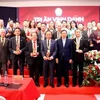
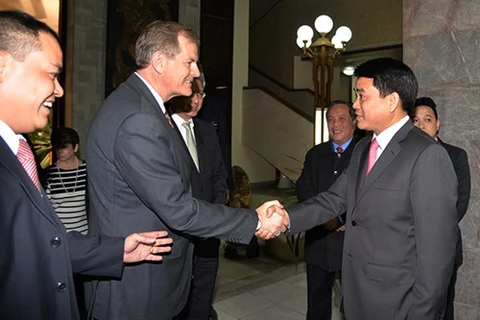
Mormon Church representative committee recognised ảnh 1Vice President of Vietnam Fatherland Front Central Committee Le Ba Trinh presents flowers to the representative committee (Source: VNA)

Hanoi (VNA) – The Government Committee for Religious Affairs on May 31 officially recognised the Representative Committee of the Church of Jesus Christ of Latter-day Saints Vietnam.

The Church is often referred to as the “Mormon Church" because of a belief in the Book of Mormon, a volume of holy scripture said to be a record of God’s dealings with ancient inhabitants of the Americas.

The Church of Jesus Christ of Latter-day Saints (LDS Church) was founded by Joseph Smith (1805 - 1844), its first president, on April 6, 1830 in Fayette Township, New York.

It was then developed by Brigham Young who migrated with the new Mormons to Salt Lake City in 1847.

The LDS Church was brought to Vietnam in 1962, and was registered in 1967 by the South Vietnam government. After 1975, the LDS Church in Vietnam ceased operations, with most of its members migrating to other countries. Those who stayed in the country practiced the religion at home.

In 1995, the Mormon Church revived its activities in Vietnam, with two groupings formed in Hanoi and Ho Chi Minh City. Currently, the Church has nearly 1,000 followers, mostly in the two cities.

To support Mormons to practice religion, the Interim Representative Committee of the Church of Jesus Christ of Latter - day Saints Vietnam was officially recognised in May 2014.

Speaking at the recognition ceremony on May 31, the committee’s Chairman Hoang Van Tung said that the recognition will help Mormon followers in Vietnam have a close and full organisation and obey Vietnamese law and the Church’s creeds.

Bui Thanh Ha, deputy head of the Government Committee for Religious Affairs, said that the recognition of the representative committee acknowledges the contributions made by Church followers, shows the Party’s and State’s policy of religious freedom, and contributes to Vietnam-US relations.

Although the Mormon Church in Vietnam is small, its Representative Committee has been recognised by the State, which shows that the country does not discriminate between religions, Ha said.

Ha affirmed that the Church has contributed to boosting socio-economic development.

According to him, Vietnam is currently home to 39 religious organisations of 14 recognised religions, with their followers accounting for 27 percent of the population.

He expressed his hope that the religions continue to coexist peacefully and contribute to national construction.-VNA

VNA

See more

Visitors to an exhibition and test-drive programme for electric vehicles organised in Cau Giay ward, Hanoi, on May 16 by the municipal People's Commitee and relevant agencies. (Photo: VNA)

Hanoi proposes subsidies to accelerate shift to electric vehicles

Under a draft resolution currently open for public feedback by the municipal People’s Committee, residents with permanent or temporary residence registration in Hanoi for at least two consecutive years, who own petrol-powered motorbikes registered before the resolution takes effect, will be eligible for support when purchasing electric motorbikes priced at 10 million VND or more.

The copyright crackdown is broadly viewed as an inevitable step in Vietnam’s cultural industry development. (Illustrative photo: VNA)

Healthy digital content market in the making

The sharper crackdown is rapidly redrawing how online entertainment is distributed and consumed, while gradually reshaping public awareness and responsibility toward copyright protection.

A view of Place Ho Chi Minh in Persan, France. (Photo: VNA)

Place preserving memories of President Ho Chi Minh in France

Although there is little publicly available documentation confirming exactly when Place Ho Chi Minh was established, French urban historians suggest that most streets and public spaces named after the Vietnamese leader in France emerged between the 1960s and 1980s, during the height of anti-war movements and solidarity campaigns supporting Vietnam across working-class towns and left-leaning suburbs around Paris.

Vietnamese Ambassador to Bangladesh Nguyen Manh Cuong speaks at the seminar. (Photo: VNA)

President Ho Chi Minh’s thought on national unity remains relevant today

President Ho Chi Minh's ideology of national unity continues to carry profound significance amid growing global challenges, including conflicts, social divisions and economic instability. His message of solidarity, consensus and placing national interests above sectional differences remains a valuable lesson for many developing nations.

Assoc. Prof. Dr. Nguyen Duc Son presents the decision establishing the Vietnamese Language Proficiency Test Council in Japan to a representative of the Vietnam Studies Centre in Japan. (Photo: VNA)

Japan hosts first standardised Vietnamese language proficiency test

As bilateral ties between Vietnam and Japan continue to expand, demand for Vietnamese language learning in Japan has also grown rapidly among OVs, educational institutions, businesses and Japanese people interested in Vietnam. Against this backdrop, the introduction of a standardised proficiency test is expected to provide an official and widely recognised benchmark for Vietnamese language skills.