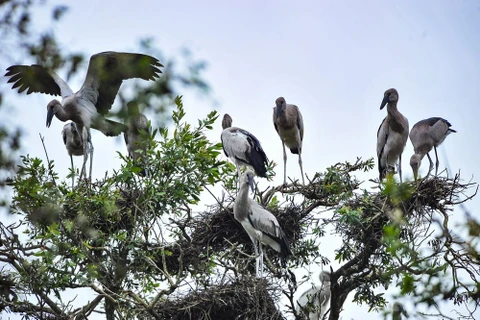
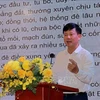
Truong Cam, director of the park’s Service and Environmental Education Centre, points to birds in the forest (Photo: VNA)
Thua Thien-Hue (VNA) - No one guards and protects Bach Ma National Park more zealously than the director of its service and environmental education centre who once hunted animals and cut down trees in the forest to earn a living. Today, Truong Cam, the only person who can "talk" with more than 100 kinds of birds, spreads his love of the forest to younger generations.
Truong Cam, a Vietnamese forest ranger, can mimic 110 kinds of bird calls. He translated one as meaning: “Today, I’m not happy and I warn you that if you enter my territory, I’ll attack you!”
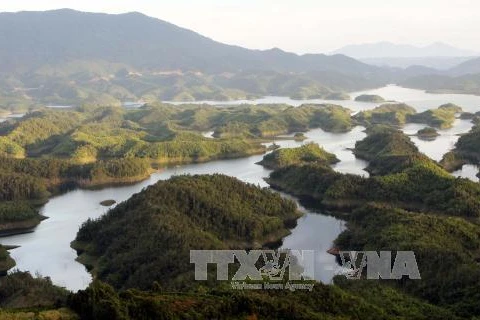
Cam, now the director of the park’s Service and Environmental Education Centre, has worked for 28 years in the Bach Ma National Park in the central province of Thua Thien-Hue.
“The birds come out to seek food from 5am to 8am. After that, they take a rest and are difficult to call and have a chat with,” Cam said.
In the 1980s, local residents living in a buffer zone that surrounds Bach Ma National Park had no earnings, except for money they collected from animal and wood poaching, all of which harmed natural resources in the area.
“At that time, we lived from forest exploitation because we were poor and had no other incomes,” Cam said.
Like his neighbours, Cam has been close to the forest for years. He once earned an illegal living from it living to support his family, but it was also where he discovered his love for the area’s flora and fauna.
After graduating from high school, Cam began trapping and cutting wood, just as his neighbours were doing. But his life changed dramatically when the hamlet authorities arrested him for trapping two pheasants and selling them in Hue.
Cam had no idea why he had been arrested until the rangers read to him the national law regulating forest protection.
Although the arrest was a stroke of misfortune, it later opened doors for him.
In 1988, the first delegation of the World Wildlife Fund (WWF) visited Hue to learn about pheasants. At that time, Huynh Van Keo, the present director of the national forest, was head of Bach Ma Prohibited Forest Protection Department, but he had no experts on his staff.
Keo thought about Cama nd visited him. Cam surprised the visitor with his deep knowledge about pheasants. After the meeting, Keo asked Cam to work as a forest ranger.
Cam looks back fondly at that moment, saying it was a way “to have a thief catch a thief”, as only illegal loggers knew every corner of the Bach Ma forest.
“I still remember the day when Mr Keo met me in a rice field. He asked me if I would like to care for the protected forest. I asked him one question: ’Do you have enough rice for me to eat because I’m strong and eat a lot. He said ‘yes’ and I agreed to be a protector of the forest’,” Cam said.
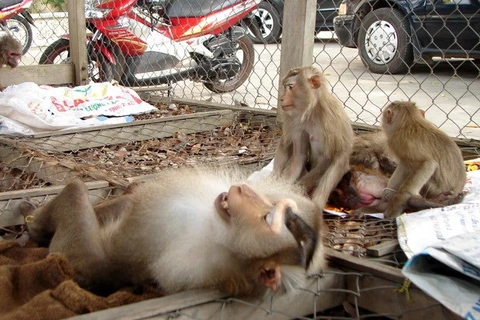
On his first day at his new job, Cam was asked to feed and study birds and other animals that had been caught by poachers who had taken part in illegal deforestation. After that, he was sent into the forest to destroy animal traps and arrest illegal loggers and hunters.
Bird talk
 Visitors walk with Truong Cam in Bach Ma National Park (Photo: VNA)
Cam travelled month by month to every corner of the Bach Ma forest, saving hundreds of animals by removing traps set by illegal hunters.
He spent time learning about birds, carefully listening and practising their voices. Day after day, his mimicry improved and birds began replying to him.
“Each bird has its own language. Their words and sounds are similarly expressive to ours in that they can show jealousy, anger and carelessness,” he said.
Cam can "talk" with more than 110 kinds of birds out of a total of around 320 living in Bach Ma National Park.
The 49-year-old-man is viewed as a “living, walking bird dictionary”.
“When I hear the flap of a wing or see a bird on land, I know exactly what kind of bird it is because I’ve lived near them for a long time,” he said.
When the Bach Ma National Park opened for tourists 10 years ago, Cam was chosen to be a guide for the special tour “Calling Birds and Enjoying the Sunrise”.
“I’m so busy now, because tourism groups like to be guided by me. Busy but happy!” he said.
“Today, nobody is cutting down trees in Bach Ma because local residents have been trained and paid to care for it,” he said. “Our mission is to introduce natural beauty to visitors.”
Cam is also in charge of four Forest Ranger Clubs for children at primary schools located in poor areas where people might consider returning to illegal logging and hunting.
“With our practical lessons, we teach children that the forest is one of the most important places in the world. If we lose the forests, we will have no more animals, no more birds, and no more flora, but only more natural disasters,” he said.
In 1999, residents began to learn about the consequences of deforestation after the results of serious flooding.
“Before that, we had been educated about the forest’s importance, but local residents didn’t really recognise it. After the flood, however, they helped us a lot in forest protection. Now, I want to share my love and knowledge of the forest with the younger generation,” Cam said.
Keo, director of the Bach Ma National Park, has set up a Forest Ranger club for children, which buys uniforms for all members, organises field trips in the forest, and teaches them how to protect the forest.
“Such clubs are very useful. Children learn quickly and deeply understand their role. Now they return home and educate their families and communities about forest protection, even environmental protection,” Keo said. “We’ve also received strong support from local authorities and school management boards.”
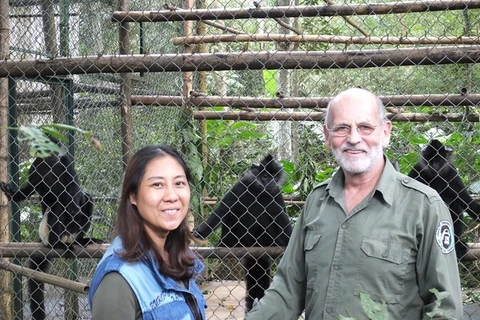
Along with Keo, Cam takes part in environmental protection activities, saying that he is very happy to “transfer my love of the forest to tourists and local children”. “I hope it will be protected forever,” he added.
Cam, however, is still looking for more bird-calling experts. Forest rangers, experts, and Cam’s two sons have all tried bird-calling, but no one can do it as well as he can.
“I think my talent for mimicry is a gift,” he said. “I’ll use the gift to protect the forest and spread my love of the forest to everyone.”-VNA
VNA