Nearly 1 in 6 TB patients undetected: expert

About 126,000 people have tuberculosis (TB) in Vietnam, but fewer than 106,000 have received treatment, while the others are undetected and sometimes unaware of their status, said Director of the Hanoi-based Central Pulmonology Hospital Nguyen Viet Nhung.
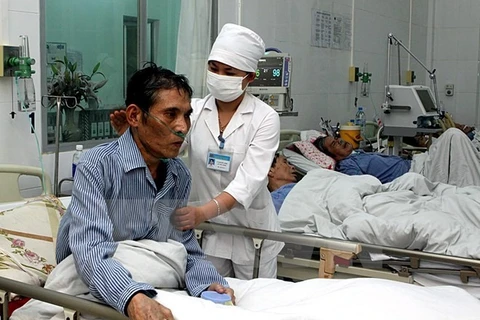
Nearly 1 in 6 TB patients undetected: expert ảnh 1A health worker at Tuy Haa City Healthcare Centre in the central province of Phu Yen gives medicine to a man suffering from tuberculosis. (Photo: VNA)

Hanoi (VNA) - About126,000 people have tuberculosis (TB) in Vietnam, but fewer than 106,000 havereceived treatment, while the others are undetected and sometimes unaware oftheir status, said Director of the Hanoi-based Central Pulmonology Hospital NguyenViet Nhung.

He said that the gap indisease detection poses a high risk to the lives of people with TB as well asto public health.

“Forty percent of theundetected TB patients will die because they haven’t treatment,” Nhung said.

Nhung, who isalso head of the country’s national TB prevention and control programme,said that people with TB do not always announce their conditions because theyare unaware of the disease or afraid of discrimination, so they do not seek medicaltreatment.

Nhung said that withcurrent techniques and tests, TB could be found in two hours after testinginstead of two months as previously. It takes four months to treat TB insteadof six months as before.

It is reported that in Vietnam,the number of people with TB has declined 5 percent yearly since 2015 and thenumber of people die of TB also reduced about 3,000 people yearly.

Vietnam has madeachievements in preventing and controlling TB.

Under the national TBprevention and control programme, new tests recommended by World HealthOrganisation such as the Gene Xpert (a machine that can detect mycobacterium tuberculosis in a sample of sputum) or the Hain Testare used to detect TB early and stop it from spreading.

The programme also facilitatedthe use of new medicine Bedquiline and a short-term treatment scheme formulti-drug-resistant tuberculosis.

In 2009, Vietnam started aninitiative to expand multi-drug-resistant tuberculosis treatment. Up to today,about 11,000 people have received treatment; 70 percent recover.

Moreover, the healthhistory records of people with multidrug–resistant TB have been digitalised.

"Vietnam still faceschallenges in controlling TB. It is necessary to improve grassroots healthcareto detect and treat TB patients early," Nhung said.

Another challenge is thatwhen international donors stop funding the country’s TB control and preventionactivities, Vietnam will need to find alternative sustainable funds.

As reported early this year on World TB Day 2017 (March 24), Vietnamis estimated to need at least 66 million USD annually toreduce the prevalence of patients with TB from 112 to 20 per 100,000people by 2030, essentially eliminating tuberculosis as a public healthproblem.

The national programme onTB prevention and control is currently funded at 26 million USD a year,including 19 million USD from foreign aid.

Now, the Health InsuranceFund covers costs for TB diagnosis and treatment. Beginning in 2019, the healthinsurance fund will also cover medicines for TB patients.

Nhung said that the CentralPulmonology Hospital was planning to develop a fund to support TB treatmentnext year. The fund is expected to help uninsured people buy health insurance.

Health insurance cardholders who cannot afford the co-payment for some medicines will be assistedtoo.-VNA
VNA

See more

The 47th Asia Pacific Dental Congress and the second Hanoi International Dental Exhibition and Congress 2026 (Photo: VNA)

Vietnam hosts 47th Asia Pacific Dental Congress for first time

The three-day event is co-hosted by the Vietnam Odonto-Stomatology Association (VOSA), the Asia Pacific Dental Federation (APDF), the Hanoi Central Odonto-Stomatology Hospital (NHOS), and the FDI World Dental Federation. It’s the first time Vietnam has hosted the APDC, drawing over 4,000 domestic and foreign experts, scientists, and dental practitioners.

Mr. Gilberto recovered well after treatment at Hong Ngoc General Hospital.

US veteran calls Vietnamese doctors “heroes” after life-saving treatment

After being assisted on a medically supported flight back to the United States for continued treatment, Gilberto’s health condition showed positive improvement. From afar, he later sent a heartfelt video message expressing gratitude to the medical team at Hong Ngoc General Hospital, the people he called “heroes.”

Residents in Hanoi's Bach Mai ward receive free health check-ups. (Photo: VNA)

Vietnam moves toward universal free annual health checkups from 2026

Every Vietnamese citizen from 2026 onward will be entitled to at least one free annual medical checkup or screening. Each individual will also have a digital health record integrated into the national digital identification platform VNeID, enabling authorities and healthcare providers to manage health data in a synchronised and continuous manner.

Ho Chi Minh City's digital citizen application (Photo: nld.com.vn)

Ho Chi Minh City rolls out electronic health records on digital citizen app

Under the plan, each resident will be assigned a unique EHR linked to their personal identification number, ensuring accuracy and consistency while minimising duplication and data discrepancies. Health data will be continuously updated from medical facilities, routine check-ups, and screening programmes, then integrated and centrally displayed on the application.

At the Government’s regular press briefing (Photo: VNA)

Hospital duo on track for Q2 opening as roadblocks vanish

The Health Ministry has worked in lockstep with the Ministry of Construction to clear cost-appraisal and contract-approval bottlenecks, with the process now flowing smoothly. It has also teamed up with the construction and defence ministries to press contractors to accelerate outstanding licensing requirements, including fire safety and waste treatment systems.

A kidney transplant performed at the Hue Central Hospital. (Photo published by VNA)

Six lives extended through single organ donation

When one heart stops beating so that others may live on, it represents not only a medical transfer but also a continuation of compassion and humanity, said Professor Dr Pham Nhu Hiep, Director of the Hue Central Hospital.

Doctors at the University Medical Center Ho Chi Minh City perform colorectal cancer surgery on the Indonesian patient. (Photo: published by VNA)

Indonesian patient travels to Vietnam for colorectal cancer surgery

The successful colorectal cancer surgery for an Indonesian patient once again demonstrates the advances in the professional expertise of Vietnamese doctors and has further strengthened the country’s medical reputation and the trust of patients across the region and beyond.

Illustrative photo (Photo: VNA)

Vietnam intensifies efforts to end malaria by 2030

In 2025, the country reported 246 cases with no deaths, down more than 30% year-on-year. In the first months of 2026, only 25 cases were recorded, again with no fatalities. So far, 26 out of 34 provinces and cities have been officially recognised as malaria-free.

Illustrative image -(Source: Internet)

Vietnam warns of HiPP baby food after Austria’s recall

The Austrian Agency for Health and Food Safety (AGES) has announced that HiPP – a German-Swiss baby food producer – and supermarket chain SPAR had recalled all 190g-jars of HiPP Vegetable Carrot with Potato from 1,500 stores in Austria due to suspected contamination with rat poison.

The caregivers’ club in Coc village, Pu Luong commune, the north-central province of Thanh Hoa, has established a livelihood support fund, helping households develop their economies through models such as rice cultivation, vegetable growing, fish farming and poultry raising. (Photo: VNA)

Community-based child nutrition care model benefits Thanh Hoa’s locality

After more than one year of implementation with the support of World Vision, the model has delivered positive outcomes in improving nutrition and enhancing the quality of childcare. Household livelihoods have improved, mothers’ awareness and caregiving skills have been strengthened, and notably, the rate of child malnutrition in Coc has declined markedly.