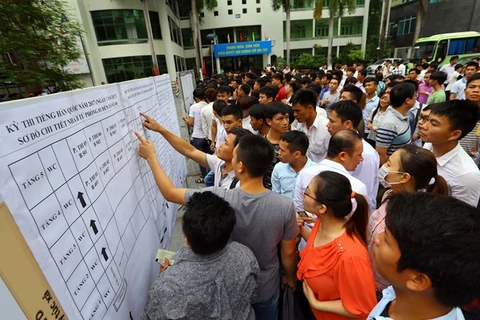
Students submit applications for university admission at the National Economics University (Photo: VNA)
 Hanoi (VNS/VNA) - A new regulation concerning recruitment quotas for public tertiary education institutions in Vietnam has been at the centre of debate among educators and lawmakers.
The Ministry of Education and Training (MoET) recently decided to use the percentage of students that gained employment after graduation as the basis to determine whether a university should be allowed to increase its recruitment quota for the next academic year.
The regulation applies to majors and universities that have not received official accreditation in education quality.
It specifies that if an educational institution has 90 percent of graduates finding employment within one year of graduation, they can choose either to keep the recruitment quota from the previous school year or raise it by no higher than 10 percent.
But if this percentage is achieved by forcing non-performing students to leave school, they are only allowed to raise the recruitment quota by no higher than 25 percent of the number of students they had forced to leave over the previous four years.
Dr Nguyen Thi Kim Phung, head of MoET’s Department of Higher Education, said the regulation would help bridge the gap between labour supply and demand.
“There has been a drastic increase in the number of universities and their educational scope as we are striving toward having 450 students for every 10,000 people by 2020,” she said.
“But we have not been able to ensure teaching quality at these institutions, so a lot of students have been unable to find jobs after getting their Bachelor or Master’s degrees, or having to work as manual labourers or in professions unrelated to their majors.
“The new regulation will require universities to learn about the labour market’s demands before opening new academic programmes or deciding on their recruitment quotas.”
Dr Vu Thu Huong, a lecturer at the Hanoi National University of Education, said one year after graduation was not a realistic indicator of a student’s employability.
“Graduates often have a lot of choices after they finish studying, such as going to study abroad, getting another degree, pursuing advanced study or getting married. In some instances personal situations prevent them from doing so. The number of students that find jobs in that time is an important factor, but I think it should be based overall across five consecutive years,” she said.
Professor Nguyen Van Minh, Principal of the Hanoi National University of Education, said he was concerned about the transparency of statistics provided by educational institutions.
He said: “Many universities have provided similar percentages [of students finding jobs within a year after graduation]. This should be tackled as soon as possible otherwise there would be no point in making student data public.
“The education ministry should take measures to control the transparency of statistics to make it fair for all universities.”
The accuracy and trustability of statistics has also raised concerns among educators.
Although statistics from the HCM City University of Education last year showed 100 percent of its French majors were employed after graduation, only 15 of the 35 graduates responded to the school’s survey.
The statistics also showed 93.3 percent of the school’s Japanese majors found employment, but that was taken from only 30 of 104 graduates who responded to the survey, of which 27 landed jobs.
Similarly, only 600 out of 1,347 graduates from the University of Architecture HCM City responded to the school’s survey, 82 percent of whom had found jobs within a year of graduation, but that made up only 36 percent of the school’s total number of graduates.-VNS/VNA
The Ministry of Education and Training (MoET) recently decided to use the percentage of students that gained employment after graduation as the basis to determine whether a university should be allowed to increase its recruitment quota for the next academic year.
The regulation applies to majors and universities that have not received official accreditation in education quality.
It specifies that if an educational institution has 90 percent of graduates finding employment within one year of graduation, they can choose either to keep the recruitment quota from the previous school year or raise it by no higher than 10 percent.
But if this percentage is achieved by forcing non-performing students to leave school, they are only allowed to raise the recruitment quota by no higher than 25 percent of the number of students they had forced to leave over the previous four years.
Dr Nguyen Thi Kim Phung, head of MoET’s Department of Higher Education, said the regulation would help bridge the gap between labour supply and demand.
“There has been a drastic increase in the number of universities and their educational scope as we are striving toward having 450 students for every 10,000 people by 2020,” she said.
“But we have not been able to ensure teaching quality at these institutions, so a lot of students have been unable to find jobs after getting their Bachelor or Master’s degrees, or having to work as manual labourers or in professions unrelated to their majors.
“The new regulation will require universities to learn about the labour market’s demands before opening new academic programmes or deciding on their recruitment quotas.”
Dr Vu Thu Huong, a lecturer at the Hanoi National University of Education, said one year after graduation was not a realistic indicator of a student’s employability.
“Graduates often have a lot of choices after they finish studying, such as going to study abroad, getting another degree, pursuing advanced study or getting married. In some instances personal situations prevent them from doing so. The number of students that find jobs in that time is an important factor, but I think it should be based overall across five consecutive years,” she said.
Professor Nguyen Van Minh, Principal of the Hanoi National University of Education, said he was concerned about the transparency of statistics provided by educational institutions.
He said: “Many universities have provided similar percentages [of students finding jobs within a year after graduation]. This should be tackled as soon as possible otherwise there would be no point in making student data public.
“The education ministry should take measures to control the transparency of statistics to make it fair for all universities.”
The accuracy and trustability of statistics has also raised concerns among educators.
Although statistics from the HCM City University of Education last year showed 100 percent of its French majors were employed after graduation, only 15 of the 35 graduates responded to the school’s survey.
The statistics also showed 93.3 percent of the school’s Japanese majors found employment, but that was taken from only 30 of 104 graduates who responded to the survey, of which 27 landed jobs.
Similarly, only 600 out of 1,347 graduates from the University of Architecture HCM City responded to the school’s survey, 82 percent of whom had found jobs within a year of graduation, but that made up only 36 percent of the school’s total number of graduates.-VNS/VNA
VNA