Nha vuon - fabulous architecture of Hue

Nha vuon (garden houses), which dots around Hue city in the central province of Thua Thien – Hue, offer visitors a glimpse into a spellbinding ancient architecture.
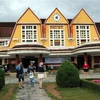
Nha vuon - fabulous architecture of Hue ảnh 1Nha vuon in Hue maintains all the characteristics of the original garden house (Photo: VietnamPlus)


Hanoi (VNA) – Nha vuon (garden houses), which dots around Hue city in the central province of Thua Thien – Hue, offer visitors a glimpse into a spellbinding ancient architecture.

A typical nha vuon in Hue maintains all the characteristics of the original garden house: a surrounding garden of various plants, trees and bonsai, a water-lily pond, a binh phong (masonry screen) and at the centre of the garden, a nha ruong with 48 columns for the cult of the ancestors and Buddha.

Blossoming under the Nguyen Dynasty, the last royal monarchy (1802 – 1945) in Vietnam’s history, An Hien and other nha vuon like Lac Tinh Vien, Tinh Gia Vien, Ty Ba Trang or Ngoc Son Cong Chua together created a prominent feature of Hue.

The symbiotic relation between gardens and Hue’s people is the glue that keeps these ancient areas intact.

Huu Ngoc, a renowned Vietnamese culture researcher, explains the meaning of the word nha vuon: "This word designates an architectural type, found specially in Hue, with which the home is integrated organically into the garden, the plants and the surrounding landscape to the extent that the ‘whole’ creates a certain spirituality. One can also translate nha vuon as ‘house garden’ because, in many ways, the garden modifies the house itself."

However, if nha vuon means merely a house and a garden, it may be mistaken with ordinary gardens in other parts of the country.

Dao Hung, another culture researcher and also a Hue native, says: "Many people believe that nha vuon is not available in other localities in Vietnam, but it is not true. However, the architecture of nha vuon in Hue is quite different from those in other provinces."

Usually, a typical nha vuon Hue comprises two main parts: nha ruong and the surrounding garden, designed according to geomancy and their owner’s spiritual life and skill. Each nha ruong is built with many beams (ruong) and pillars (cot), and its name derives from this very characteristic. But the most distinctive feature is that all beams and pillars are joined by mortise and tenon, not nails.

Roofed with brick tiles, nha ruong has all beams and pillars made of precious and solid wood, such as lim (iron wood), gu (sindora) or thong xanh (teranthera pine). The whole house stands on big pillars placed on a round or square stone base.

Moreover, different from gardens of the North or South, gardens in Hue serve more decorative, rather than practical desires. While a common garden in the North or the South often specialises in a specific plant, the house-garden in Hue often includes various species of trees, plants and also vegetables.

Tall trees are planted around the first green fence embracing the house-garden. The second fence sits among ornamental plants or fruit trees like the orange or the mangosteen. Along the alley leading from the gate to the house are trellises of flowers, providing a cool and decorative "roof" to the garden.

Hue makes efforts to preserve the old structures

Hue city is currently housing over 1,000 nha vuon, mostly in Gia Hoi, Vi Da and Kim Long wards. The old structure is now at risk of become deteriorated due to ravages of time, as well as rapid pace of urban development.

Nha vuon - fabulous architecture of Hue ảnh 2Fabulous nha vuon like An Hien, Lac Tinh Vien, Tinh Gia Vien, Ty Ba Trang or Ngoc Son Cong Chua together created a prominent feature of Hue. (Photo: VietnamPlus)


Tradition says that nha vuon cannot be sold out of the family in order to keep ancestral links firm. However, rocketing land values have urged some people to sell their land or dissemble the nha ruong.

Some homeowners cannot afford to restore their nha ruong, so they dissemble them to sell to people from other localities. If this trend continues, all the valuable knowledge stored in those nha ruong will disappear into history and culture books.

To deal with the situation, the provincial People’s Committee outlined and issued policies to support preservation and value promotion of typical nha vuon Hue.

Accordingly, during 2015-2020, the province splashed out 5-8 billion VND (216,000 – 345,800 USD) to restore 3-5 nha vuon each year.

The preserved houses must cover an area of at least 600 square metres, and have special feature of nha vuon in Hue./.
VNA

See more

The luxurious resorts ecosystem contribute to elevating Phu Quoc's image in the eyes of international media. (Photo: Sun Group)

Phu Quoc and its luxury resorts "take the leaderboard by storm" in DestinAsian rankings

On March 6, 2026, the prestigious travel magazine DestinAsian officially announced its list of the top 10 islands in Asia for 2026 as part of its Readers' Choice Awards. Not only was it the sole representative from Vietnam, but Phu Quoc also made a remarkable impression by climbing to the runner-up position, continuing an impressive three-year upward trend.

A view of the opening ceremony of the Ban Flower (Bauhinia) Festival 2026 in Dien Bien province on March 8 evening. (Photo: VNA)

Government leader attends Ban Flower Festival 2026 in Dien Bien province

Themed “Hoa Ban – Khat vong Dien Bien,” the festival was a highlight of the Dien Bien Culture and Tourism Week running from March 6 – 12. The annual event celebrated the beauty of the iconic Ban flower and promoted the culture, history and tourism potential of the Northwestern region.

Khem beach in Phu Quoc island of An Giang province. (Photo: VNA)

Phu Quoc strengthens appeal as international arrivals soar in early 2026

Phu Quoc special zone is increasingly affirming its strong appeal to international visitors with impressive growth, positioning the “pearl island” as a standout destination in Southeast Asia and a direct competitor to renowned resort islands such as Bali in Indonesia and Phuket in Thailand.

Leaves of loc vung (Barringtonia acutangula tree) change colour beside Hoan Kiem Lake (Photo: VNA)

Hanoi named among world’s 50 most beautiful cities by Condé Nast Traveler

Hanoi’s appearance within the global media ecosystem of Condé Nast Traveler is expected to provide a significant boost to the city’s tourism appeal. Beyond enhancing its credibility as a travel destination, the recognition could also help attract high-end tourism services and encourage higher spending by international visitors.

Overseas Vietnamese in traditional ao dai explore Nguyen Hue flower street. (Photo: qdnd.vn)

Overseas Vietnamese amplify Ho Chi Minh City’s tourism appeal

With their understanding of both local traditions and international contexts, OVs are proving to be an effective “soft bridge” in promoting the city globally, contributing to rising international arrivals and reinforcing Ho Chi Minh City’s position as a creative, globally integrated and culturally rich urban tourism destination

Smoke rises following US and Israeli airstrikes on Tehran, Iran, on March 1. (Photo: XINHUA/VNA)

Hanoi urges suspension of tours to Middle East conflict zones

Vietnamese citizens have been advised not to travel to Iran, Israel, and other countries in the Middle East at present due to ongoing conflicts and complicated security developments, according to an official dispatch sent by the department to the above-mentioned units on March 3.

A representative of a Vietnamese enterprise shows it products at ITB Berlin 2026. (Photo: VNA)

Vietnamese firms promote tourism at ITB Berlin 2026

Vietnam’s exhibition area stands out with spacious and visually striking booths featuring businesses' most outstanding products as well as Vietnam's cultural icons such as cyclo models and traditional ao dai attire while a Vietnamese cuisine counter has drawn long queues of visitors.

International tourists are increasingly choosing Phu Quoc over giants like Bali and Phuket, driven by the freshness that Phu Quoc offers (Photo: Sun Group)

US media explains why Phu Quoc is becoming a tourism phenomenon

In 2025, international arrivals to Phu Quoc surged by nearly 60%, marking a new breakthrough cycle. As 2026 begins, during the Lunar New Year alone, the island welcomed nearly 366,000 visitors (a 30% increase year-on-year), with international guests accounting for nearly 93,000 (up 24.3%).

The crystal-clear waters and powdery white sands of Kem Beach are especially appealing to visitors (Photo: Fabl Belek)

Australian magazine hails Phu Quoc as a worthy alternative to Bali

In its list of “the best Bali alternatives worth exploring,” published by Australia’s leading travel site Escape, Phu Quoc is highlighted as a standout Southeast Asian destination, thanks to its appealing blend of reasonable costs, striking scenery, and diverse experiences.

Young locals explore Co Loa Citadel in digital space (Photo: nhandan.vn)

Hanoi festivals embrace digital tools to modernise management

During spring festival season 2026, Hanoi's major celebrations have aggressively adopted digital technologies across management, organisation, communications and promotion, presenting a more orderly and civilised image for traditional events.

The international cruise ship Adora Mediterranea arrives at Chan May Port, carrying 2,613 passengers and 732 crew members from Guangzhou, China, to Hue city. (Photo: VNA)

Unified promotion strategy sets stage for tourism expansion

Vietnam’s tourism brand is demonstrating strong momentum and robust recovery amid record-breaking international arrivals, driven not only by market demand but also by renewed thinking and innovative approaches to destination promotion and marketing.

Five-coloured sticky rice encapsulates the essence of the land and skies of Muong Lo in Lao Cai province. (Photo: VNA)

Vietnam positions cuisine as core national tourism product

To build a national culinary brand, Vietnam must align heritage, the food and beverage industry, and artisan standardisation—laying the groundwork for greater global presence and the elevation of Vietnamese cuisine as a tourism icon.