Hanoi (VNA) - In his recent key speeches and writings, Party General Secretary To Lam has articulated a clear theoretical and strategic vision for a new era - that of the nation’s rise. This concept has rapidly gained prominence in the country’s political and social life. However, hostile forces have actively sought to misrepresent and undermine its significance.
Era of nation’s rise – A new development milestone
This new era marks a crucial phase in which the country must strive with determination to fulfil its strategic objectives, achieving breakthrough development at new levels of sophistication, quality, and global standing, laying the foundation for further growth. Era after era forms a continuous history of development, ascending steadily from one level to the next.
Over the past 95 years, under the leadership of the Communist Party of Vietnam (CPV), founded by President Ho Chi Minh, the nation has gone through two proud historical epochs. The first was the era of independence, freedom and socialism building (1930–1975). The second was the era of national reunification, renewal, and development (1975–2025).
The achievements made during these two transformative periods, through struggle and relentless creativity, have laid a solid foundation for the third era - the era of nation’s rise, which begins with the 14th National Party Congress.
This new era seeks to integrate and elevate the core objectives of the previous two to a new level, relecting qualitative progress towards national independence and socialism, and the dialectical pursuit of independence, freedom, and happiness. The demands of this era are historic and unique. The entire Party, people, and armed forces are called upon to embrace this vision with conviction and action, aiming for a prosperous and happy Vietnam.
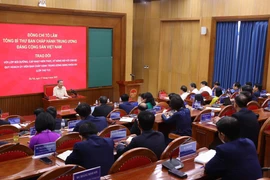
On October 31, 2024, at the Ho Chi Minh National Academy of Politics, General Secretary To Lam outlined fundamental perspectives on the new era, and era of the nation’s rise. He offered a comprehensive explanation of the era’s meaning and purpose. He described it as “a new era, an era of the Vietnamese nation’s rise, an era of strong growth and prosperity under the leadership of the CPV, with the successful building of a socialist Vietnam where the people are affluent, the nation is powerful, and society is democratic, just, and civilised, on par with the world’s powers.” It envisions a future where every citizen enjoys a properous and happy life, and receives support to develop and get rich, making more and more contributions to global peace, stability, development, and human happiness and global civilisation.
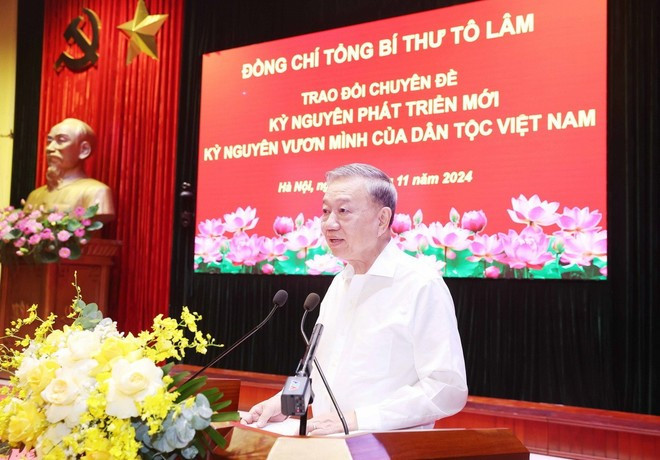
The Party chief also clarified the ultimate goal, core priorities, and formal starting point of the new era. Specifically, the goal of the new era is to build a strong country with wealthy people and socialist society on equal footing with global powers. The top priority is to successfully realise the strategic targets of turning Vietnam into a developing country with a modern industry and a upper-middle income by 2040, a developed socialist country with a high income by 2045. It also aims to strongly ignite the national spirit, self-reliance, confidence, resilience, national pride, and the aspiration for national to development; and closely combine the strength of the nation with the strength of the times. The beginning of the new era is marked by the 14th National Party Congress.
This is not only a target; it is a call to awaken patriotic spirit and national pride, and to galvanise the ambition for development. Vietnam aims to accomplish the 2030 goals of becoming a modern, industrialised middle-income country, and to become a fully developed high-income nation by 2045.
Heightening vigilance – strengthening trust
As the entire nation unites around its development aspirations, hostile forces have intensifed ideological sabotage by distorting and discrediting the meaning of the era of rise.
Reactionary and politically opportunistic elements have wasted no time in amplifying their distortion and opposition. With media campaigns, fabricating narratives, and adopting the guise of academic discourse or “constructive commentary,” they have put forward false and fabricated arguments about the new era with the aim of misrepresenting and attacking the guiding directions of the Party Central Committee, the Politburo, and the General Secretary, undermining the Party’s role and prestige, and sabotaging the socialist regime in Vietnam.
Foreign media outlets with a history of antagonism towards Vietnam have claimed that the new era is merely an “illusion”. Some hostile commentators dismiss the concept as “vague”, a product of “subjective political rhetoric”, or label it a hollow slogan without scientific or practical foundation.
Worse still, extremist groups such as the terrorist organisation called “Viet Tan” have used social media platforms like Facebook to spread misleading articles by anti-State actors. They assert that Vietnam can only "rise in the new era" by adopting pluralistic, multi-party democracy, arguing that the Communist Party of Vietnam must relinquish its leadership role.
These forces argued that Vietnam’s new of nation’s rise is ill-defined, inherently unachievable, and merely wishful thinking. They attempted to portray the Party’s long-term goals as unrealistic and ideologically driven fantasies without a foundation in reality. Moreover, they have actively distorted the Party’s policies and the General Secretary’s guidance concerning the prerequisites and strategies for Vietnam’s advancement.
Their ultimate aim is to sow doubt, confusion, and mistrust, eroding public confidence in the Party’s leadership and derailing Vietnam’s path towards socialism.
This strategy poses a serious threat, especially as the nation enters the final year of implementing the resolutions of the 13th National Party Congress, a critical phase of acceleration that demands the full mobilisation of all resources and drivers of progress to fulfil the set goals.
Hostile forces choose not to engage with the progressive nature of the Party’s goals or examine the historical and practical basis of Vietnam’s achievements. Instead, they resort to blame, doubt and denial - masquerading as “intellectual critique”, “independent scholarship”, or “scientific dissent”.
If left unchecked, these distorted narratives could undermine awareness, resolve, and trust among Party members, officials, and the wider public. It is therefore essential to proactively identify, confront, and discredit such fallacies with well-reasoned, evidence-based arguments./.