Hanoi (VNA) – Caring for and protecting legitimate rights of women, both in family and society, is the consistent policy of the Vietnamese Party and State since the birth of the Democratic Republic of Vietnam in 1945, now the Socialist Republic of Vietnam.
The tireless efforts in ensuring and promoting gender equality have brought about great and practical results.
The tireless efforts in ensuring and promoting gender equality have brought about great and practical results.
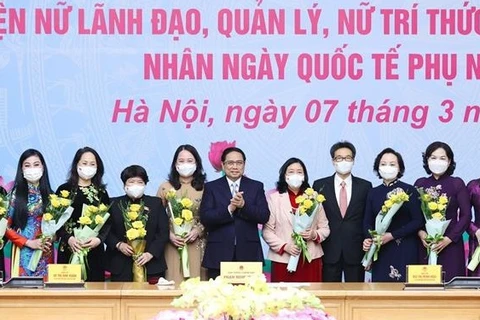
 The Executive Committee of the 7th Vietnam Women's Union. (Photo: VNA)
 The policies on gender equality rolled out in Vietnam have kept up with different periods of time.
After President Ho Chi Minh read the Declaration of Independence declaring the birth of the Democratic Republic of Vietnam on September 2, 1945, the 1946 Constitution, the first in Vietnam, prescribed gender equality. Article 9 of the Constitution said women and men enjoy equal rights in all aspects.
The 1959 Constitution also stipulated rights and obligations of women in its Article 24, Chapter 3, which also emphasised equal rights of women and men in politics, economy, culture, social affairs and family.
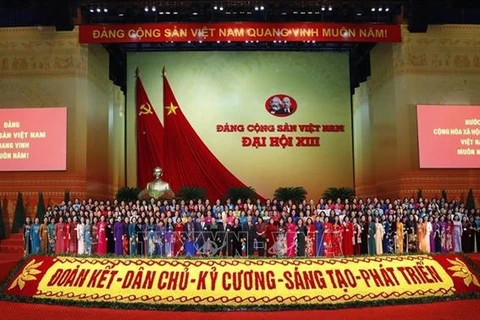
 The opening ceremony of the 10th National Women Congress (Photo: VNA)
 According to Article 57, citizens above 21 years old, regardless of their gender, can be elected to the National Assembly and all-level People’s Councils, the highest organs of State power at the central and local levels.
Meanwhile, Article 63 said the State and the society are responsible for improving women’s political, cultural, scientific and technological knowledge, as well as promoting their careers, helping them to raise their position in the society.
For labour policies, men and women in the same employment performing equal work receive equal pay, and women can take a maternity leave before and after childbirth with full-rate payment.
The 1992 Constitution, which was amended and supplemented in 2001, maintained the above-said regulations.
To concretise provisions of the Constitution, Vietnam issued the Law on Gender Equality in 2006, under which women’s rights were prescribed more adequately, specifically and comprehensively.
Other laws and legal documents have also materialised the Constitution’s provisions, notably the Law on Social Insurance (in 2006 and 2014), the 2006 Law on Residence, the 2007 Law on Domestic Violence Prevention and Control, and the Law on Marriage and Family (in 2000 and 2014), among others.
The 2013 Constitution has detailed regulations on rights of women, with articles from 14 to 49 of Chapter 2 stipulating human rights and rights of citizens, including women.
The legal regulations emphasise equal and priority rights of women, like those in employment, job arrangement and retirement, helping women prove their capacity and avoid risks at workplace, in family and society.
 Vietnam's female officers join UN peacekeeping operations. (Photo: Vietnam Department of Peacekeeping Operations)
 The 15th National Assembly of Vietnam was elected on May 23, 2021 with 499 deputies, including 151 females or 30.26 percent of the total. This is the second time that female NA deputies have exceeded 30 percent. The first time was recorded in the 5th legislature with 32.31 percent.
During the first tenure, female deputies made up only 3 percent. However, they had outstandingly performed their tasks.
The 14th tenure has gone down in the 75-year history of the legislature as the first time a woman was sworn in as chair of the NA – Nguyen Thi Kim Ngan, and at the same time, another woman assumed the post of vice chair – Tong Thi Phong.
The number of female NA deputies holding leadership positions during the present tenure now accounts for nearly 40 percent of the total.
Meanwhile, female representatives at People’s Councils at the provincial level make up 26.5 percent, up 1.37 percent from the previous term; and at the district level, 27,9 percent, a rise of 3.2 percent as compared with the previous tenure.
 Female mobile police soldiers of Ninh Binh province. (Photo: VNA)
 Vietnam’s efforts in gender equality have been acknowledged by the international community.
The country ranks 51st globally, fourth in Asia and first in the ASEAN Inter-Parliamentary Assembly in the rate of female NA deputies.
Its gender equality index is also constantly rising as Vietnam claimed the 87th position out of the 153 countries surveyed for gender gap narrowing.
Vietnam has a greater percentage of women in senior leadership positions than the global average, according to Grant Thornton’s International Business Report.
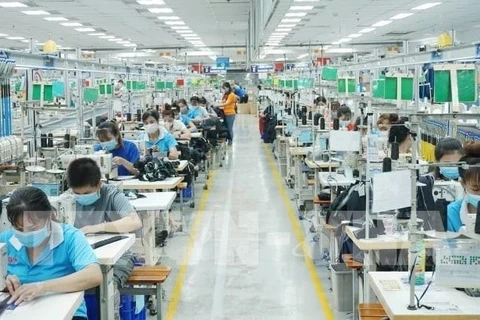
In Vietnam’s mid-market companies, women hold 33 percent of senior leadership positions with the most common being personnel director (36 percent) and chief financial officer (32 percent). Globally the rate is 29 percent.
Ninety five percent of businesses in Vietnam have at least one woman in senior management, again above the global rate of 87 percent./.
VNA