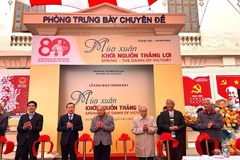
Hanoi (VNA) – The Outline of Vietnamese Culture, drafted by Party General Secretary Truong Chinh and approved by the Communist Party of Vietnam (CPV) Central Committee’s Standing Board in February 1943 was the CPV’s first official document that brought fresh air to the Vietnamese culture.
For the last 80 years, the content and core values of the outline have been continuously applied and developed by the CPV. It is also the foundation for Vietnamese writers, artists, and intellectuals to find inspiration for their works and creativity.
On the occasion of the 80th anniversary of the outline, Associate Professor, Doctor Nguyen The Ky, Chairman of the Central Council for Theory and Criticism of Literature and Art, spoke to VietnamPlus about its origin, significance, and practical value in the current context.
Cultural revolution’s guidebook
Reporter: What is the historical background that led to the birth of the Outline of Vietnamese Culture in 1943?
Assoc. Prof. Dr. Nguyen The Ky: In 1943, looking at the global and domestic situations, the Party found opportunities to overthrow French - Japanese colonialism and fascism and to establish a democratic republic regime. Among many important jobs to do, leader Nguyen Ai Quoc and Party General Secretary Truong Chinh clearly recognised the important role and contribution of culture. Revolution is culture, culture is revolution. Such urgencies include to radically shift the colonial-feudal regime into a democratic and republic regime, to eliminate obscurantism and enslavement of the fascists and colonialists, and wrong ideological trends. The hope is to build a new culture, and a new class of people for the new regime.

Associate Professor, Doctor Nguyen The Ky, Chairman of the Central Council for Theory and Criticism of Literature and Art. ( Photo: VietnamPlus)
Party General Secretary Truong Chinh started drafting the Outline of Vietnamese Culture in which he indicated the threats that Vietnamese culture faces under the yoke of Japanese and French fascists. He analysed the relationship between political revolution and cultural revolution, and affirmed the Party's leadership in the cultural revolution. The outline pointed out the right direction to fight colonialists, fascists and their henchmen, build a new cultural guideline of the Party, and gather culturalists, intellectuals, writers and artists to participate in the cause of national liberation.
For the first time, the Indochinese Communist Party (ICP) stated its outline of culture, content, nature, organisation, and development orientation of a cultural revolution must be associated with the national liberation revolution and the future of the culture after the revolution is successful. The Outline of Vietnamese Culture defines the building of the Vietnamese culture including ideology, academia, and arts "will be liberated by the victory of the democratic revolution, and will build a new democratic culture in the world.”
Reporter: What are the basic content of the outline? What are the foundations that the outline made for Vietnam to build a national culture?
Assoc. Prof. Dr. Nguyen The Ky: The outline clearly defines three principles - nationalisation, massification, and scientificisation.
Nationalisation means the inheritance, construction and development of the nation's thousands-year-old culture, self-respecting national culture, overcoming self-deprecating and conceited thoughts, and raising patriotism, heroic spirit, independence and freedom.
In the aspect of massification, the national culture is created, built, protected, and promoted by generations of the Vietnamese people, clearly sees and opposes all undertakings and actions that separate culture or cause harms to the masses. The new culture and the revolutionary culture must direct all creativity and all activities to serve the masses of the people, constantly improving the spiritual life of the people. The Party’s humanistic ideology - Art for life's sake – must be thoroughly understood. The tendency of “art for art's sake” that makes artistic creation away from reality, annihilating or neglecting the will to join revolution must be opposed.
Scientificisation means ensuring and enhancing scientificity in building the Vietnamese culture, making the culture constantly scientific, advanced, and able to resist anti-scientific and anti-progressive cultural products. Scientificity is also shown by inheriting and promoting the quintessence of the human culture.

The development of mass media facilitates the spread of cultural products. (Photo: VietnamPlus)
Appropriate cultural development strategy needed
Reporter: In your opinion, how should managers and workers in the culture sector implement the “Outline of Vietnamese Culture” in the current context of integration and digital transformation?
Assoc. Prof. Dr. Nguyen The Ky: Those who work in the culture and arts sector today need to understand and deeply grasp the Party's humanistic ideology on culture. It is necessary to clarify the content, principles, and characteristics of culture as the Outline pointed out and the Party has perfected through each revolutionary period.
We have been developing a knowledge-based economy, a digital society, a start-up nation, and an e-government, and integrating deeply, which requires an appropriate cultural development strategy.
The 4.0 technology revolution creates important prerequisites for cultural development, making culture the foundation, goal, driving force, and important endogenous force to boost the socioeconomic development. The branches of culture, literature and art are making the most of new and modern modes of expression which are unprecedented in human history. They pose both opportunities and challenges in managing and orienting cultural activities.
The development of the mass media creates favourable conditions for spreading cultural products, forming multi-faceted communication channels, contributing to the expression of opinions and views and promoting the freedom of expression and cultural diversity in the society. However, the negative side of cultural activities and products also impact the society, especially young people.
Applications of virtual reality technology, artificial intelligence, Internet of Things, Big Data, 3D printing and many new ways of thinking force Vietnam to change in heritage management and organisation of culture and artistic activities. Making changes is compulsory to meet the changing needs of art and culture itself and the desires of the society.

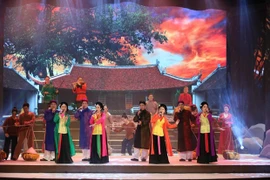
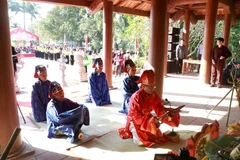
An art performance. (Photo: VietnamPlus)
Dealing with these issues requires a change in the way of thinking, not just responding through policy amendment. Cultural development also needs to be placed in general changes to ensure the sustainable development of each country. Scientificity must be ensured and enhanced in building the Vietnamese culture.
Reporter: It can be said that the concise and basic contents in the “Outline of Vietnamese Culture” have become a guideline, creating strong roots for the nation's "cultural tree" to grow. So, in promoting Vietnamese culture, what part in the Outline can we use to create works that vividly features the Vietnamese culture?
Assoc. Prof. Dr. Nguyen The Ky: With the 80-year-old outline, Vietnam has gone through a long journey that is full of sacrifices and hardships. The point of view that creators must keep in mind is the cultural cause belongs to the people and comes under the leadership of the Party. The characteristics of the new Vietnamese culture are to preserve the traditional expression and promote new democratic content. The three principles of Vietnam's new culture are nationalisation, massification, and scientificisation. As summarised by President Ho Chi Minh, "Culture lights the way for the nation ". It is the viewpoint, goal, motto and principle for the country to prosper together with politic and economic activities.
Reporter: Thank you very much!