Overnight interbank interest rate hits 16-month low thanks to abundant liquidity

According to the State Bank of Vietnam (SBV), in the interbank market, the trend of decreasing overnight interest rates has continued, starting at 3.13% in the first session of last week and gradually decreasing over the sessions to 1.67% at the last session of the week. In total, overnight interest rates decreased by 1.46 percentage points within one week.

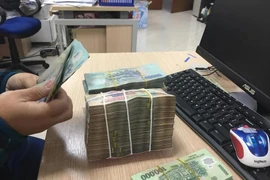
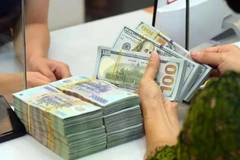
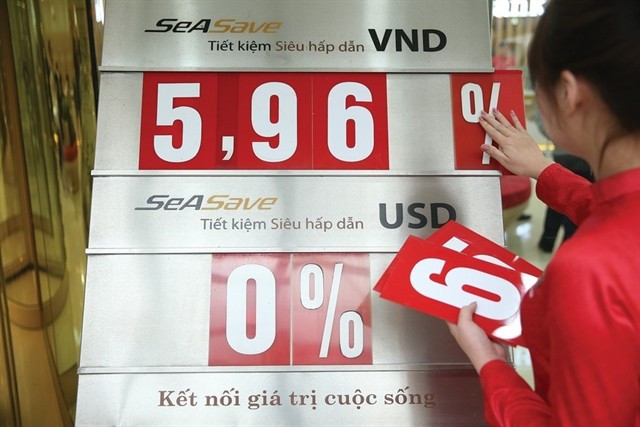
Deposit and lending interest rates listed at commercial banks have also continually decreased. (Photo: vietnambiz.vn)

Hanoi (VNS/VNA) - Overnight interbank interest rates have dropped to 1.67% per year, the lowest level since March 2024, thanks to abundant liquidity.

According to the State Bank of Vietnam (SBV), in the interbank market, the trend of decreasing overnight interest rates has continued, starting at 3.13% in the first session of last week and gradually decreasing over the sessions to 1.67% at the last session of the week. In total, overnight interest rates decreased by 1.46 percentage points within one week.

Interest rates for terms from one week to three months have also decreased, ranging from 2.2% to 5.03%.

According to data from the US Federal Reserve’s New York branch, the gap between the US secured overnight financing rate (SOFR) and Vietnam’s overnight interest rate on June 18 was 2.28 percentage points.

Experts at Vietcap Securities Company predict that interbank interest rates will remain low this month, thanks to abundant liquidity from a large amount that the State Treasury of Vietnam is depositing at domestic commercial banks.

In addition, according to the Government's orientation of low interest rates to support economic growth, commercial banks are likely to continue to maintain low interest rates in the short term, the experts said.

Deposit and lending interest rates listed at commercial banks have also continually decreased.

As of the end of May 2025, the average 12-month term deposit interest rate of the group of private joint-stock commercial banks has decreased by 12 basis points compared to the beginning of the year, to 4.93% per year; while the rate of the group of commercial banks with State-owned capital has remained at 4.7% per year.

As for loan interest rate, in a recent report sent to the National Assembly, the SBV said that as of mid-April 2025, the average lending interest rate for new loans of the commercial banking sector was about 6.34% per year, down 0.6 percentage points compared to the end of 2024. This was a record low in many years, even lower than that in the COVID-19 pandemic period. According to statistics of the financial data provider Finpro, during the COVID-19 pandemic period from 2020 to 2022, the lowest average quarterly lending interest rate was 7.9% per year, seen in the first quarter of 2022.

However, according to the SBV, interest rates in the coming time will face many pressures to rise. The SBV explains that the lending interest rate has decreased sharply in recent times, making room for further cuts limited. At the same time, credit demand for production, business and consumption is forecast to increase sharply to meet the economic growth target in 2025, while bank capital raising may face difficulties due to competition from other attractive investment channels.

Forecasting about the interest rate trend in the second half of 2025, Dr. Nguyen Huu Huan, a lecturer at Ho Chi Minh City University of Economics, said that if the SBV continues to significantly pump money into the banking system, interest rates will remain low.

However, Huan notes, everything has two sides. He explains that if interest rates are kept low in the current context, the pressure on the USD/VNĐ exchange rate will be very large. Although the strength of the US dollar is showing a weakening trend, the Vietnamese dong continues to depreciate against the dollar, which means a double weakening situation.

The SBV said that it will continue to closely follow market developments and the domestic and international economic situation to proactively, flexibly, promptly and effectively manage monetary policy. At the same time, monetary policy will be coordinated synchronously, harmoniously and closely with fiscal policy as well as other macro policies, aiming to achieve the priority goal of promoting strong economic growth associated with maintaining macroeconomic stability, controlling inflation and ensuring major balances of the economy./.

VNA
See more

Minister of Industry and Trade Le Manh Hung, President and Chief Executive Officer of Murphy Oil Eric M. Hambly, and delegates at their meeting on June 8 in Hanoi. (Photo: moit.gov.vn)

Murphy Oil urged to expand investment in Vietnam

Murphy Oil has operated in Vietnam since 2012 and currently participates in and operates many important oil and gas contracts at projects such as Lac Da Vang and Hai Su Vang, which are expected to contribute additional oil and gas supplies, strengthen energy security and support Vietnam’s economic development.

Deputy Prime Minister Nguyen Van Thang (R) receives Krishna Srinivasan, Director of the Asia and Pacific Department at the International Monetary Fund (IMF), in Hanoi on June 8. (Photo: VNA)

Deputy PM receives IMF Asia-Pacific Director

Director of the Asia and Pacific Department at the International Monetary Fund (IMF) Krisha Srinivasan affirmed that the IMF will continue to accompany and support Vietnam in the development of its financial sector, thereby helping to strengthen resilience and promote sustainable growth in the years ahead.

An article on Vietnam's e-commerce boom on Le Monde (Photo: VNA)

Digital economy fuels new growth momentum in Vietnam: French daily

French daily Le Monde recently reported that Vietnam’s e-commerce revenue approached 26 billion EUR (29.6 billion USD) in 2025, jumping 25% from a year earlier on the heels of a 20% gain in 2024. The sector now commands roughly 11% of total retail sales, cementing Vietnam’s status as one of Southeast Asia’s most dynamic markets.

Vietnam Airlines Group offers nearly 2.2 million discounted domestic seats from now until August 16 to meet peak summer travel demand. (Photo: VNA)

Vietnam Airlines Group offers nearly 2.2 million discounted domestic seats

Vietnam Airlines Group, comprising Vietnam Airlines, Pacific Airlines and Vietnam Air Services Company (VASCO), will provide nearly 5.5 million seats on domestic routes from now until August 16 to meet peak summer travel demand, including around 2.2 million seats offered at promotional fares on various routes.

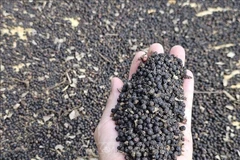
A pepper farm in Gia Lai province (Photo: VNA)

Vietnam’s pepper exports jump 21.7% in volume in five months

May shipments, however, totaled 25,180 tonnes worth 166.2 million USD, down 18.9% by volume and 13.9% by value from April, and 4.8% lower in volume from a year earlier. Major exporters reported declining shipments, underscoring a sector-wide pullback.

Representatives of Vietrade and TFO Canada discuss a new cooperation project for 2026–2030. (Photo: VNA)

Vietnam, TFO Canada move towards strategic trade partnership

Director General of Vietrade Vu Ba Phu said the success of cooperation during 2021–2024 had laid a solid foundation for elevating bilateral ties in the new phase, with Vietrade now serving as TFO Canada’s strategic partner in Vietnam.

Aircraft at Noi Bai International Airport. (Photo: VNA)

Hanoi bets on aviation network to power economy

The capital’s newly approved master plan places aviation infrastructure at the centre of long-term economic development, with a second international airport and low-altitude transport network expected to reshape urban growth, logistics and high-tech industries.

Green SM Global CEO Nguyen Van Thanh and Haryana's Minister of Industries and Commerce Rao Narbir Singh, together with delegates, press the button to officially launch the service. (Photo: VNA)

Vietnamese electric taxi service launched in India

The launch of Green SM Limo in India further expanded the company’s international footprint and brought its all-electric mobility model and service standards, already established in several markets, to users in one of the world’s most dynamic economies.