Party chief, President meets Chinese front leader

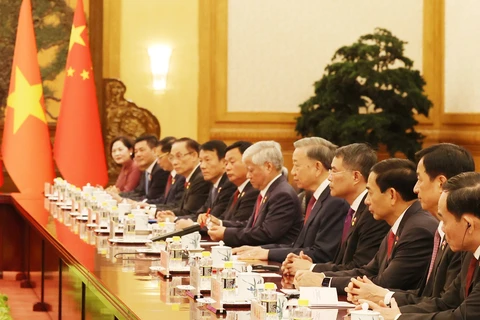
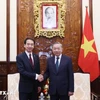
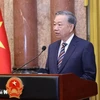
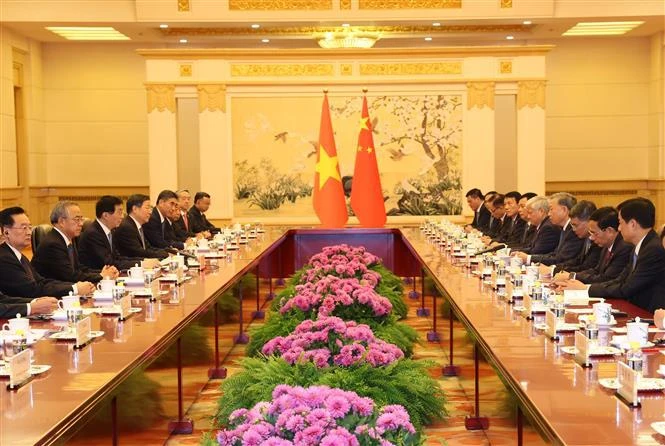
Party General Secretary and President To Lam met with Wang Huning, member of the Standing Committee of the Political Bureau of the Communist Party of China (CPC) Central Committee and Chairman of the Chinese People's Political Consultative Conference (CPPCC) National Committee, in Beijing on August 19.

At the meeting. Photo : VNA

Beijing (VNA) – Party General Secretary and President To Lam met with Wang Huning, member of the Standing Committee of the Political Bureau of the Communist Party of China (CPC) Central Committee and Chairman of the Chinese People's Political Consultative Conference (CPPCC) National Committee, in Beijing on August 19.

Lam once again extended heartfelt gratitude to Wang for his role as the Special Representative of Party General Secretary and President Xi Jinping during the funeral for late Party General Secretary Nguyen Phu Trong. This gesture, he said, reflected the profound respect and regard of the Chinese Party, Government and people for the Vietnam-China relationship and the late Vietnamese leader.

He stressed that the Vietnamese Party and State attach special importance to consolidating and developing ties with the Chinese Party and State, considering it a strategic choice and a top priority in its foreign policy.

Vietnam remains steadfast in its "One China" policy, supports China's growth and the promotion of its important role to global and regional peace, cooperation and development, he said, adding that the Vietnamese Party, State and people always remember and value the significant and wholehearted support from their Chinese counterparts in the past struggle for national independence and reunification, as well as in the current national construction and development.

The Vietnamese Party and State leaders will continue inheriting and realising the common perceptions reached by late Party General Secretary Trong and Party General Secretary and President Xi, he said.

Wang, for his part, noted that the visit, following Vietnam’s completion of the elections of key leadership positions, underscored the special importance that both countries place on their comprehensive strategic cooperative partnership and the Vietnam-China community with a shared future that carries strategic significance.

He affirmed China’s consistent view of its relationship with Vietnam as a priority in its neighborhood diplomacy. China always supports Vietnam to successful build socialism suited to its national conditions, maintain strategic self-reliance, and play an increasingly important role in the region and globally, he said.

In reply, Lam expressed a desire for the enhanced sharing of information, experience, theories and practices between the two Parties through high-level visits and various exchange and cooperation mechanisms.

He suggested improving the effectiveness of cooperation mechanisms among key ministries and sectors such as public security, national defence, and foreign affairs; bolstering the friendly ties between the Vietnam Fatherland Front and the CPPCC, and encouraging sectors and localities to advance cooperation in the areas of mutual interest, such as increasing the import of Vietnamese agricultural products, developing rail connections, attracting Chinese large-scale and quality investment projects in Vietnam, and boosting tourism to the pre-COVID-19 levels.

The guest also hoped for increased multilateral coordination in the areas of shared interest and expanded people-to-people exchanges, particularly among the younger generation.

Agreeing with the top Vietnamese leader’s recommendations, Wang said China wishes and is willing to bolster exchanges between the two countries via all channels and at all levels, enhance substantive cooperation in all areas, and promote the coordinating role of the China-Vietnam Steering Committee for Bilateral Cooperation for their win-win collaboration.

He expressed his respect for the Vietnamese side’s suggestion on increasing the imports of Vietnamese goods, particularly farm produce, as well as expanding cooperation in new areas such as digital economy, green economy and IT, while promoting strategic connections under the “Belt and Road” and “Two corridors, One Belt” initiatives, bringing practical benefits to the two countries’ people and enterprises.

He spoke highly of Vietnam’s review process, and practical and theoretical achievements after nearly 40 years of “Doi moi” (renewal), as well as its preparation for the 14th National Party Congress.

Wang also briefed the Vietnamese leader on the important outcomes of the third plenary session of the 20th Central Committee of the Communist Party of China during the country’s key development period.

The host affirmed to join hands with the Vietnamese side to well implement the common perceptions reached by high-ranking leaders of the two countries, and suggested enhanced theoretical exchanges that contribute to the building of socialism in each nation.

Describing the people as the basis and source of strength of the Vietnam-China relations, he recommended both sides to carry out people-to-people exchanges, and cooperation projects in areas relating to people’s livelihoods.

Lam and Wang exchanged their viewpoints on the sea-related issues in a sincere and frank fashion, and laid stress on the significance to the maintenance of peace and stability in the region.

The Vietnamese leader suggested both sides control, and properly settle disagreements at sea, respect each other’s legitimate rights and interests, handle disputes and disagreements via peaceful means and in line with international law, including the 1982 United Nations Convention on the Law of the Sea (1982 UNCLOS), and work together to develop the East Sea into the waters of peace, friendship and cooperation./.
VNA

See more

Vietnamese Ambassador to Venezuela Vu Trung My speaks at the event (Photo: VNA)

President Ho Chi Minh’s enduring legacy highlighted at Venezuela commemoration

Vice President of the United Socialist Party of Venezuela (PSUV) Jesús Faria expressed deep admiration for President Ho Chi Minh and Vietnam’s indomitable struggle for national independence. He described President Ho Chi Minh as an immortal symbol of 20th-century national liberation movements, whose legacy continues to inspire leftist parties, progressive movements, and peoples across Latin America, including Venezuela.

Standing Vice Chairman of the municipal People’s Committee Nguyen Loc Ha (R) and EU Ambassador to Vietnam Julien Guerrier. (Photo: VNA)

Ho Chi Minh City, EU boast ample room for sustainable development cooperation

Since the establishment of their diplomatic ties in 1990, Vietnam and the EU have deepened the bilateral ties into one of the bloc’s most dynamic and in-depth partnerships with an ASEAN member, Ha noted, adding that the relationship entered a new chapter in January when the President of European Council’s visit upgraded it to a Comprehensive Strategic Partnership.

Deputy Minister of Foreign Affairs Nguyen Minh Hang speaks at a discussion session on reforming multilateral systems and global governance, held on May 15, 2026, as part of the expanded BRICS Foreign Ministers’ Meeting in India. (Photo: VNA)

Vietnam ready to strengthen BRICS connection with Asia-Pacific

Hang called on countries to act responsibly in accordance with international law and the UN Charter; respect the independence, sovereignty and territorial integrity of states; refrain from using or threatening to use force; and settle disputes peacefully through dialogue. She also underscored the importance of ensuring security, safety and freedom of navigation through straits in line with international law, including the 1982 United Nations Convention on the Law of the Sea (UNCLOS).

Vietnamese Minister of Foreign Affairs Le Hoai Trung (centre), DPRK Vice Minister Pak of Foreign Affairs Sang Gil (left), and Vietnamese Ambassador to the DPRK Le Ba Vinh cut the ribbon to open the exhibition. (Photo: VNA)

Photo exhibition highlights Vietnam–DPRK relations

Visitors at the exhibition were moved by historical photographs dating back nearly 70 years, including images of the founding leader of the DPRK Kim Il Sung personally welcoming President Ho Chi Minh and a CPV delegation at Pyongyang’s Sunan International Airport during their visit to the DPRK from July 8–12, 1957. In return, the DPRK leader paid an official visit to Vietnam from November 27 to December 3, 1958.

Illustrative image (Photo: VNA)

Deputy PM calls for substantive assessment of two-tier local administration operations

Chairing a meeting on the development of a scheme to review the first-year operations of the political system’s organisational apparatus and the two-tier local administration model, Tra emphasised that the review must comprehensively and objectively evaluate the nationwide implementation of administrative unit restructuring and the operation of the new local administration model.

Vietnamese Ambassador to Russia Dang Minh Khoi (right) and First Deputy Chairman of the Federation Council of Russia Andrey Yatskin at their meeting in Moscow on May 14. (Photo: VNA)

Key directions for Vietnam–Russia cooperation in 2026

Vietnamese Ambassador to Russia Dang Minh Khoi had a working session with a delegation from the Russian Federation Council led by First Deputy Chairman Andrey Yatskin, in Moscow on May 14, discussing the expansion of multifaceted cooperation in 2026.

Officials from Cao Bang province of Vietnam and Baise city in the Guangxi Zhuang Autonomous Region of China hold talks on May 15. (Photo: VNA)

Cao Bang, China’s Baise city eye to boost all-around cooperation

Cao Bang province of Vietnam and Baise city in the Guangxi Zhuang Autonomous Region of China are exploring a “red tourism” route linking Pac Bo and Meng Mo (China) to promote revolutionary tradition education and strengthen bilateral friendship. They are also stepping up cooperation in human resource development through training exchanges and efforts to improve workforce quality.

Atsaphangthong Siphandone (centre), Secretary of the Vientiane Party Committee and Chairman of the municipal People’s Council, speaks at the working session. (Photo: VNA)

Ho Chi Minh City, Vientiane strengthen cooperation for 2026–2030

Under the MoU, the two sides will strengthen cooperation in politics – diplomacy, security – defence, legal and judicial affairs, economic affairs, education, culture and society, cooperation among mass organisations and socio-political organisations, and development support.

Politburo member and Minister of Foreign Affairs Le Hoai Trung (left) meets with Jo Yong Won, Chairman of the Standing Committee of the Supreme People's Assembly (SPA) and Chairman of the SPA of the Democratic People's Republic of Korea, in Pyongyang on May 15. (Photo: VNA)

Vietnam wishes to unceasingly develop ties with DPRK: Foreign Minister

Jo Yong Won, Chairman of the Standing Committee of the Supreme People's Assembly (SPA) and Chairman of the SPA of the Democratic People's Republic of Korea (DPRK), expressed confidence that under the leadership of the CPV, headed by General Secretary and President Lam, Vietnam will successfully achieve the strategic goals set forth at the 14th National Party Congress.

New Hungarian Prime Minister Peter Magyar (front) at the swearing-in ceremony of the new Government in Budapest on May 12, 2026. (Photo: Xinhua/VNA)

Congratulations to newly-elected Hungarian leaders

Prime Minister Le Minh Hung and National Assembly Chairman Tran Thanh Man on May 15 sent messages of congratulations to Magyar Péter and Forsthoffer Ágnes on their election as Prime Minister and Speaker of the National Assembly of Hungary, respectively.

Ministers and deputy ministers from BRICS member and partner countries pose for a group photo while attending the Expanded BRICS Foreign Ministers' Meeting in India on May 14. (Photo: VNA)

Vietnam proposes key cooperation orientations at BRICS Foreign Ministers' Meeting

Deputy Foreign Minister Nguyen Minh Hang shared Vietnam’s approach to building an independent and self-reliant economy linked to deep international integration, while proposing several key areas for enhanced cooperation between BRICS and partner countries at the Expanded BRICS Foreign Ministers' Meeting that opened on May 14 in India.

Dr Anatoly Sokolov from the Oriental Research Institute under the Russian Academy of Sciences in an interview with the Vietnam News Agency (VNA)'s correspondent in Russia. (Photo: VNA)

President Ho Chi Minh’s experience in Soviet Union crucial to Vietnam’s revolution: Russian scholar

The Russian scholar emphasised that Ho Chi Minh’s years in the Soviet Union provided him with essential experience in organising the masses and conducting political work for revolutionary purposes. This knowledge proved crucial when he later successfully led the August Revolution in 1945, establishing the Democratic Republic of Vietnam - the first people’s democratic state in Southeast Asia - without relying on external assistance. The victory became a powerful inspiration for national liberation movements across colonised countries worldwide, he added