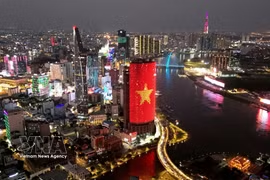
Hanoi (VNA) – Vietnam’s draft Law on Urban Development introduces a stronger decentralisation framework, granting greater autonomy and creating a more enabling institutional environment for special urban centres such as Ho Chi Minh City and special economic zones.
However, to truly fulfill its role as a special urban area, Ho Chi Minh City should be guided by a clear development philosophy that places people at the centre, recognises culture as the foundation of sustainable growth, and measures success by the quality of life and happiness of its residents.
Talking about the draft law, Prof., Dr Tran Ngoc Them from Hung Vuong University in Ho Chi Minh City, stressed that a special city requires not only special institutions but also a distinctive vision that prioritises human development and cultural identity.
In line with the Politburo’s Resolution No. 80-NQ/TW on Vietnamese culture development, which identifies culture and people as key drivers of sustainable national development, the draft law should explicitly require all urban planning and development strategies to promote human well-being while preserving historical, cultural and local values.
For Ho Chi Minh City, this means safeguarding the cultural identity of Sai Gon–Gia Dinh–Ho Chi Minh City, fostering a civilised urban lifestyle, promoting responsible digital citizenship and strengthening civic education. The city should also adopt policies to honour cultural creators, invest in public arts to enhance its attractiveness as a tourism destination, and support creative industries through dedicated innovation funds and preferential policies.
Urban heritage should likewise be recognised as a strategic development resource. Particular attention should be given to conserving Ho Chi Minh City's unique river-based landscape. The Sai Gon-Dong Nai river system and the Can Gio mangrove forest are invaluable environmental and cultural assets that should be protected and developed sustainably. The draft law should therefore include principles safeguarding waterways, ecological corridors and natural water surfaces, while encouraging waterway transport and riverside public spaces.
The draft law’s emphasis on decentralisation has also been welcomed. Nevertheless, the professor argued that meaningful autonomy should extend to wards and communes, particularly in strategically important areas.
Alongside greater decentralisation, the draft law should strengthen mechanisms for meaningful public participation in urban governance. Mandatory community consultations for major projects, digital access to planning data and public feedback on planning adjustments, large-scale resettlement and the use of public spaces would help ensure greater transparency and accountability.
Ultimately, the true measure of a special city lies not in its skyline or economic growth figures, but in its ability to improve people's lives. Residents’ happiness and well-being should remain both the starting point and the ultimate goal of urban development, serving as the highest benchmark for effective governance and sustainable progress, Them added./.
See more
Kites ground flights at Tan Son Nhat as aviation authority calls for stronger UAV controls
Two disruptions in two days at Ho Chi Minh City's main international airport have exposed gaps in early-warning systems and prompted calls for a single lead agency to manage unauthorised aerial objects near airport zones.
Vietnamese students shine at International Olympiad in Informatics 2026
Nguyen Huu Tuan, a 12th-grade student at the High School for Gifted Students under the University of Natural Sciences, Vietnam National University, Hanoi, won gold.
Eight mass graves uncovered at Le Thi Rieng Park in Ho Chi Minh City
The teams have so far recovered 311 sets of remains at the site, including 278 individual remains and 33 from the eight mass graves.
Free bus fares drive sharp rise in ridership in Ho Chi Minh City
As of August 12, the city’s bus network had served nearly 12 million passenger trips, up about 44% year on year. On August 12 alone, around 306,000 passengers used free buses, an increase of roughly 55%, despite students having yet to officially return to school.
Vietnam forges cooperation with US to access advanced technologies for identifying fallen soldiers' remains
A key destination was the University of Georgia, home to a leading interdisciplinary research model for locating and recovering human remains. Its research teams have developed an integrated scientific ecosystem combining history, anthropology, archaeology, artificial intelligence (AI), chemical sensing, environmental DNA (eDNA), remote sensing and geophysics.
More than 1,700 war martyrs’ remains recovered
The national steering committee will continue verifying information on suspected martyrs’ graves in key areas, including Tan Son Nhat Airport in Ho Chi Minh City, Quan Y Bac Son Hill in Dong Nai, the Con Tien base area in Quang Tri and former Vi Xuyen battlefields in Tuyen Quang.
Deputy Prime Minister orders completion of database of fallen soldiers by year-end
Authorities have collected 1,715 sets of remains, or 24.5% of the target, since March 15. Of those, 691 sets were recovered in Vietnam, 174 in Laos and 850 in Cambodia. A total of 13 mass graves were found, including five in Tuyen Quang and eight at Le Thi Rieng Park in Ho Chi Minh City.
Ho Chi Minh City launches psychological, social support places for children, families
In its initial phase, the office will focus on providing psychological support for children and families facing difficulties, while gradually expanding its network of experts and support services.
Quang Tri celebrates 100th birthday of Cuban leader Fidel Castro
Addressing the ceremony, Vice Chairman of the provincial People’s Committee Le Duc Tien said Fidel Castro was a figure of exceptional stature whose life and revolutionary career were closely associated with the victory of the Cuban Revolution and the struggle for national independence and sovereignty, as well as the aspirations of peoples around the world for independence, freedom, peace and justice.
Top leader calls for stronger Vietnam–New Zealand ties in higher and vocational education
General Secretary and President To Lam called on the two sides to jointly develop high-quality human resources for the digital, green, circular and knowledge-based economies, prioritising areas of strong demand and high complementarity such as artificial intelligence (AI), data science, digital technology, cybersecurity, biotechnology, smart agriculture, food technology, renewable energy, environmental technology, public governance and emerging occupations of the future.
Lang Son tackles skilled labour shortage in border-gate logistics
As the province promotes investment in logistics services and infrastructure at border gates, businesses are increasingly shifting from relying on manual labour for loading and transshipment to workers capable of operating modern equipment and handling specialised tasks.
Vietnamese seek greater independence in old age, opening new room for silver economy
Vietnamese people are changing their perception of old age from a period of dependence to a journey that requires proactive preparation. Financial independence and health is increasingly regarded as a meaningful “asset” for families.
Hanoi to provide free textbooks from 2026–2027 school year
The municipal Department of Education and Training will work with the Department of Finance to guide wards, communes and educational institutions in implementing the student support policies adopted by central authorities and the municipal People’s Council.
AIC case in Ca Mau: Nguyen Thi Thanh Nhan sentenced to 10 years in prison
The People's Court of Ca Mau province on August 12 sentenced former Chairwoman and General Director of the Advanced International Joint Stock Company (AIC) Nguyen Thi Thanh Nhan to ten years in prison for "violating bidding regulations, causing serious consequences" in a case involving the inflation of equipment prices for environmental monitoring stations in the former Bac Lieu province (now Ca Mau province).
Party General Secretary and President meets Vietnamese community in New Zealand
General Secretary of the Communist Party of Vietnam (CPV) Central Committee and President To Lam described overseas Vietnamese as “ambassadors” who help promote Vietnam's positive image internationally, and urged them to maintain solidarity, preserve national pride and cultural traditions, and make practical contributions to the country's development.
73 flights directly affected by UAV sightings at Tan Son Nhat int’l airport
UAVs were detected twice near the Tan Son Nhat International Airport over more than two hours, from 6 pm to 8 pm on August 11, disrupting flight operations.
Vietnam’s language push abroad gains traction
The 2023–2030 project to honour the Vietnamese language overseas kicked off at a timely moment, meeting the OVs' expectations for wider language spread. More than four years since its 2022 launch, the project has produced concrete results, with a growing number of effective initiatives and novel approaches.
Resolution 23 creates space for overseas Vietnamese to contribute to national development
After more than 20 years of implementing Resolution 36, the Party and State’s policies have been translated into numerous effective policies and actions, helping strengthen the group’ attachment to their homeland and creating favourable conditions for increasing numbers of them to return to Vietnam to visit relatives, invest, do business, work and engage in exchanges.
Vietnam–Australia education cooperation enters new phase
The Vietnam–Australia TechConnect Forum, held on August 10 at the University of Technology Sydney during General Secretary and President To Lam’s state visit to Australia, showcased this opportunity. The event brought together representatives from both countries’ governments, universities, research institutes, and businesses, creating a space to link education with science, technology, and investment.
Vietnam Red Cross Society provides 100 billion VND in aid to Cuban people
President of the VRCS Central Committee Do Thi Thu Thao said the assistance represents the sentiments, solidarity and gratitude of the Vietnamese people towards the Cuban people, as well as the continuation of the friendship nurtured by generations of the two countries.