Personnel work heats up Party plenary session

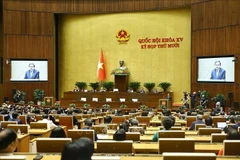
The 7th plenary session of the 12th-tenure Communist Party of Vietnam (CPV) Central Committee continued its second working day on May 8, discussing many crucial issues for the country.
Personnel work heats up Party plenary session ảnh 1Party General Secretary Nguyen Phu Trong delivers a speech at the opening of the 7th session of the 12th-tenure Communist Party of Việt Nam (CPV) Central Committee. (Photo: VNA)

Hanoi (VNA) – The 7th plenary session of the 12th-tenure Communist Party of Vietnam (CPV) CentralCommittee continued its second working day on May 8, discussing many crucialissues for the country.

In the morning, the Party CentralCommittee scrutinised the project on building a contingent of cadres at alllevels, especially strategic level, with sufficient virtue, capacity andprestige on par with their assigned tasks.

Politburo member and Prime Minister Nguyen Xuan Phuc, on behalf of thePolitburo, chaired the debate.

In the afternoon, the committeeworked in groups, discussing the scheme on salary reform for officials, civilservants, public employees, armed forces, and workers in businesses.

In his opening remark, Party General Secretary Nguyen Phu Trong noted theimportance of the meeting, which takes place at the middle of the 12th tenurein the context of good development of the country and new opportunities for therenewal cause.

He asked the Party Central Committeeto uphold their responsibility and study carefully submitted reports andprojects in order to make quality contributions to documents to be passed atthe end of the session.

The plenary session will conclude onMay 12-VNA
VNA

See more

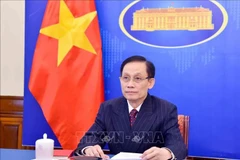
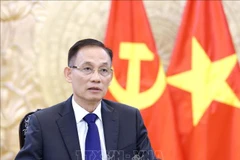
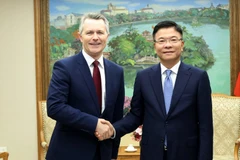
Vietnamese Minister of Foreign Affairs Le Hoai Trung (Photo: VNA)

Vietnamese, Lao foreign ministers hold online talks

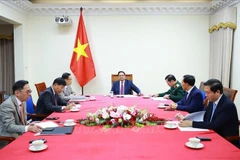
The two ministers agreed to maintain close coordination in the time ahead and to expand cooperation under the new framework and orientation, underscoring the significance of the two countries’ “great friendship, special solidarity, comprehensive cooperation, strategic cohesion”.

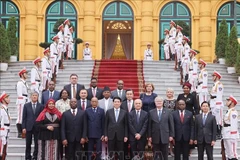
State President Luong Cuong (fourth from left, first row) and newly-appointed foreign ambassadors in Hanoi on December 12, 2025. (Photo: VNA)

State President receives newly-appointed foreign ambassadors

Receiving Egyptian Ambassador Hany Mostafa Mohamed Mostafa Hassan, President Cuong affirmed that Vietnam highly evaluates Egypt’s role, position, and contributions to regional peace and stability. He also congratulated the African country on its achievements in implementing the 2030 Vision.

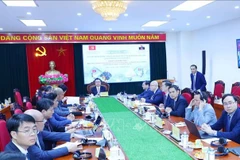
An overview of the seminar on the Party’s leadership in ensuring macroeconomic stability, renewing the growth model, restructuring the economy and promoting international integration (Photo: VNA)

Vietnam, Cuba exchange theoretical views on Party’s leadership in macroeconomic stability

The two sides explored in depth the Party’s role in leadership, orientation, oversight and strategic coordination in economic management; approaches to implementing economic restructuring programmes alongside the renewal of the growth model; measures to respond to global economic volatility, inflationary pressures and shifts in global trade; and the building of effective strategic advisory bodies to ensure the Party’s comprehensive leadership in a changing context.

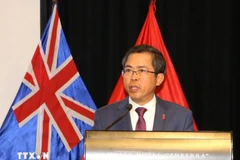
Vietnam’s Ambassador to Australia Pham Hung Tam (Photo: VNA)

Australia–Vietnam Policy Institute serves as bridge for bilateral relations

Established in 2022, AVPI serves as a forum for exchanging ideas among businesses, government agencies, non-profits, universities, and scholars in Australia on Vietnam. The institute acts as a platform for policy dialogue, focusing on research and insights on strategic relations and bilateral economic ties.

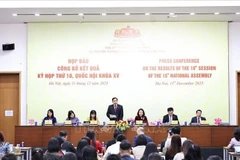
General Secretary and Chairman of the NA Office Le Quang Minh chairs the press conference announcing the results of the NA's 10th session (Photo: VNA)

10th session helps strengthen public trust in personnel work, NA’s supreme oversight

Personnel consolidation carried out at the NA's 10th session helps ensure continuous, unified, effective, and efficient leadership of the state apparatus; guarantee smooth and uninterrupted direction and governance; and prevent any leadership gaps in critical areas. All positions elected or approved by the legislature meet the key criteria required within the organisational structure.