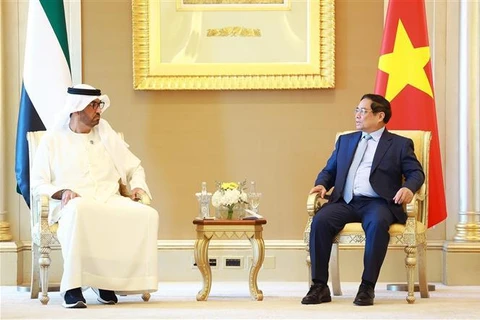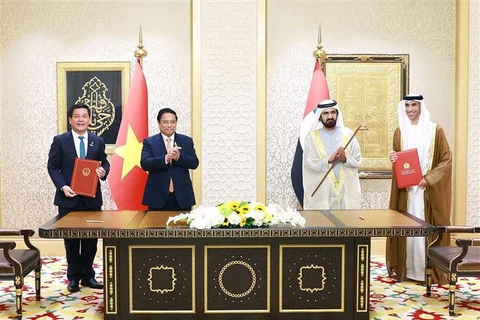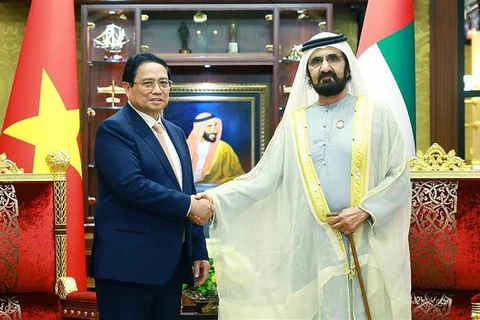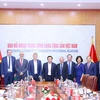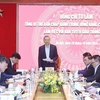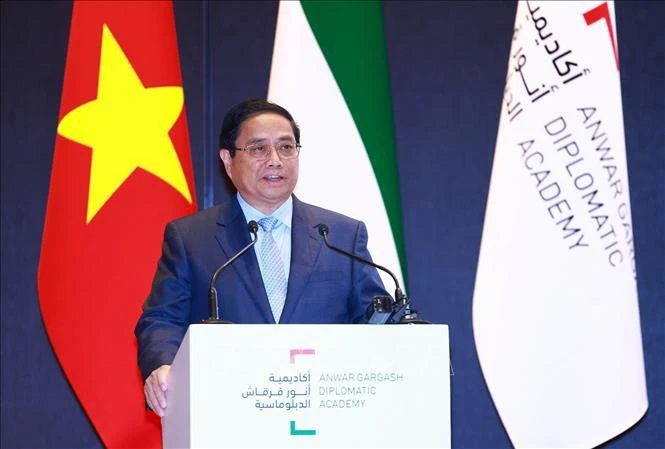
Abu Dhahi (VNA) – Vietnamese Prime Minister Pham Minh Chinh visited and delivered a policy speech at the Anwar Gargash Diplomatic Academy (AGDA) in Abu Dhabi on October 29 morning (local time), as part of his official visit to the United Arab Emirates (UAE).
Founded in 2014, the AGDA has been contributed to shaping the UAE’s diplomatic vision, particularly in reconciliation diplomacy and fostering a spirit of international solidarity and cooperation.
Addressing the audience of 200 students, professors, UAE government officials and diplomatic representatives, PM Chinh shared insights on the current global and regional landscapes; Vietnam’s foundational factors, development perspectives, achievements, and future directions; a vision for the Vietnam-UAE Comprehensive partnership and Vietnam’s relations with the Middle East in the coming years.
Profound and epochal changes
On the current global and regional situation, PM Chinh noted that the world, the Gulf and the Association of Southeast Asian Nations (ASEAN) are experiencing profound and epochal changes.
While peace, cooperation and development remain the prevailing trends and the ardent aspirations of all nations worldwide, the global security environment is becoming increasingly unstable, uncertain and unpredictable. Multilateralism and international law are being seriously challenged in some places and at sometimes, and strategic competition among major powers is intensifying.
The Vietnamese leader asserted that the future of the world is being profoundly shaped by the explosive growth of sci-tech, innovation, particularly digitalisation and artificial intelligence (AI); the negative impacts of non-traditional security challenges such as climate change, population aging, natural disasters and resource depletion; and the fragmentation, polarisation and division driven by global geo-strategic and geo-economic competition.
Three key areas, he stressed, will lead and define the future: the development of digital economy, green economy, and circular economy, knowledge-based and night-time economy; innovation, entrepreneurship and the fourth industrial revolution; the development of quality human resources and artificial intelligence (AI).
Addressing these challenges, he called for a comprehensive, inclusive and global mindset, methodology and approach. This requires that all nations persist in dialogue and cooperation, embrace a spirit of solidarity and unity in diversity, and uphold multilateralism and international law. Efforts must be made to find effective, holistic and effective solutions that put people at the centre, leaving no one behind, while creating new development spaces to maintain a peaceful, cooperative and prosperous global environment.
According to the PM, within this broader trend, collaborating to shape such an international order is both a benefit and a responsibility of all countries, including Vietnam and the UAE.
Vietnam enters a new era - the rising era of the nation
In his address, PM Chinh outlined Vietnam’s foundational factors, development perspectives, achievements and future directions.
Vietnam consistently focuses on building three main foundational elements: a socialist democracy, a socialist rule-of-law state, and a socialist-oriented market economy, he said, adding that its guiding principle is to maintain political and social stability while placing people at the centre, the subject, the goal, driving force and the most important resource of development.
The PM reiterated that the country will not sacrifice social progress, equality, security, or environmental protection in pursuit of mere economic growth.
Building on this foundation, Vietnam is performing six key policies focused on external relations and integration, ensuring national defence and security; economic development; cultural development, guaranteeing social equality and welfare, and strengthening the Party and political system while combating corruption, negativity and wastefulness.
Additionally, Vietnam is pushing forward three strategic breakthroughs in institutional framework, infrastructure, and human resources, with the belief that resources stem from innovative thinking, momentum arises from reform, and strength is drawn from the people, he said.
After nearly four decades of renewal, Vietnam, once a war-torn nation which was besieged and embargoed, has forged diplomatic ties with 194 countries, including comprehensive strategic partnerships with eigh nations, strategic partnerships with 10 countries, and comprehensive partnerships with 14 others, including the UAE. Vietnam is also an active member of over 70 global and regional organisations. The Communist Party of Vietnam (CPV) has established relations with 253 parties across 115 countries worldwide.
From being a poor and backward nation ravaged by war, Vietnam has evolved into a developing country with a middle-income status, achieving an average income of roughly 4,300 USD per person. It ranks among the 34 largest economies and the top 20 in terms of trade in the world. Vietnam has signed 17 free trade agreements, with the Comprehensive Economic Partnership Agreement (CEPA) with the UAE being the latest. The country is also ranked 11th out of 133 nations in terms of innovation index.
In the face of numerous global economic challenges and instability, with many economies experiencing a downturn in growth and investment, Vietnam’s economic growth and investment have continued to recover positively, estimated at around 7% in 2024, with foreign investment expected to reach some 39-40 billion USD. Budget deficit, public debt, government debt, and foreign debt are being effectively managed. Social welfare and living standards have continued to improve, with political and social stability maintained, and national defence and security strengthened. Vietnam's international relations and integration efforts have also yielded significant results.
Vietnam is also leading the way in accomplishing many Sustainable Development Goals (SDGs), particularly in poverty reduction, health care and education. With its growing strength and influence, Vietnam is increasingly proactive in contributing to global shared concerns.
Regarding future orientations, tasks and key solutions, PM Chinh conveyed that Party General Secretary To Lam has clearly articulated the message of leading the country into a new era - the rising era of the nation.
Vietnam has set an overarching goal of a rich and strong nation, with democracy, equality, and civilisation as its driving force. The strategic objective is to become a modern industrialised nation with upper-middle income by 2030 and a developed high-income country by 2045, he said.
Looking ahead, Vietnam will focus on six key task areas and solutions, including prioritising growth in tandem with maintaining macro-economic stability, controlling inflation, and ensuring the major balances of the economy; renewing traditional growth drivers while advancing new growth engines like sci-tech, innovation, digital transformation, green transition, circular economy, sharing economy, AI and semiconductor chips; accelerating industrialisation and modernisation, and making substantive progress in strategic breakthroughs and economic restructuring; effectively mobilising and using all resources, harmoniously combining internal and external resources; ensuring social welfare, environmental protection, and climate change adaptation; and fortifying national defence-security, stepping up external relations and global integration to create a peaceful and stable environment conducive to national development, he added.
Six key priorities in Vietnam – UAE relations
PM Chinh said that the UAE is the first stop on his tour to the Middle East. The upgrade of the bilateral relations to a Comprehensive Partnership and the signing of the Comprehensive Economic Partnership Agreement (CEPA) signify a strong affirmation that, in the new era - the rising era of the Vietnamese nation, the Middle East and the UAE hold significant importance in Vietnam's foreign policy.
Describing the UAE as a nation that has turned the impossible into possible, the PM congratulated the UAE Government and its people on their success in developing the country as a leading economic, financial, and technological hub in the region.
While the UAE is striving to realise its "UAE Vision 2031" and "UAE Vision 2071" with a relentless ambition to progress, Vietnam is working to achieve its centennial goals: becoming a developing country with a modern industry and upper-middle income by 2030 (the 100th founding anniversary of the CPV) and a developed country with high income by 2045 (the 100th anniversary of the nation’s founding).
Both nations need to accompany and inspire each other on the journey to realise their visions and aspirations for a prosperous and happy future, he said.
To realise the newly-established Comprehensive Partnership, he proposed that Vietnam and the UAE strengthen cooperation across six key priorities. These include maintaining and fostering political trust, particularly through the exchange of high-ranking delegations, and actively promoting cooperation, friendship and solidarity between the States, Governments and people of both countries; turning economic-trade-investment collaboration into a pillar of the bilateral relationship via the effective implementation of the recently signed CEPA, facilitation of UAE investments in major and breakthrough projects and development of Halal industry in Vietnam; increasing cooperation in sci-tech, innovation, digital transformation; further enhancing collaboration in education-training, people-to-people exchanges, tourism and culture; intensifying multilateral cooperation, upholding international law, and persisting in promoting dialogue to build trust, enhance solidarity, and mutual understanding among people. They should also actively contribute to global efforts in addressing global challenges.
In conclusion, the Vietnamese leader stressed that the Middle East, particularly the Gulf region, including the UAE, is a land of great potential. Despite geographical distantance, the countries in the region, especially the Gulf Cooperation Council (GCC), are becoming increasingly close to ASEAN in terms of vision and development orientations.
He expressed his confidence that Vietnam and the UAE will together write a brighter new chapter in their bilateral relations, for the practical benefits of their people and contributing to peace, stability, cooperation and development in both regions and the world as well.
It was the final activity of PM Chinh and his entourage during their official visit to the UAE, concluding a highly successful first leg of their tour to three Middle Eastern countries.
In the afternoon of the same day, PM Chinh, his spouse and the Vietnamese delegation left Abu Dhabi, successfully wrapping up their visit to the UAE before heading to Riyadh to attend the 8th Edition of the Future Investment Initiative (FII) and pay a working visit to Saudi Arabia./.