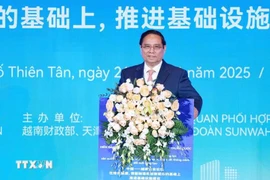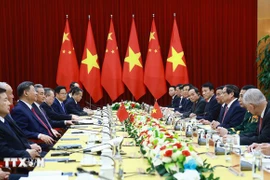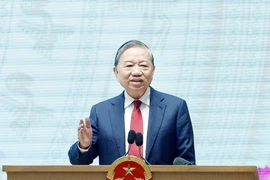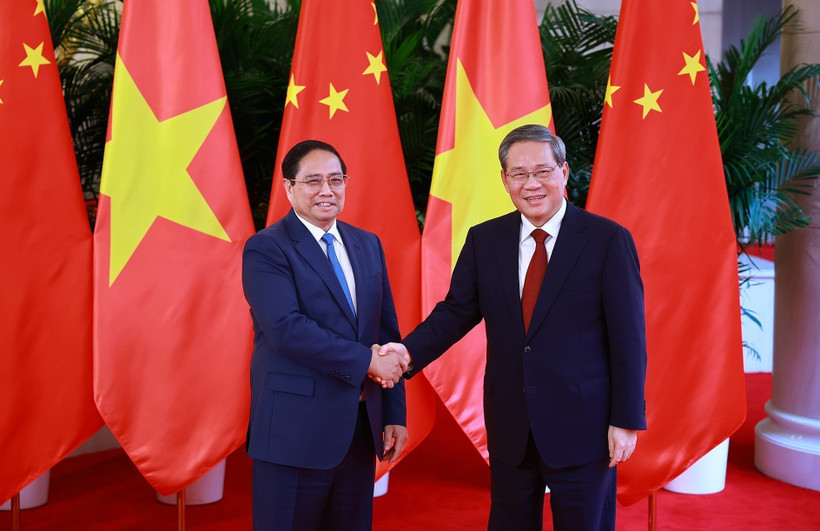
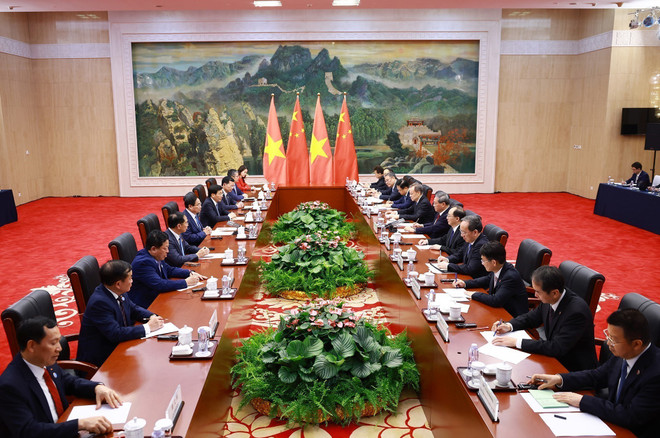
Tianji (VNA) – Prime Minister Pham Minh Chinh and Chinese Premier Li Qiang held talks in Tianjin on June 24, reaching a shared understanding to effectively implement high-level common perceptions between the top leaders of the two Parties and countries, and to translate the outcomes of recent high-level exchanges into concrete results.
The meeting took place on the sidelines of the 16th Annual Meeting of the New Champions of the World Economic Forum (WEF Tianjin 16), during PM Chinh’s working visit to China.
PM Chinh highly valued the substantive and fruitful outcomes of reciprocal visits by General Secretary of the Communist Party of Vietnam (CPV) To Lam and General Secretary of the Communist Party of China and President of China Xi Jinping, as well as successive exchanges between the two PMs in 2024 and 2025, which have provided strong impetus for bilateral cooperation across all fields.
Vietnam always considers developing its relationship with China a strategic choice, an objective necessity, and a top priority in its foreign policy, said the Vietnamese PM, expressing confidence that China will continue to grow and play an increasingly important role in global development, security, and civilisation. He shared updates on Vietnam’s far-reaching reforms being undertaken under the leadership of the CPV Central Committee, headed by General Secretary To Lam.
Premier Li welcomed PM Chinh’s continued participation in the WEF meetings in China for the third consecutive time, which he said demonstrates Vietnam’s strong commitment and top priority given to the bilateral relationship.
Congratulating Vietnam on its recent socio-economic achievements, he voiced support for Vietnam’s successful realisation of its development goals and for the CPV’s 14th National Congress.
Reflecting on the progress made in bilateral cooperation, both leaders agreed that relations between the two Parties and countries have witnessed significant and substantive strides, with notable highlights such as regular high-level exchanges, reinforced political trust, the establishment of new cooperation mechanisms, and sustained momentum in economic, trade, investment, and tourism cooperation. Progress has also been made in railway and aviation partnerships, as well as vibrant locality-to-locality and people-to-people links.
The two sides agreed to maintain regular exchanges at all levels, enhance the quality and effectiveness of cooperation in all areas, strengthen coordination within multilateral frameworks, and jointly safeguard a peaceful and stable environment, bringing greater benefits to the peoples of both countries.
PM Chinh proposed that both sides further promote the key role of security and defence cooperation in the overall bilateral relationship; improve the quality and effectiveness of practical cooperation across various fields; and maintain regular operations of the intergovernmental working groups on land-based infrastructure, monetary issues, and maritime cooperation, as well as the joint committees on economic-trade and scientific-technological cooperation.
He also suggested studying the establishment of new working groups in education, training, finance, culture, and people-to-people exchanges.
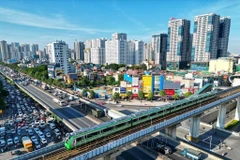
The Vietnamese PM proposed the synchronised implementation of three standard-gauge railway lines connecting Vietnam and China, with priority given to accelerating the groundbreaking of the Lao Cai – Hanoi – Hai Phong route in December 2025.
He expressed his hope that China would support the project through concessional loans, technology transfer, personnel training, and cooperation with Vietnam to build a modern and integrated railway industry.
For more balanced and sustainable bilateral trade, Prime Minister Chinh suggested that China expand imports of Vietnamese agricultural products, strengthen electricity grid connectivity, accelerate the construction of smart border gates, and study the pilot model of cross-border economic cooperation zones.
The two countries should jointly invest in major projects that symbolise bilateral ties, deepen cooperation in science and technology, innovation, healthcare, culture, sports, tourism, and aviation; promote local-level cooperation and people-to-people exchanges, especially among the younger generations; and support each other in multilateral frameworks, he said.
For his part, Premier Li Qiang expressed his hope that both countries will successfully organise the 17th meeting of the China-Vietnam Steering Committee for Bilateral Cooperation, as well as the strategic dialogue mechanism among the Ministries of Foreign Affairs, Public Security, and National Defence, to comprehensively promote cooperation following the “six major orientations".
He affirmed that China is ready to speed up strategic development alignment with Vietnam and values Vietnam’s desire to commence the standard-gauge railway projects soon.
Li proposed the early organisation of the first meeting of the Joint Committee on Railway Cooperation, accelerating feasibility studies, and adopting the best possible plan for implementation, ensuring scientific integrity, safety, and compliance with standards.
He affirmed China’s readiness to expand imports of more high-quality Vietnamese goods and to encourage capable enterprises to invest in Vietnam in fields such as AI, digital economy, green economy, next-generation 5G, and satellite applications. He also expressed willingness to boost people-to-people exchanges and expedite aid projects that directly benefit local communities.
During their talks, the two leaders engaged in sincere and frank exchanges on maritime issues and agreed to better manage and resolve disagreements to maintain peace and stability. Prime Minister Chinh proposed that both sides strictly implement high-level common perceptions and the "Agreement on Basic Principles Guiding the Settlement of Maritime Issues between Vietnam and China."
He also called on the two countries, together with ASEAN, to strive for an early conclusion of an effective and substantive Code of Conduct (COC) in the East Sea in compliance with international law and the 1982 United Nations Convention on the Law of the Sea (UNCLOS), based on the sides' consensus.
The two leaders also exchanged views on international and regional issues of mutual concern and agreed to maintain coordination and cooperation at regional and international forums. Premier Li welcomed Vietnam’s decision to become a partner of BRICS./.