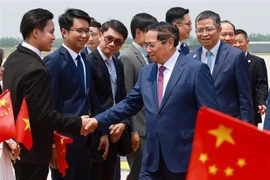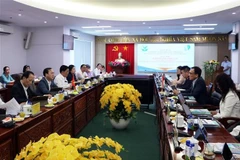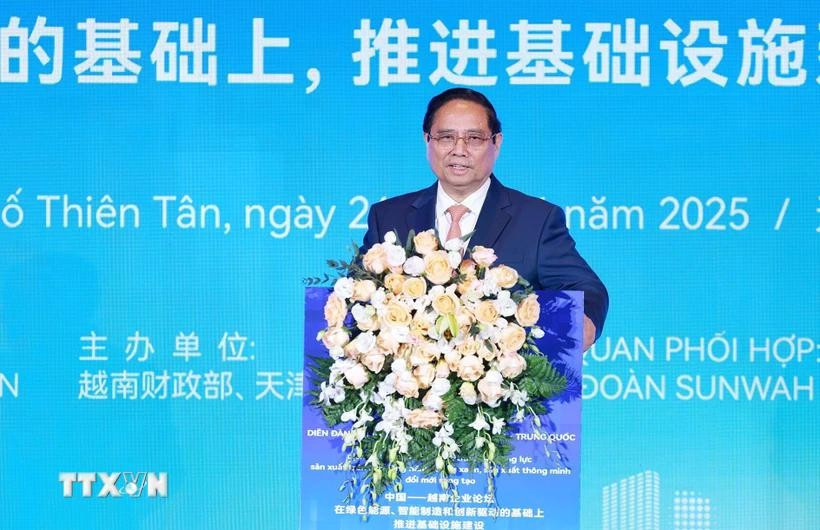
Tianjin (VNA) – Prime Minister Pham Minh Chinh affirmed that science, technology, innovation, digital transformation, green transition, and circular economy are offering limitless opportunities for bilateral collaboration while addressing the Vietnam-China business forum in Tianjin on June 24.
Reviewing the long-standing development of Vietnam–China relations, PM Chinh, who is in Tianjin to attend the 16th Annual Meeting of the New Champions of the World Economic Forum (WEF), emphasised that building on the strong foundation of the bilateral ties, enterprises from both countries are not only cooperating for mutual development but are also contributing to the bilateral relationship, the Vietnam-China Comprehensive Strategic Cooperative Partnership, and to building a Vietnam–China community with a shared future which carries strategic significance.
As current difficulties and challenges outweigh opportunities and favourable conditions, he urged both countries and their business communities to unite, remain confident, and be ready to confront these challenges, and view them as opportunities for growth and transformation, so as to contribute to fostering a peaceful, stable, cooperative, and development environment in the region and around the world.
The PM informed participants that Vietnam is entering a new era of strong development and prosperity, with the Party and State recently identifying “four strategic pillars” to realise the country’s long-term centennial goals and to assert its position in this new era. At the same time, Vietnam is undertaking a major reform in restructuring the political system’s organisational apparatus and the two-tier local administration model.
In recent years, the Vietnamese Government has consistently advanced the three strategic breakthroughs in institutions, infrastructure, and human resources with the aim of creating favourable conditions for more efficient investment and operations of businesses, he said.
The Vietnamese leader called on enterprises of both countries to actively promote cooperation, investment, and business development in a spirit of mutual benefit, harmonised interests, and shared risks.
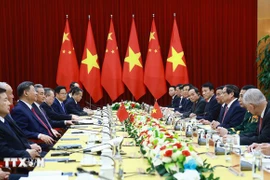
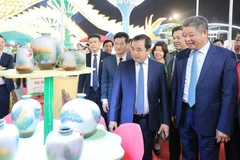
The PM also expressed his confidence that, with the current positive political atmosphere, economic collaboration will continue to thrive, generating greater added value. He emphasised that the successes of Chinese businesses in Vietnam are also the successes of Vietnam, contributing to the cultivation of the Vietnam–China friendship. The forum also saw the attendance of Vietnamese Deputy Prime Minister and Minister of Foreign Affairs Bui Thanh Son, ministers, senior officials from both countries, as well as ambassadors, and a large number of Vietnamese and Chinese enterprises, with discussions focusing on cooperation in developing modern infrastructure and financial services, enhancing production capacity on the foundation of green energy, smart manufacturing, and innovation.
Participants reviewed the current situation of Vietnam–China economic cooperation and introduced each country’s investment potential and partnership needs. They agreed that economic cooperation remains a vital pillar of the Vietnam–China relationship, which has been continuously growing.
In 2024, Vietnam maintained its position as China’s largest trading partner among ASEAN member countries and the fourth largest in the world, with bilateral trade reaching 205.2 billion USD, a 19.3% increase from 2023. In the first five months of 2025, bilateral trade reached 92.9 billion USD, up 18.7% year on year.
On the investment front, by the end of 2024, China ranked 6th out of 148 countries and territories investing in Vietnam, with 5,111 valid projects and 30.83 billion USD in total registered capital. Chinese investors are present in 19 out of 21 sectors with FDI and operate in 55 out of Vietnam’s 63 provinces and centrally-run cities.
Last year, Vietnam welcomed 3.74 million Chinese visitors, making China the second largest source of international arrivals and accounting for 21.26% of the total number of foreign visitors to the Southeast Asian country.
Chinese enterprises regarded Vietnam as one of the fastest-growing and most dynamic economies in the region, offering a favourable investment climate. They expressed their strong interest in stepping up investment in sectors such as infrastructure, high technology, energy, particularly electricity, and finance, including the development of international financial centres.
Vietnamese delegates highlighted the country’s strategic priorities in areas such as railway development, telecommunications, high-tech industries, innovation, digital transformation, and energy. They expressed their confidence that with the foundation of strong bilateral ties and the proven track record of Chinese businesses in Vietnam, more Chinese companies will expand operations and collaborate in financing, technology transfer, and smart governance.
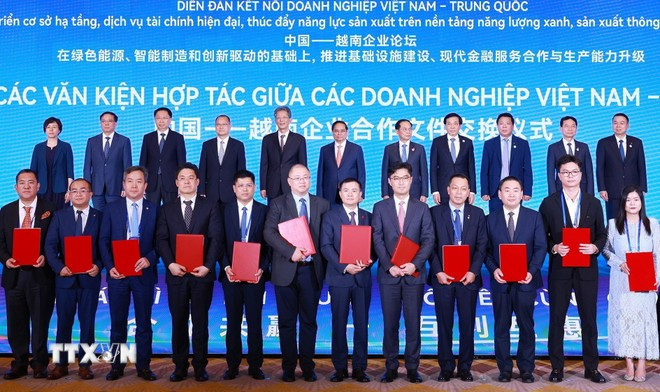
At the forum, in the presence of PM Chinh and other delegates, Vietnamese and Chinese companies exchanged nine cooperation and investment agreements in different fields, including energy, railways, information and telecommunications technology, real estate, transport, and goods import-export./.