FAO Representative hails Vietnam’s progress in sustainable agriculture

Mr. Vinod Ahuja, Food and Agriculture Organization of the United Nations (FAO) Representative for Vietnam hails Vietnam’s progress in sustainable agriculture, particularly low-emission rice, in an exclusive interview with the Vietnam News Agency as 2025 wraps up.

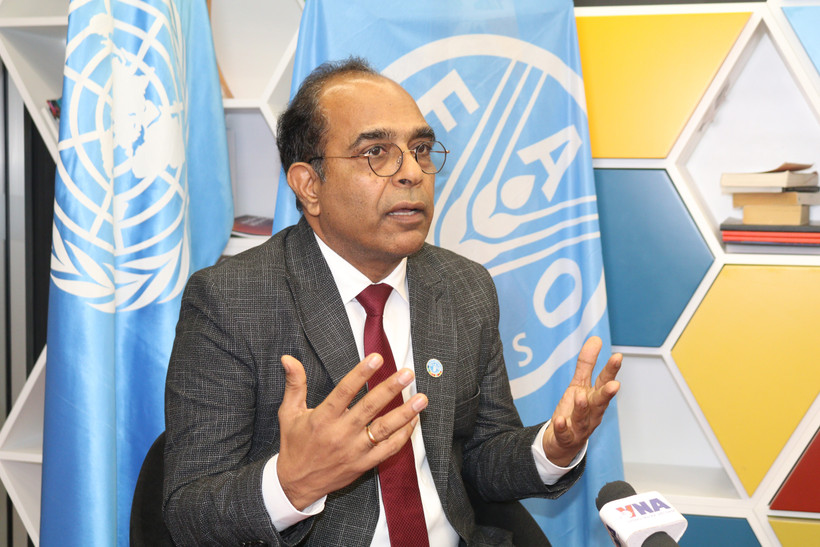
Mr. Vinod Ahuja, Food and Agriculture Organization of the United Nations (FAO) Representative for Vietnam. (Photo: VNA)

Hanoi (VNA) - Mr. Vinod Ahuja, Food and Agriculture Organization of the United Nations (FAO) Representative in Vietnam granted an exclusive interview to Vietnam News Agency reporter, during which, he hailed Vietnam’s progress in sustainable agriculture, particularly low-emission rice.

Reporter: As the Country Programming Framework (CPF) for Vietnam for the period 2022–2026 nears completion, how would you assess the collaboration between the Food and Agriculture Organization (FAO) and the Ministry of Agriculture and Rural Development, now the Ministry of Agriculture and Environment, and the key outcomes achieved under this framework?

Mr. Vinod Ahuja, FAO Representative for Vietnam: Our collaboration with the ministry has been very close, very practical, and very results-focused. What I value most is how the partnership has evolved. It is no longer only about individual projects. It is increasingly about systems change.

A good example is food systems transformation.

In 2023, Viet Nam approved its national action plan. In 2024, we moved further with the Food Systems Transformation Partnership Agreement. It brings together key ministries and more than 45 national and international partners. And it is now driving implementation across agroecology, nutrition, and reducing food loss and waste.

At the same time, the CPF has delivered very tangible results. FAO has mobilized almost 40 million US dollars. But more important than funding is impact.

On One Health, we worked closely with the ministry to reduce endemic zoonotic diseases. We helped manage major risks such as African Swine Fever and avian influenza. And we addressed antimicrobial resistance and pesticide misuse. We also strengthened animal disease surveillance and the national veterinary management scheme.
2.jpg
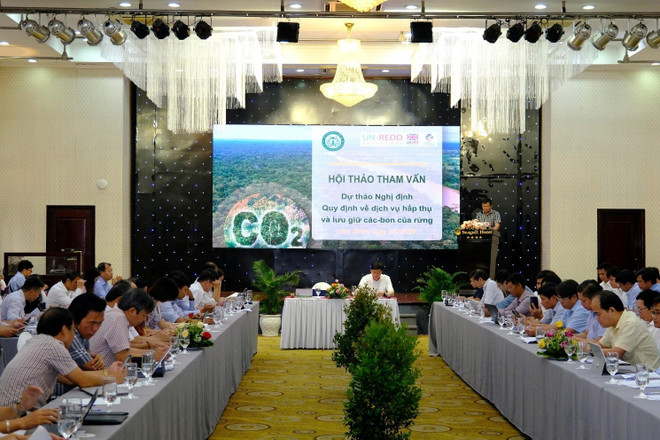
A Consultative Workshop on the Draft Decree Regulations on forest carbon sequestration and storage services in Gia Lai, July 2025. (Photo: FAO in Vietnam)

On climate, environment, and natural resources, we worked towards strengthened capacity at both national and local levels. From forest governance and land-law revision to water accounting in the Mekong Delta, Red River Delta, and Central Highlands.

Through the Forest and Farm Facility, we supported more than 50 producer organizations and over 2,200 farming households in the Northern Mountains.

These are just a few examples. But today, the CPF is not just about projects. It is about systems change. And strong national ownership.

Reporter: Vietnam is pursuing a more sustainable agricultural pathway under its “Sustainable Agriculture and Rural Development Strategy 2021–2030,” which emphasises low-emission rice cultivation. How do you evaluate Vietnam’s progress to date, and what recommendations would you make to further strengthen the effectiveness of this strategy?

Mr. Vinod Ahuja, FAO Representative for Vietnam: Vietnam has made real and encouraging progress under its Sustainable Agriculture and Rural Development Strategy, especially on low-emission rice.

But the context is very challenging. Climate change is already affecting farmers. In the Mekong Delta, land is sinking, salinity is increasing, and natural resources are under pressure. Some rice-growing areas today may no longer be suitable in the future.

That is why the One Million Hectares of High-Quality, Low-Emission Rice Scheme, is so important. It marks a clear shift: from quantity to quality and from higher emissions to lower emissions, with stronger resilience. Early pilots are promising. The key challenge now is scaling up.

Looking ahead, I would highlight four priorities. First, keep farmers at the centre. Incentives must be clear at farm level. Lower costs. Lower risks. Better returns for quality rice. Second, low-emission rice must be rewarded across the value chain. This means traceability, strong quality standards, and buyer commitments. Third, we need simple and credible systems to measure emissions and water productivity. Finally, finance is critical. Public funding alone will not be enough. Blended and private finance will be essential.

If we do this well, low-emission rice is not just good for the climate. It becomes the smart economic choice for Viet Nam.
img-6958.jpg
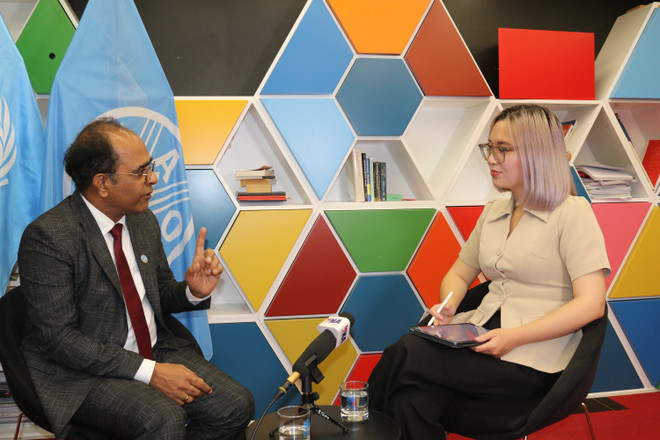
Mr. Vinod Ahuja, Food and Agriculture Organization of the United Nations (FAO) Representative for Vietnam talks to Vietnam News Agency reporter Ngoc Ly. (Photo: VNA)

Mr. Vinod Ahuja, Food and Agriculture Organization of the United Nations (FAO) Representative for Vietnam talks to Vietnam News Agency reporter Ngoc Ly. (Photo: Quyet Thang/VNA)

Reporter: What measures should Vietnam prioritise to enhance its food security and increase its meaningful contributions to the global food supply chain, particularly in the context of intensifying climate change impacts and global economic uncertainties?

Mr. Vinod Ahuja, FAO Representative for Vietnam: Viet Nam is already a major contributor to global food markets. To protect that role, and to strengthen food security at home, I would mention a few priority areas.

First, we need to invest much more in climate resilience, anticipatory action, and shock-responsive social protection. Climate shocks are hitting harder and more often. Last year’s Typhoon Yagi and this year’s multiple storms and tropical depressions caused widespread damage to agriculture, infrastructure, and livelihoods, especially in the north and centre. The lesson is simple: preparedness, early action, and resilient livelihoods are no longer optional. They are at the heart of food security.

Second, plant and animal health must be protected through stronger, integrated One Health systems. Disease risks, including antimicrobial resistance, can disrupt production, trade, and livelihoods very quickly if we are not ahead of them.

Third, Viet Nam needs to compete in global markets on quality and sustainability. That means better standards, stronger traceability, greener value chains, and practical support for smallholders. This also means need for more investment in digital traceability, harmonised food safety and phytosanitary measures. And equally important cooperatives and small enterprises need training, technology, and access to finance to make green and low-carbon agriculture work in practice.

Finally, digital tools, including artificial intelligence, can be real game changers across agriculture and the food system. But they only work if they are human centered, built into strong institutions, and backed by capacity and infrastructure.

Taken together, these steps will help Viet Nam remain a trusted global supplier of safe, traceable, and green food.

Thank you for your insights./.

VNA

See more

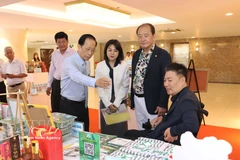
A Vinh Long official introduces signature local products to Korean guests. (Photo: VNA)

Vinh Long courts Korean investment in key sectors

Vice Chairman of the provincial People’s Committee Nguyen Truc Son vowed to accompany investors and provide them with optimal conditions, while building a transparent and stable business environment to secure long-term engagement from foreign enterprises, particularly those from Daejeon.

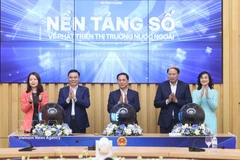
Delegates at the launching ceremony (Photo: VNA)

Digital platform on overseas market development launched

With Vietnam’s network of 64 trade offices overseas, Deputy PM Son noted that connecting them through a modern digital platform could help establish a unified national trade information system that operates efficiently, transparently and with strong forecasting capacity.

The Government’s issuance of Decree No. 72/2026/ND-CP revising preferential import tariffs on several petrol products and raw materials is a timely move to diversify supply sources. (Photo: VNA)

Fuel import tariff cuts strengthen Vietnam’s energy resilience: experts

Economic expert Dinh Trong Thinh said revising fuel import tariffs helps diversify supply sources and reduce reliance on traditional markets, thereby strengthening Vietnam’s ability to cope with potential global supply shocks. Ensuring access to multiple energy sources is also vital for safeguarding national energy security, he added.

Leaders of Dak Lak province inspect IUU fishing prevention and control efforts at Phu Lac fishing port, Hoa Hiep ward. (Photo: daklak.gov.vn)

Dak Lak readies for EC mission on anti-IUU fishing efforts

Dak Lak province is completing preparations for an upcoming European Commission (EC) inspection on efforts to combat illegal, unreported and unregulated (IUU) fishing, with a view to having the fisheries “yellow card” removed.

Vietnamese Ambassador to Argentina Ngo Minh Nguyet speaks at the event. (Photo: VNA)

Vietnam, Argentina promote trade, investment cooperation

On relations with South America, Nguyet noted that in December 2025, Vietnam and the Southern Common Market (MERCOSUR) announced the launch of negotiations for a Preferential Trade Agreement (PTA). She expressed her hope that the agreement will be signed soon, thereby further boosting trade and investment between Vietnam and MERCOSUR member states, including Argentina.

Customers buy petrol at a Petrolimex petrol station in Tran Hung Dao ward, Hung Yen province. (Photo: VNA)

PM orders stronger measures to ensure stable petrol supply

The MoIT was instructed to direct key petrol producers and traders to proactively develop supply plans to guarantee adequate fuel provision for distribution systems, maintain regular sale operations, and sell products at listed prices. It must also closely monitor developments in global and domestic petrol markets and adopt appropriate management measures when necessary.

Farmers in Ca Mau province use combine harvesters to harvest rice. (Photo: VNA)

PM orders coordinated measures to stabilise rice production and markets

The Minister of Agriculture and Environment is tasked with instructing local authorities to closely monitor production developments, improve forecasting capacity, strengthen pest control measures, and proactively respond to adverse weather conditions to protect crops, maintain planned yields and output, and reduce production costs.

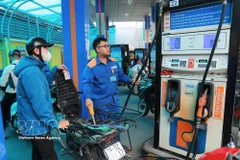
A worker refuels a vehicle at a petrol station in Hung Yen province. (Photo: VNA)

Fuel prices slashed as stabilisation fund used

According to a joint decision by the Ministry of Industry and Trade and the Ministry of Finance, the price of RON95-III petrol – the most widely used grade – fell by 3,880 VND to 25,240 VND (0.95 USD) per litre.

Customers purchase petrol at Station No. 03 (Petrolimex Hung Yen) on Quang Trung Street, Tran Hung Dao ward, Hung Yen province. (Photo: VNA)

Hung Yen takes measures to curb speculation, stabilise fuel market

Petrolimex Hung Yen maintains regular reserves of about 5,500 cubic metres at directly managed outlets and roughly 2,000 cubic metres at franchised stations. The provincial Department of Industry and Trade has ordered closer monitoring of supply and demand and retail prices to detect shortages or unjustified price hikes.

The automobile assembly line of the Honda Phuc Yen factory in Phu Tho province (Photo: VNA)

Honda Vietnam sees decline in motorcycle, car sales

Sales of both motorcycles and automobiles by Honda Vietnam declined in February, dropping 19.6% and 41.8% year-on-year, respectively, according to the company’s latest business results released on March 11.

Team 2 of the Hanoi Market Surveillance Sub-department inspects operations of a Petrolimex petrol station on Tran Quang Khai street (Photo: VNA)

Hanoi maintains stable supply of petrol, LPG

The Hanoi Market Surveillance Sub-department said petrol and LPG trading activities across the city remain stable, with supply largely meeting demand despite volatility in global energy prices.

A Qatar Airways aircraft is seen at Noi Bai International Airport in Hanoi. (Photo: VNA)

Qatar Airways cancels 13 more flights amid Middle East conflicts

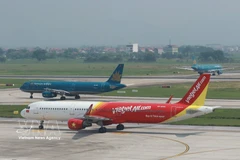
Statistics show that airspace across the Middle East has yet to return to normal operations, with multiple FIRs still imposing restrictions or partial closures. As a result, international flight operations through the region continue to face disruptions and route adjustments.