Policies needed to boost agricultural land market

A failure to improve the agricultural land market has discouraged the private sector to invest in the sector, experts have said.
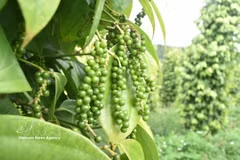
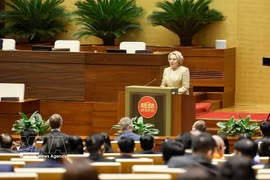
Policies needed to boost agricultural land market ảnh 1Illustrative image (Photo: VNA)
Hanoi (VNA) - Afailure to improve the agricultural land markethas discouraged the private sector to invest in the sector,experts have said.

Vice Director of the Institutefor Policy and Strategy of Agricultural and Rural Development (IPSARD) Hoang VuQuang said the prevailing problem with the country’s agriculture sector wasthat farmers often owned small land lots instead of large-scale fields.

Speaking at a workshop onmeasures to develop the agricultural land market last week in Hanoi, Quang said26 percent of Vietnamese farmers had less than 2ha of arable land, of which 63 percentowned less than 0.5ha.

The Government had recentlyattempted to adjust its land policy towards allowing large-scale landaccumulation to help create concentrated production areas and attract theprivate sector to invest in agriculture, he said, but things “did not work outas expected”.

“We can only increase ourcompetitiveness once we address the land accumulation puzzle,” Quang said.

But according to Nguyen Van Tonfrom the Department of Agriculture – Rural Affairs under the Party CentralCommittee’s Economic Commission, Vietnam’s farmland market was still young andlacked much-needed transparency to attract investors.

“Some administrativeregulations are not in favour of promoting the agricultural land market,” hesaid.

Dau An Tuan, Director of the Departmentof Legal Affairs under the Vietnam Chamber of Commerce and Industry (VCCI), told theworkshop that up to 31 percent of agricultural businesses in a survey said thatpaperwork was the biggest challenge for them.

Nguyen Trung Kien from IPSARDsaid that the Government could consider learning lessons from Japan andChina to develop the farmland market.

Japan, for example, set up theFarmland Intermediary Administration Organisation (FIAO) in 2014. It mainlyacts as a middle-man, renting land from farmers and redistricting smallfarms to form larger plots and lend to the large-scale farms and enterprises.  

“The Government’s role in thatorganisation is crucial. The Japanese government supports the FIAO by a rangeof policies like levying a high tax on abandoned land, revoking unclaimed lotsand offering financial aid for commercial farms and firms to rent the land,” hesaid.

China, meanwhile, establishedthe first Land Transfer Service Centre (LTSC) in 2010 to acquire land andprovide information on the demand and supply of the rental land market, Kiensaid. The Chinese government guarantees preferential loans for big farms andbusinesses to rent land or to build irrigation infrastructure and otherfacilities.

Meanwhile, Quang from IPSARD suggestedthe government should create a smooth legal corridor for the agricultural landmarket and have support policies in terms of credit or labour. It should buildan effective and transparent land management system, he added./.
VNA
See more

Representatives of the three first-prize-winning startups receive their awards at the event. (Photo: SGGP)

Seven green-tech startups secure 770,000 USD at Net Zero Challenge 2026

In its fourth year, the competition attracted more than 1,100 applications from 80 countries and territories, making it the most competitive edition since its launch in 2023. Nine finalists presented solutions in three categories, namely renewable energy and carbon removal; food systems and sustainable agriculture; and circular economy and waste management.

Vietnamese and Malaysian businesses connect at the event (Photo: VNA)

Vietnam, Malaysia connect businesses to boost bilateral trade cooperation

It centred on a business-to-business (B2B) matchmaking session, bringing Vietnamese and Malaysian companies together to discuss import-export needs, seek partners and explore cooperation. Vietnamese businesses aimed to connect with Malaysian importers, distributors and retailers, while expanding access for their products to Malaysia and other markets.

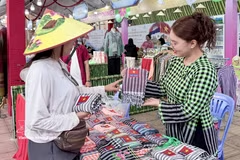
Visitors browse traditional Southern Vietnamese checked scarves on display at the Vietnam-Cambodia Trade Fair. (Photo: VNA)

Vietnam-Cambodia trade fair opens in An Giang

The fair features 150 booths representing 200 businesses, cooperatives, household businesses and production and trading establishments from both countries. The exhibition space is arranged into 10 zones showcasing products from Vietnamese localities and three zones featuring Cambodian products, creating opportunities for businesses from the two countries to promote their products, seek partners and expand markets.

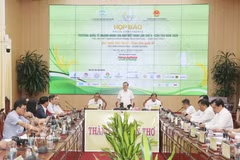
An overview of the press conference to announce the organisation of the second Vietnam International Rice Festival - Can Tho 2026. (Photo: VNA)

Festival to chart new course for rice industry

The second Vietnam International Rice Festival - Can Tho 2026 will take place from November 22 to 25, showcasing the achievements and potential of Vietnam’s rice industry while promoting Can Tho’s image, cultural identity and people, as well as the distinctive river culture of the Mekong Delta.

Japanese business representatives review Ho Chi Minh City’s investment project portfolio at the conference. (Photo: VNA)

Vietnam remains attractive destination for Japanese businesses

Fukai Akihiko, President and Representative Director at Gunma Bank and head of a business delegation from Japan’s Gunma prefecture, said cooperation between Gunma and Vietnam has continued to expand in recent years. Around 15,000 Vietnamese people currently live in Gunma, forming the largest foreign community in the prefecture.

A panoramic view of the site designated for the Ninh Thuan 1 nuclear power plant in Phuoc Dinh commune, Khanh Hoa province. (Photo published by VNA)

Vietnam to access MBIR reactor research capabilities, gradually master nuclear technology

As Vietnam develops its nuclear science and technology and prepares the necessary conditions in terms of human resources, research capacity, safety systems and technical infrastructure, participation in international research programmes and access to MBIR will enable the country to conduct experiments supporting its programme for the peaceful use of atomic energy.

Illustrative image (Photo: chinhphu.vn)

State secret list for financial sector issued

Top secret items include detailed submissions, reports, proposals, explanatory documents, and data concerning state financial and budgetary policies presented to the Party Central Committee, the Politburo, the National Assembly, the National Assembly Standing Committee, or the Government in the event of an emergency related to national defence, national security, social order and safety, or a war for the defence of the Fatherland.

At the 2026 Vietnam Food Forum (Photo: VNA)

Vietnamese food exporters see EU as major market amid stricter standards

The EU–Vietnam Free Trade Agreement (EVFTA) tariff cuts are opening doors. But the EU is also a market with a strict and frequently updated system of standards and regulations, especially in food safety, quarantine, traceability, environmental protection and sustainable development.

Laos accelerates 47 power projects for export to Vietnam

Laos accelerates 47 power projects for export to Vietnam

A notable project is the 600 MW Monsoon Wind Power Plant, located in Dakcheung district of Xekong province and Xanxay district of Attapeu province. Featuring 133 turbines, the project began commercial operations on August 22, 2025, and supplies electricity to Vietnam Electricity (EVN) under a 25-year power purchase agreement.