President supports Vietnam-Kansai economic dialogue

President Tran Dai Quang said he supports the Vietnam-Kansai economic dialogue mechanism, which will help Vietnam’s authorised bodies to promptly remove investment obstacles and bolster economic links
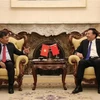
President supports Vietnam-Kansai economic dialogue ảnh 1President Tran Dai Quang (centre, right) receives the delegation of the Kansai Economic Federation on September 12 (Photo: VNA)

Hanoi (VNA) – President Tran Dai Quang said he supports the Vietnam-Kansai economic dialogue mechanism, which will help Vietnam’s authorised bodies to promptly remove investment obstacles and bolster bilateral economic links.

He had a meeting in Hanoi on September 12 with a delegation of Japan’s Kansai Economic Federation (Kankeiren), which organised the economic dialogue together with the Vietnamese Ministry of Planning and Investment.

Talking to Kankeiren Chairman Shosuke Mori, President Quang expressed his delight at the expansion of economic, trade and investment ties between Vietnam and Japan, saying it has contributed to the countries’ extensive strategic partnership.

He thanked Japan’s Government and investors for effectively helping Vietnam in socio-economic development and welcomed more investments from Japan.

Kansai is among the top Japanese investors in the Southeast Asian nation with a number of big projects, he noted.

President Quang said he hopes advanced technologies which are the strength of Kansai businesses will greatly help his country better infrastructure and develop support industries while protecting the environment.

Vietnam pledges the best possible conditions for Japanese enterprises, including those from Kansai, to operate in the country, he said, repeating its consistent viewpoint of prioritising relations with Japan.

Shosuke Mori said Kankeiren groups 1,300 companies and aims to support its members to promote competitiveness in Kansai region and expand operations in the world.

He noted through this visit, his federation looks to enhance economic ties between Kansai and Vietnam and seek business opportunities, especially when the Trans-Pacific Partnership (TPP) agreement will take effect in the near future.

He added that he hopes the Vietnam-Kansai economic dialogue will become an annual event through which Kansai businesses can contribute more to Vietnam’s development.

Kansai, a region in the centre of Japan, comprises 10 prefectures, including the big cities of Osaka, Kyoto and Kobe. It is the second biggest economic, financial and sci-tech hub of Japan after Kanto region of Tokyo and has strength in manufacturing industry.

Kansai accounts for 25-30 percent of its country’s trade with and investment in Vietnam, mostly in the fields of seafood processing, household electric and electronic products, automobile spare parts, machinery components, and building materials.-VNA
VNA

See more

Minister of Foreign Affairs Le Hoai Trung meets with Canada's Minister of International Trade Maninder Sidhu on February 12, 2026. (Photo: Ministry of Foreign Affairs)

Vietnam–Canada ties gain fresh momentum after ministerial meeting

The two ministers agreed on measures to advance the Comprehensive Partnership, pledging to facilitate cooperation in trade and investment, defence and security, official development assistance, tourism and people-to-people exchanges, while expanding collaboration in emerging areas such as supply chains, AI, semiconductors, quantum technology, clean energy transition, renewable energy, green agriculture, environmental protection and climate change response.

From right: National Assembly Chairman Tran Thanh Man (2nd) visits and extends New Year greetings to former State President Nguyen Minh Triet (3rd) on February 12. (Photo: VNA)

NA Chairman pays pre-Tet visits to former Party, state leaders

On behalf of the NA Standing Committee, the top legislator expressed deep appreciation for the significant contributions made by the former leaders to the revolutionary cause of the Party and the State, as well as to the national construction and development during the Doi Moi (Renewal) period.

A delegation led by PM Pham Minh Chinh pays respect to former Deputy Chairman of the Council of Ministers Doan Duy Thanh (Photo: VNA)

Memorial service for former Government leader in Hanoi

The Central Committee of the Communist Party of Vietnam, the National Assembly, the State President, the Government, the Central Committee of the Vietnam Fatherland Front (VFF) held a state-protocol memorial service for former Deputy Chairman of the Council of Ministers (now the Government) Doan Duy Thanh in Hanoi on February 12.

Party General Secretary To Lam speaks at the working session (Photo: VNA)

Dak Lak must link Central Highlands with south central coast: Party chief

During a working session with the provincial Party Organisation, authorities and residents on February 11, which linked virtually with 102 local wards and communes, Party General Secretary To Lam hailed their achievements last year, urging immediate translation of the 14th National Party Congress's orientations and directives into concrete actions and measurable outcomes from the outset of the new term.

Party General Secretary To Lam, who is also Secretary of the Central Military Commission, visits officers and soldiers of the Ea H’Leo Border Guard Station on February 11 (Photo: VNA)

Party chief extends Tet greetings to border guards in Dak Lak province

The Party leader acknowledged and highly valued the strong sense of responsibility and perseverance of the station’s officers and soldiers. Despite being stationed in a border area with many difficulties, they have remained steadfast at their posts, focused on building a regular, green, clean and beautiful unit, promoted production activities, and gradually improved the material and spiritual lives of the troops.

Nguyen Manh Cuong, member of the Party Central Committee, Standing Deputy Secretary of the Party Committee and Deputy Minister of Foreign Affairs. (Photo: VNA)

Official stresses proactive implementation of 14th Party Congress Resolution in foreign affairs

The foreign policy of the 14th Congress represents both continuity and development. It inherits the fundamental objectives, principles and approaches affirmed over previous congresses, namely independence, self-reliance, peace, cooperation, development, multilateralisation and diversification, while introducing new dimensions to meet the country’s Fatherland construction and safeguarding requirements in the new era.