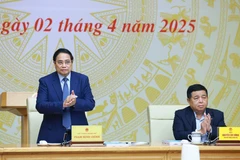
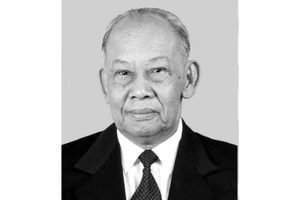
Prime Minister Nguyen Xuan Phuc notes that keeping macro-economic stability is an important and consistent requirement in developing a socialist-oriented market economy (Photo: VNA)
 Hanoi (VNA) – Prime Minister NguyenXuan Phuc highlighted keeping macro-economic stability, creating a favourableenvironment for production and business, and promoting rapid and sustainabledevelopment as the tasks of the Government to steer the national economy in thefuture in a recent article.
He wrote that keeping macro-economic stabilityis an important and consistent requirement in developing a socialist-orientedmarket economy.
“To bring into play the outcomes attained overthe past time, we have to continue making efforts to create a more solid andstable macro-foundation in 2018 and the following years, thus creating afavourable environment and conditions for promoting production and business,and helping to successfully implement the socio-economic development targetsand tasks in 2018 and the five years from 2016 to 2020 under the Party andNational Assembly’s resolutions.”
PM Phuc noted despite internal and externaldifficulties and challenges in 2017, the country’s socio-economic situationimproved comprehensively in all fields. Particularly, the macro-economicstability continued to be maintained, featuring a great success and greatlycontributing to production and business development and economic growth.
The strict, flexible and effective monetarypolicy implemented in tandem with the fiscal, trade, investment, price andmarket policies made an important contribution to controlling inflation at theset rate, he said.
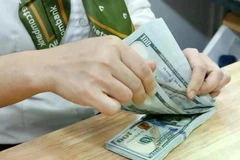
He added that the surge of export, a trade surplus of 2.8 billion USD, and thestrong inflow of foreign direct investment and overseas remittances intoVietnam helped improve the balance of payments and raise foreign reserves tonearly 60 billion USD.
Meanwhile, stable exchange rates and the declinetrend of interest rates in line with the inflation situation helped to facilitateproduction and business activities. In 2017, the state budget balance wasimproved while state budget collection was 5.9 percent higher than theestimated figure, helping to reduce budget overspending to 3.48 percent andpublic debt to 61.2 percent of the country’s GDP.
The Cabinet leader wrote that the stock market –the “barometer” of the economy – has risen sharply, at about 1,050 – 1,100points at present. Economic growth no longer depends on short-term demandstimulation solutions and the mining industry. It reached the highest levelsince 2007, making Vietnam among the countries with the fastest growth in theregion and the world. Most of the economic sectors posted fair growth, createdjobs and income, and helped people lead a stable life.
Aside from the stable macro-economy, theinvestment and business climate of Vietnam has been improved considerably,climbing 14 places from the 82nd to the 68th position among 190 economies. Thecountry’s competitiveness index also increased, from the 60th to the 55thposition among 137 countries and territories. The outlook for the local bankingsystem was upgraded from “stable” to “positive”.
PM Phuc said Vietnam’s reform determination andthe attained achievements have created a heartening atmosphere in investmentand business activities and the whole society, thereby reinforcing investorsand businesses’ trust.
The successful organisation of the APEC Year2017 also greatly helped to heighten Vietnam’s prestige and stature in theinternational arena, he added.
He stressed that the country is entering a newstage of development with mixed opportunities, advantages, difficulties andchallenges.
The Government will, therefore, steer themacro-economy in the time ahead in a drastic, proactive and flexible manner,harmoniously and synchronously combining policy tools to ensure themacro-economy’s firm stability and major balances of the economy, striving tohave 2018’s growth rate higher than 2017’s, and creating a foundation for morerapid and sustainable growth in the following years, he underlined.
Noting several key solutions in the coming time,PM Phuc said the Government needs to implement a prudent and effective monetarypolicy, along with a strict and thorough fiscal policy to ensure financial andstate budget discipline in all sectors and at all levels.
Meanwhile, it is necessary to ensure reasonableallocation of resources nationwide, for each sector, region and locality, henoted, adding that the Government will continue the roadmap on electricitymarket prices so as not to subsidize power prices and educational andhealthcare services but still support policy beneficiary and low-incomeearners.
Another solution is promoting production andbusiness development to create a solid micro-foundation for macro-economicstability. The country also needs to mobilise and effectively use technicalassistance, learn from other countries’ experience, and enhance themacro-economic analyzing and forecasting capacity in terms of the whole economyand each sector and locality.
Last but not least, the Government needs tocomprehensively improve policy coordination and the leadership and steeringactivities of the state administrative apparatus, while doing a good job ofcorruption and wastefulness prevention, helping to reinforce investors,businesses and people’s trust, PM Phuc wrote.
In the article, he said with many optimisticsigns in the international and domestic situation, the macro-economy and growthin 2018 are forecast to continue improving.
“However, we must completely not be subjectiveamid the rapidly changing and unpredictable situation with many hidden risks,”he added.
Perfecting institutions, keeping macro-economicstability, and creating an optimal investment and business environment isimportant to bringing into play the State’s role of enabling growth indeveloping a socialist-oriented market economy under the Party’s guidelines onreform.
Meanwhile, determinedly and persistently keepingmacro-economic stability and not boosting growth at all costs is a consistenttarget in the Government’s steering work, the leader said.
He added steering the macro-economy is a scienceand also an art, requesting all-level authorities at and sectors be proactiveand flexible while closely keeping an eye on the reality and unceasingly makingreforms and innovation, thus promoting Vietnam’s economy on the path of rapidand sustainable development.-VNA
VNA