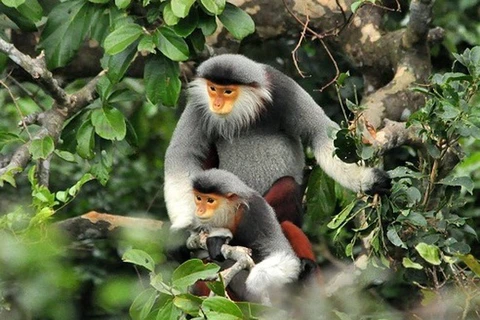
A mountain is seen in a strict protection zone of the Hatinh langur population in Tuyen Hoa district of Quang Binh province (Photo courtesy of Nguyen Thanh Tu)
 The province said all rock mining and mineral exploitation activities will be banned in the area and surrounding communes to ensure a safe habitat for the endangered primates.
The provincial rangers sub-department said at least 22 endangered langur herds with a total population of 156 have been found living in 509ha of primary limestone forest of Son Hoa, thanh Hoa, Dong Hoa, and Thuan Hoa communes since 2015. Thanh Hoa commune is home to the largest population with 12 herds and 91 individuals.
The urgent action plan on the protection of the endangered primates will help conserve the langurs and promote awareness among the community to conserve their natural habitat and the forest.
International biologists, conservationists and wildlife photographers have visited the site to take photos of the primates and nature.
According to Nguyen Thanh Tu, 59, a retired border guard soldier, he and local communities in the area have voluntarily protected the Hatinh langurs in Dong Hoa commune over the past decades.
The Hatinh langur, which is listed as an endangered species by the International Union of Conservation of Nature (on the IUCN Red List of Threatened Species), lives only in central Vietnam and eastern Laos.
The largest population is in Quang Binh province, and a small group lives in neighbouring Quang Tri province.
A herd of five Hatinh langurs, which was found in a primary forest of Huong Lap commune of Huong Hoa district in Quang Tri, was reported to have had conflicts with local residents in 2020. The district rangers have been trying to move the endangered herd back to the forest since early May./.
VNA