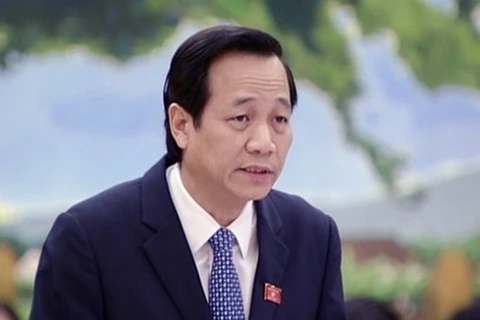
ILO senior specialist on social security Nuno Cunha (Photo nguoiduatin.vn)
 Hanoi (VNS/VNA) - Nuno Cunha, ILO senior specialist on social security, has stressed the need for Vietnam to increase retirement age in an interview granted to Vietnam media regarding a recent proposal to increase the retirement age of Vietnamese labourers.
The following is the interview.
Q: Is it possible to keep the current retirement age by increasing the performance of the social insurance funds investment?
A: The performance of the social insurance funds can indeed play a long-term role in the sustainability of the fund, but the pace of demographic change with such a fast growing elderly population creates challenges that can only be solved by changing system parameters. One of those changes is the retirement age. Increasing the retirement age is a trend seen in several countries in the region, and when compared with other countries with the same life expectancy the age of retirement in Vietnam is evidently low.
We understand that people are not happy with an increase in retirement age and it is indeed a difficult decision. However, when we look at the life expectancy in Vietnam, particularly life expectancy at 60, we can see that today a woman who reaches 60 is expected on average to live until she is 81 years old. Retiring at 55, women would receive on average a pension for more than 26 years. Imagine that someone enters the labour market at 25, they would contribute a maximum of 30 years, probably less. A contribution of 30 or 35 years for a pension payment of 26 years is just not possible. It is not difficult to understand the challenge that this poses to a pension system.
And with time this situation will get more dramatic. Not only life expectancy will continue to increase, but the ratio of working adults to elderly people will drop to 3 to 1.
We do not see how the system can survive if parameters like retirement age are not adjusted.
At the same time, we understand the challenges to this, and recognise that change will need to be a gradual process. One solution is to increase retirement age by three months every year. If the changes start to be implemented in 2020, it would mean that by 2024 women will retire at 56 instead of 55, and at 57 by 2028. This gradual approach will give time for people and the economy to adjust.
Q: Are there any other methods to prevent the social insurance fund from bankruptcy without increasing the retirement age?
A: There are three key elements to balancing the financial sustainability of social security schemes: reducing benefits; increasing retirement age and increasing contribution rate. Each of them has different impacts in the fund financial situation; and also in individuals’ and businesses’ situations. Finding the right balance imperative, and implementing gradual reforms to give people and business time to adjust is essential in creating financial balance, and also guaranteeing the positive social impact of the reforms.
Q: What is the relation between the increase of retirement age and productivity? How do they affect each other?
A: We don’t think there is any proof for the assumption that increasing retirement age will have negative impacts on the economy. We don’t think older workers are necessarily less productive. You may have to shift them to different positions but let’s look at the issue this way: How do younger people get trained if not by those who have experience and share it? You should shift the older workers to a place where they can share their knowledge, and where their experience can be beneficial.
Given the case of such a gradual adjustment we do not expect a big impact on productivity. The issue of productivity is an important one for the future of the country and for sure, other policies will be put in place. I would emphasise the relationship between these two elements.
With an ageing population Vietnam will face future labour shortages. Increasing retirement age can help to cope with this challenge.
Q: One of the weaknesses of Vietnam’s social insurance system is its lack of coverage. What is your recommendation to improve that?
A: You are right. More important than the discussion on retirement age is the number of elderly people that still don’t benefit from any pension.
One lesson we see from other countries is that it is very difficult for a country to rely on people to make contributions voluntarily. For employers, it looks like a business expense. For workers, it looks like something that reduces their monthly pay. Many people do not see the need or urgency of a pension system until they are old.
Some of them can contribute, and they should be asked to do so. The health insurance system in this country shows it can be done, if people see immediate pensions. This is why the short-term benefits are so important, like maternity, sickness and possibly future family benefits.
In terms of extension of coverage there are various mechanisms in place to achieve this. For instance, there should be some benefits for everybody in the country that are paid by the State. You have to have a basic level of protection for everyone so nobody falls into poverty, for instance by expanding the social pensions to those who are already old and did not have the chance to pay contributions to the system when they were young. This largely benefits the women and men in informal sectors. So when you want to mitigate from State intervention to people actually putting up contributions, you could tell everyone that as a member of society, and also because directly or indirectly everyone contributes to the development of the society, you have the right to a minimum level of protection offered by the State, and on top of that, you may have higher benefits that come from your wages.-VNA
VNA