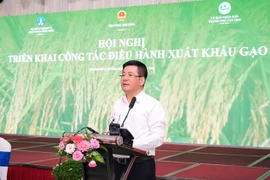
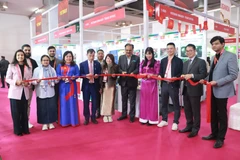
Businesses introduce Vietnamese rice to international friends (Photo: VietnamPlus)
Hanoi (VNA) – Vietnamese rice exporters should make careful preparations to promote rice exports and maintain the markets, especially traditional ones, while ensuring the supply for domestic consumption, according to insiders.
Global prices are fluctuating, and some countries have issued a ban on rice exports, providing a good chance for Vietnamese rice exporters and farmers. This is especially so for farmers in the Mekong Delta region, the rice production hub of Vietnam.
However, agricultural expert Hoang Trong Thuy said that domestic exporters should design a long-term strategy to stay competitive.
Reporter: Vietnam exported 7.13 million tonnes of rice in 2022 and 4.38 tonnes worth 2.68 billion USD in the first seven months of this year. What do you think about the ban on rice exports that some countries have imposed?
Hoang Trong Thuy: Several countries have suspended their rice exports for various reasons. Firstly, it is because of climate change, extreme weather conditions, and a prolonged El Nino phenomena, leading to a drop in rice supply. Rice exports have been halted in Russia and the UAE. India, which exported 22 million tonnes of rice, is suffering a rice shortage of about 25%, and thus has had to reserve rice by banning exports.
I think that rising prices are also another chance for Vietnam. If we can manage to maintain our markets and do good business, we will keep our reputation with traditional customers, creating momentum for rice exports in the following years.
This is a new experience for businesses and farmers as the market develops fast, requiring accurate forecasts and the reorganisation of production activities that follow the value chain. From this, it is necessary to draw lessons for the rice sector itself, economic organisations for farmers, and other economic sectors.
Another chance for them to promote production and create a horizontal link between rice production region of farmers and farmers to form cooperatives, while requiring cooperatives to enhance their capacity.
The reorganisation will help create vertical links between farmers, intermediaries, producers, milling establishments, and exporters. This is a valuable lesson for us to look at ourselves, thus rearranging and strengthening these relationships. And what’s more, in my opinion, is the situation is creating good conditions for Vietnam to develop a strong rice trademark in all three levels of collectives, in business, and internationally.
Reporter: In your opinion, amid the current developments in the market, what should we do to promote exports of this product?
Hoang Trong Thuy: The current problem for us is when export prices increase, there are two scenarios. In the first one, businesses suffer losses as they had already signed contracts to export rice to Africa and Indonesia at the price of 500 USD per tonne. Now they don’t have rice to sell, or they have to buy rice to fill the contract at an even higher price.
In the second circumstance, businesses sign new contracts and already have rice in the warehouses, they will enjoy big profits. On the other hand, when the price increases, competition will become fierce among buyers who seek profit from exporting, which means consumers will be wiped by this price hike. This is also a thing to worry about.
In my opinion, Thailand currently has about 4-5 million tonnes of rice that has not been released. Vietnam has about 2-2.5 million tonnes of rice left. This is also a major competitor for Vietnam. Therefore, businesses need to calculate when to sell their products. Careful calculation is also needed in giving market forecasts.
 Businesses should make careful preparations to increase rice exports and maintain markets, especially traditional ones (Photo: Vietnam Plus)
Lessons learnt from previous years showed that when businesses have already signed a rice export contract but failed to buy rice for their contract, new contracts gave them higher prices, then they decided to cancel the deposit and break the deal. Taking advantages from the market is necessary, but businesses should at the same time ensure the chances to receive orders for the rest of 2023, early 2024 and following years.
Obviously, there are opportunities, but challenges are also huge. Rice export is a long-term game. It is crucial to keep the reputation, especially in traditional markets such as China, the Philippines, Indonesia and Malaysia. Businesses that cancel deposits must receive strict punishments, or else we will lose the market for the whole sector, not just a single enterprise.
Reporter: In the current context, in your opinion, what is the solution for us to maintain our reputation and grasp the market opportunity at the same time?
Hoang Trong Thuy: I think that the role of the State is significant. It is to encourage banks to give medium and long-term loans, thus enabling businesses to make fair payments to farmers. In this way, they will ensure the input supply.
This August, September and October when the stormy season lingers, the sector will be impacted by the weather conditions. Therefore, buying, transporting and storing activities will still play a decisive role in rice export activities.
Due to the increase in rice prices, businesses will find it easy to buy rice of different varieties and mix them together, which does not follow buyer’s standards. I want to emphasise once again that this will lead to market loss. Businesses should calculate for the long run, and they should avoid the situation of chasing the immediate benefit and take wrong steps.
Reporter: Thank you very much./.